











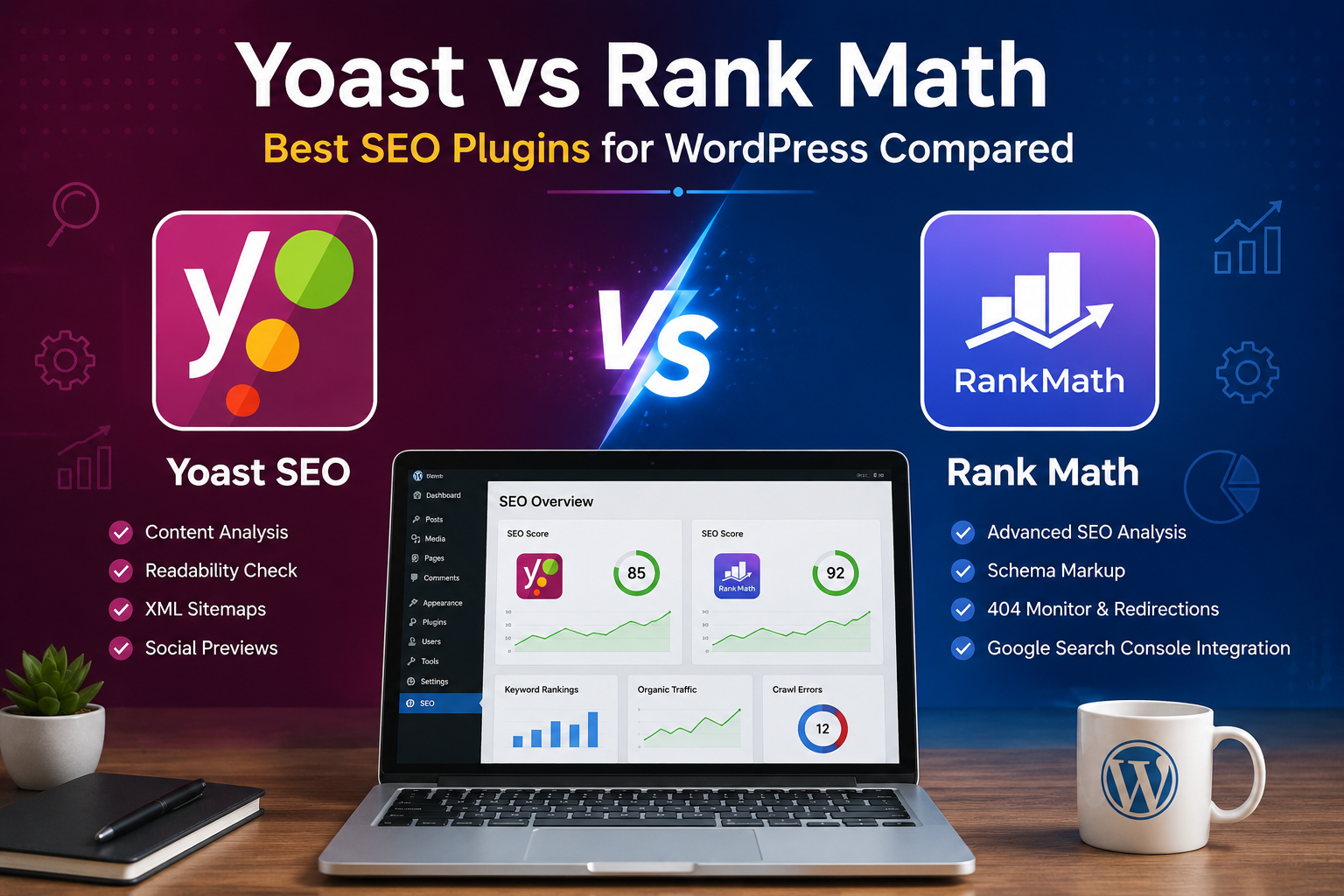
I was a die-hard Yoast SEO user for almost four years. It was the first plugin I installed on every WordPress site I built, and whenever someone asked me about the best SEO plugin, I’d shout “Yoast!” without even blinking. I genuinely believed there was no real competition.
Then one quiet Tuesday evening, a client called me frustrated. She’d been running her small handmade jewelry store online for two years with Yoast, doing everything “right,” and her rankings were going nowhere. A friend had mentioned Rank Math to her, and she asked whether I’d ever tried it. I had not. And honestly? The question annoyed me a little. Why mess with something that works?
But curiosity got the better of me. I spent the next three weeks testing both plugins, side by side, across three different websites — a personal blog, a WooCommerce store, and a service-based business site. What I discovered surprised me more than I expected. So here’s my full, no-fluff breakdown: Yoast SEO vs Rank Math — from someone who actually lived inside both of them.
A quick background: why this comparison matters
If you run a WordPress website — whether it’s a blog, an eCommerce store, or a portfolio — you’ve probably heard about these two. They’re the most downloaded SEO plugins in the WordPress ecosystem, and the debate between their fans can get surprisingly heated online.
But most comparisons I’ve read online feel like they were written by someone who spent 20 minutes on each plugin’s official website. I wanted to write the kind of guide I wished I had found before I spent those three weeks testing everything myself.
“Both Yoast and Rank Math are genuinely good SEO tools for WordPress — the real question is which one fits your specific situation better.”
That’s the honest answer. But let me walk you through the details so you can figure out exactly where you land.
My first impressions when I installed both

Yoast SEO — the familiar friend
I’ve installed Yoast so many times that I could probably do it blindfolded. The setup wizard is friendly and clear. The dashboar d is clean and uncluttered. Within minutes, you have a working SEO configuration — sitemap generated, meta tags set up, social cards ready. It just works, without demanding much from you upfront.
There’s a real comfort in that. And for someone new to WordPress SEO plugins, Yoast is genuinely welcoming. The famous red-orange-green traffic light system for content analysis? I’ve recommended it to dozens of beginners, and it genuinely helps them write better-structured posts.
Rank Math — overwhelmed in the best way
Rank Math’s setup was a different experience. The first time I ran its setup wizard, I thought I was configuring a NASA dashboard. The amount of configuration options it throws at you is staggering. Import from Yoast? Sure. Connect to Google Search Console directly in the plugin? Absolutely. Set up 404 monitoring, redirection manager, schema markup, keyword tracking — all before you’ve even published your first post?
My first reaction was mild panic. But once I got through it, I realized how much power was sitting right in front of me — power that Yoast either locks behind its premium version or doesn’t offer at all.
If you’re a beginner: Yoast’s onboarding is more forgiving. If you’re a developer or a seasoned site owner: Rank Math’s setup gives you far more control right from day one.
Must Read: How Custom WordPress Website Development Improves Website Performance?
Feature comparison: what you actually get

Yoast SEO (Free)
- 1 focus keyword per post
- Meta title & description
- XML sitemaps
- Readability analysis
- Social previews
- Breadcrumbs support
- Basic schema types
Rank Math (Free)
- Up to 5 keywords per post
- Meta title & description
- XML sitemaps
- Advanced schema builder
- 404 monitor + redirects
- Google Search Console integration
- Rich snippet support
This is where the scales started tipping for me. With Yoast’s free plan, you get one focus keyword. One. For most casual bloggers, that’s fine. But once you start thinking seriously about SEO — targeting semantic keywords, related terms, long-tail phrases — that limitation stings.
Rank Math’s free plan gives you up to five focus keywords per post. Not five premium keywords. Five keywords in the free version. When I realized this during my testing, I genuinely stopped and re-read the plugin description. I kept expecting a catch that never came.
The built-in redirect manager in Rank Math’s free version is another thing I’d been paying for separately with Yoast. And the Google Search Console integration? Rank Math pulls your GSC data directly into WordPress. That alone saves me the extra browser tab I used to keep open all day.
Content analysis: the famous traffic light test
Both plugins analyze your content and give you recommendations. Yoast’s green-yellow-red scoring system is iconic for a reason — it’s dead simple and incredibly visual. My non-technical clients have always found it reassuring. “Green means good” is a language everyone speaks.
Rank Math uses a numerical score out of 100. And honestly? I’ve grown to prefer it. Rather than trying to hit a vague “green,” I’m shooting for 80+, which gives me a more granular sense of how complete my on-page SEO actually is. The recommendations are also more specific and actionable — it told me things like “your focus keyword doesn’t appear in the first 10% of your content” and “you’re missing an outbound link,” which Yoast wouldn’t flag unless I was on premium.
For content creators who want to geek out on their SEO score: Rank Math’s 100-point scoring feels more like a real audit. Yoast’s traffic light is better for anyone who just needs simple reassurance.
Schema markup: where Rank Math runs away with it

This was the biggest surprise for me. Schema markup — the structured data that helps Google understand what your page is about and display rich results in search — is complicated. Getting it right used to mean either hiring a developer or buying a separate plugin.
Rank Math has a visual schema builder built right in. I added FAQ schema, HowTo schema, Article schema, and even a Recipe schema to a test post in under five minutes. The interface is clean, the options are extensive, and it works without touching a line of code.
Yoast supports some schema types but the control is limited in the free version. If you’re serious about rich snippets — and you should be, because they dramatically improve click-through rates — Rank Math wins this round outright, without even paying for premium.
Performance & site speed: does it slow you down?
This one surprised a lot of people in my WordPress community when I shared my findings. Because of its enormous feature set, you might assume Rank Math is the heavier plugin. But in my tests across all three sites, Rank Math actually added marginally less overhead than Yoast.
Now, we’re talking milliseconds here — nothing that’s going to visibly tank your site speed. But for people who obsess over Core Web Vitals and every millisecond of load time (hello, it’s me), knowing that the feature-richer option is also the leaner option was genuinely satisfying.
| Feature / Category | Yoast SEO | Rank Math | Winner |
| Ease of setup for beginners | Excellent | Good | Yoast |
| Free keyword tracking | 1 keyword | 5 keywords | Rank Math |
| Schema / rich snippets | Basic | Advanced builder | Rank Math |
| Redirect manager (free) | No | Yes | Rank Math |
| GSC integration | No | Yes (free) | Rank Math |
| Content analysis quality | Good | More detailed | Rank Math |
| WooCommerce SEO | Premium only | Free (basic) | Rank Math |
| User interface familiarity | Very intuitive | Slightly complex | Yoast |
| Long track record / trust | 10+ years | Since 2018 | Yoast |
| Site speed impact | Slightly heavier | Slightly lighter | Rank Math |
The pricing conversation (aka the moment Yoast loses the room)
Here’s where I have to be blunt, because this is what changed my perspective the most.
Yoast SEO Premium costs around $99 per year for a single site. For that, you get multiple focus keywords, internal linking suggestions, redirect management, and a few other features. These are genuinely useful things — but they’re things Rank Math gives you for free.
Rank Math Pro costs $59 per year and includes rank tracking, advanced analytics, keyword position monitoring, and more. If you’re comparing what you get dollar-for-dollar, Rank Math’s free version outperforms Yoast’s paid version in several categories. And Rank Math Pro at $59 gives you things that Yoast Premium at $99 simply doesn’t offer.
I don’t love saying this because I genuinely have respect for what the Yoast team built over the years. They pioneered WordPress SEO plugins and made on-page optimization accessible to millions of non-technical users. That legacy matters. But the value gap in 2025 is hard to ignore.
When I would still recommend Yoast SEO
Despite everything I’ve said, there are real scenarios where Yoast is still the right call — and I want to be fair about that.
If you’re running a WordPress site for a client who is completely non-technical, Yoast’s interface is more forgiving. The traffic light system reduces confusion. The documentation is extensive and has been refined over a decade. If something breaks or you need help, Yoast’s support resources are among the best in the WordPress ecosystem.
If you’re managing a very large organization where multiple editors use WordPress and you need the simplest possible SEO guidance for non-marketers, Yoast’s opinionated approach — “do these things, get green” — is actually a feature, not a limitation.
And if you’ve been using Yoast for years and everything is working? Switching plugins always carries migration risk. All your existing metadata, your sitemaps, your schema — migration tools exist but they’re not always perfect. If it ain’t broke, think carefully before you fix it.
My final verdict after three weeks of testing
I switched my personal blog and the WooCommerce store to Rank Math. The client with the jewelry store switched too — and six weeks later, she texted me to say three of her product pages had moved to the second page of Google for their target keywords. Is that all Rank Math? Definitely not. But the richer schema, the better keyword targeting, and the Search Console integration helped us make smarter decisions faster.
My Recommendation
Rank Math — for most WordPress users in 2025
Better free features, more powerful schema, built-in GSC integration, and lower premium pricing. The learning curve is real but worth it for anyone serious about their rankings.
Still a great choice
Yoast SEO — for beginners and non-technical teams
Simpler interface, 10+ years of trust, and the most recognizable SEO guidance system in WordPress. If ease-of-use is your top priority, Yoast still earns its place.
One last thing before you decide
The best SEO plugin is the one you’ll actually use consistently. Both Yoast and Rank Math are miles better than not having any SEO plugin at all. Both will help you write better-optimized content, generate clean sitemaps, and give Google the structured information it needs to understand your pages.
My advice? If you’re starting fresh or willing to migrate, give Rank Math’s free version a serious try. Install it, go through the setup, spend a week writing posts with it. You might be as surprised as I was. And if you try it and find yourself missing Yoast’s simplicity — that’s completely valid information about what works for you.
Either way, you’re investing in one of the most impactful things you can do for your WordPress site’s visibility. And that’s always worth it.
Have you used both? I’d love to know which one you landed on and why. The best SEO wisdom usually comes from real experience, not plugin documentation.