Businesses working with a digital marketing agency in toronto are already beginning to rethink how advertising works in an AI-first world. The shift isn’t gradual anymore it’s happening fast, and platforms like ChatGPT are at the center of it.
Over the past few years, user behavior has changed significantly. Instead of just typing short keywords into search engines, people are now asking for the full questions, comparing options and also making decisions through conversations with the AI. In response to this shift, ChatGPT has started introducing advertising in such a way that feels native to how users interact with the platform.
For businesses, this opens up a new kind of opportunity. Instead of interrupting users, ads can now appear exactly when someone is actively thinking about a problem or looking for a solution.
What Are ChatGPT Ads?
ChatGPT ads are sponsored placements that appear within the conversational interface, typically just below the AI’s response. They are designed to match the context of what a user is asking/want rather than relying only on the keywords or browsing history of the user.
What is ChatGPT Advertising?
ChatGPT advertising is a form of AI-driven advertising where sponsored content is shown based on the intent and context of a user’s conversation inside ChatGPT.
This is what makes it fundamentally different from traditional formats. In most digital channels, ads compete for attention. Here, they are placed within an ongoing interaction. That changes how users perceive them.
Instead of being intrusive, these ads feel more like suggestions—appearing at the exact moment someone is already exploring a topic.
Why OpenAI Introduced Ads in ChatGPT
The introduction of ads is not surprising when you look at the scale of AI usage today. Running large language models requires significant infrastructure, and offering free access to millions of users comes with real costs.
Advertising provides a way to support that ecosystem without restricting access. It also creates a new revenue stream that can fund further development.
At the same time, it positions ChatGPT as more than just an assistant. It becomes part of the broader advertising landscape, competing with search and social platforms.
How ChatGPT Advertising Works
At its core, ChatGPT advertising is built around context.
How does ChatGPT advertising work?
ChatGPT advertising works by analyzing what a user is asking and placing relevant sponsored content below the response, without influencing the answer itself.
When someone asks a question—say about buying property, choosing software, or finding a service—the system identifies the intent behind that query. Based on that, a relevant ad can appear underneath.
What’s important here is that the ad doesn’t shape the AI’s response. It sits separately, clearly labeled, and is selected because it fits the topic being discussed.
This approach is closer to intent-based targeting than traditional audience targeting. It relies less on who the user is and more on what they are trying to solve in that moment.
Who Sees Ads in ChatGPT?
Not every user will see ads, at least for now. The rollout is still controlled and limited.
Ads are primarily shown to users on free or entry-level plans, while those on paid subscriptions such as Plus, Pro, or Enterprise typically have an ad-free experience.
There are also basic conditions around age and region, since the feature is still being tested in selected markets. As the platform expands, this is likely to change.
Privacy & Data Safety in ChatGPT Ads
One of the biggest concerns around any advertising platform is how user data is handled. ChatGPT takes a different approach compared to many traditional platforms.
Do ChatGPT ads use personal data?
No, ChatGPT ads do not rely on sharing personal conversations with advertisers. Targeting is based on general context rather than individual identity.
This means advertisers are not accessing private chats. Instead, they are working with aggregated signals—essentially understanding what category of topic is being discussed.
For users, this creates a more privacy-conscious environment. For businesses, it means learning to rely on relevance and messaging rather than heavy tracking.
Benefits of ChatGPT Advertising for Businesses
The biggest advantage of ChatGPT advertising is timing. Businesses are reaching users when they are actively thinking, not passively scrolling.
When someone asks a question inside ChatGPT, they are already in a decision-making mindset. That makes the interaction more valuable than many traditional impressions.
There is also a clear advantage for early adopters. Because the platform is still new, competition is lower, and there is more room to experiment without high costs.
Another important factor is engagement. Ads placed within a conversation tend to feel more natural, which can lead to better interaction compared to formats that interrupt the user experience.
ChatGPT Ads vs Google Ads vs Meta Ads
Each platform still serves a different purpose, but the differences are becoming more interesting.
Google Ads are built around keywords. They work well when users know what they are searching for. Meta Ads, on the other hand, rely on interests and behavior, often appearing when users are not actively looking for something.
ChatGPT sits somewhere in between, but leans closer to intent. It captures users who are exploring, comparing, and asking questions in real time.
This ability to understand full conversations gives it an edge in situations where traditional keyword targeting falls short.
How Businesses Can Prepare for ChatGPT Ads
Even if full access to ChatGPT ads is still limited, the preparation can start now. The first step is to rethink how messaging is written. Traditional ad copy often focuses on short, punchy lines.
In a conversational environment, that approach feels out of place. Messaging needs to sound more natural, more helpful, and more aligned with how people actually ask questions.
Content strategy also plays a role. Businesses that already create useful, question-based content will have an advantage. This is where alignment with SEO becomes important.
If you’re already investing in structured content, this connects directly with broader strategies like ai marketing agency ontario positioning and long-term organic visibility.
At the same time, paid strategies will evolve. Businesses familiar with performance-driven campaigns—especially those working with a PPC marketing agency toronto—will find it easier to adapt once AI ad platforms become more accessible.
Use Cases: Where ChatGPT Advertising Works Best
Some industries are naturally better suited for this format.
In real estate, for example, users often ask detailed questions before making decisions. This creates an ideal environment for ads that appear during that research phase.
Local businesses can also benefit, especially when users are looking for recommendations or comparing options nearby.
SaaS companies and service providers have another advantage. Their customers tend to evaluate multiple options, and ChatGPT becomes a space where those comparisons happen naturally.
Agencies, particularly those evolving into a performance marketing agency toronto model, can use this as an opportunity to offer new capabilities to clients.
Future of AI Advertising
AI advertising is still in its early stages, but the direction is clear.
We are now moving towards a model where the conversations don’t just inform decisions—they complete them. Booking a service, purchasing a product, or comparing options could all happen within a single interaction.
This will likely change how businesses think about the entire funnel. Instead of separating awareness, consideration, and conversion, everything may happen in one continuous experience.
For agencies transitioning into a marketing agency toronto ecosystem focused on AI, this shift is not just an opportunity—it’s a necessity.
Conclusion
ChatGPT advertising is not just another channel to test. It represents a broader shift in how the users interact with information and how businesses will connect with them.
This move from keywords to conversations change the rules completely. It rewards more relevance, clarity, and timing over volume and visibility alone.
Businesses that start adapting now—whether through content, messaging, or strategy—will be in a stronger position as the platform evolves.
The early stages of any advertising platform tend to offer the greatest advantage. ChatGPT is no different. The difference is that this time, the change is not just about a new platform—it’s about a new way of thinking.
FAQs
Can businesses run ads on ChatGPT right now?
ChatGPT ads are currently in a limited testing phase and not yet fully available worldwide.
How are ChatGPT ads different from Google Ads?
They rely on the conversational context instead of catching keywords, which allows for a deeper intent targeting.
Do ChatGPT ads use my personal data?
No, they are based on general context rather than personal conversations or identity.
Will ChatGPT ads be available globally soon?
A wider rollout is expected, although the exact timelines have not been officially confirmed.
How can businesses prepare for ChatGPT advertising?
By focusing on conversational content, improving messaging, and aligning with AI-driven strategies.
Are ChatGPT ads better than Meta ads?
ChatGPT have a different purpose which is focusing more on intent rather than discovery.
Which industries benefit the most from ChatGPT ads?
Real estate, SaaS, local services, and consulting-based businesses tend to benefit the most.
Is AI advertising the future of digital marketing?
Yes, it is becoming a central part of how businesses reach and convert users in an AI-driven environment.
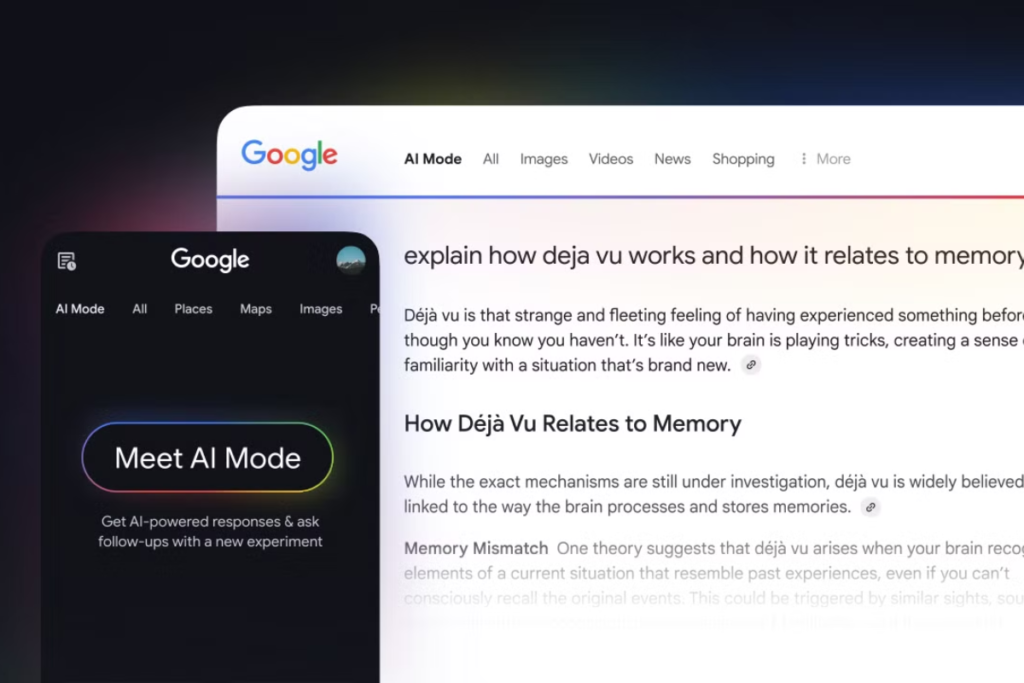
After the launch of Google AI Mode, discovery no longer works the same traditional way. Users are not just clicking links. They are getting direct answers, summaries, recommendations, and even shopping suggestions inside Google’s AI interface.
This shift changes how leads are generated. Instead of competing for blue links, brands now compete to be mentioned, referenced, or suggested by Google’s AI Mode search experience. If your business is not understood clearly by Google’s AI systems, you can lose visibility even if your website still ranks well in traditional results. This is why learning how to use Google AI Mode, how Google AI Mode search works, and how to position your brand inside this new system is no longer optional. It directly affects discovery, trust, and lead generation.
Google AI Mode is being tested and rolled out in different regions, including early availability in the US and gradual expansion through Google Labs AI Mode in markets like the UK and India. As more users try Google AI Mode, especially on mobile devices like Google AI Mode on iPhone and Android, the way people interact with search is becoming more conversational and less transactional. People are asking longer questions, expecting structured answers, and trusting Google AI Mode search engine outputs more than individual websites. If you want more leads in this environment, you must understand how to get discovered by Google AI Mode before your competitors do.
What Is Google AI Mode and Why Does It Change Search Behavior
Google AI Mode is not just a design update to Google Search. It is a shift in how Google presents information. Instead of showing a simple list of links, Google AI Mode search attempts to understand user intent and present synthesized answers. This includes explanations, comparisons, shopping suggestions, and contextual recommendations. When users try Google AI Mode, they often stay inside the AI experience longer because the system answers follow-up questions and offers deeper search pathways through what Google calls deep search.
This matters because Google AI Mode search engine behavior reduces direct clicks to websites for simple queries. For example, if someone searches for the best CRM software for small businesses, Google AI Mode may present a summarized comparison with recommended tools before the user even scrolls to traditional links. If your brand is not part of that summary, you may not get noticed at all. This is why understanding Google AI Mode vs Gemini also matters. While Gemini is Google’s general-purpose AI assistant, Google AI Mode is tightly integrated into search. Gemini helps users think. Google AI Mode helps users decide. That distinction affects lead generation.
As Google AI Mode launch continues, more features are being layered in. Users now see the Google AI Mode tab in some search interfaces, which allows them to switch between classic search and AI-powered responses. Some users discover Google AI Mode through Google Doodle AI Mode experiments or Google Labs AI Mode previews. Others encounter it through Google Shopping AI Mode when browsing products. Each of these surfaces creates new discovery pathways for brands, but only if Google’s AI understands who you are and when to recommend you.
How Google AI Mode Search Works Behind the Scenes
To understand how to get discovered by Google AI Mode, you need to understand what the system is trying to do. Google AI Mode search does not rank pages in the same way traditional search does. Instead, it identifies entities, understands relationships between concepts, and then generates answers that feel complete. This means your brand must be recognized as an entity with a clear purpose. If your website content is scattered, inconsistent, or overly promotional, Google AI Mode may struggle to place you confidently inside its answers.
Google AI Mode deep search goes further than surface-level queries. When users ask complex questions, the AI system tries to combine multiple sources of information into a single narrative. If your brand contributes meaningfully to that narrative through clear explanations, practical insights, or authoritative positioning, Google AI Mode search engine is more likely to surface your name. This is different from traditional SEO, where matching keywords could sometimes be enough. In AI Mode, matching meaning matters more than matching terms.
Another important change is how users interact with Google AI Mode on mobile devices. Google AI Mode on iPhone and Android is designed for conversational use. People type or speak longer questions, expect natural language answers, and rely on follow-up prompts. This means your content must align with how humans actually ask questions, not just how SEO tools suggest keywords. If your content sounds robotic, Google AI Mode will find it harder to reuse or reference naturally.
How to Turn On Google AI Mode and Why Users Are Adopting It
Many users still don’t realize they are using Google AI Mode. Some encounter it through a prompt to try Google AI Mode, others through a Google AI Mode shortcut in their search interface. Depending on the region, users in the US, UK, and now gradually Google AI Mode India markets are seeing AI Mode integrated into Google Search. Some users actively ask how to enable Google AI Mode or how to get Google AI Mode because they want faster, summarized answers.
At the same time, there are users searching for how to turn off Google AI Mode or remove Google AI Mode from search bar because they prefer traditional results. This split behavior is important for brands. It means you must optimize for both classic SEO and AI-driven discovery. People will continue to use traditional search, but the number of users relying on Google Search AI Mode is growing steadily, especially for research-heavy queries, comparisons, and buying decisions.
The presence of options like Google AI Mode turn off, remove Google AI Mode, or Google search remove AI Mode does not mean AI Mode will go away. It simply means Google is still experimenting with user control. The long-term direction is clear. Google Search AI Mode is becoming a core part of how people interact with information. If your lead generation strategy depends entirely on old-school rankings, you are exposed to risk as this shift accelerates.
How Google AI Mode Suggests Brands and Why Some Get Picked
When Google AI Mode suggests a brand, it is not doing so randomly. The system looks for sources that help complete the answer. This means your brand must fit naturally into the user’s question. If someone asks about tools, Google AI Mode shopping features may suggest products. If someone asks about services, Google AI Mode search may reference companies that clearly explain their offerings and appear consistently in authoritative discussions.
One reason people search for Google AI Mode Reddit threads is because they want to understand how suggestions happen. Users often notice that some brands appear repeatedly in Google AI Mode answers while others never show up, even if they rank well in traditional search. The difference usually comes down to clarity and consistency. Brands that explain their category well, use stable terminology, and show up in multiple credible contexts are easier for Google AI Mode to trust.
Google AI Mode vs Gemini comparisons also reveal an important insight. Gemini is more conversational and open-ended. Google AI Mode is more decision-oriented. If your brand can help users make decisions, whether through clear product positioning, transparent service descriptions, or educational content that frames options properly, Google AI Mode is more likely to surface you as part of its answer.
How to Use Google AI Mode as a Marketer or Business Owner
Learning how to use Google AI Mode is not just for users. Businesses can actively use Google AI Mode search to understand how their brand is perceived. When you search your own category inside Google AI Mode, pay attention to which brands appear and how they are described. This gives you direct insight into how Google’s AI understands the market.
If your brand does not appear, the question is not “Why am I not ranking?” but “Why does Google AI Mode not see me as relevant to this conversation?” The answer usually lies in how your content is structured, how consistently your brand is positioned, and whether your explanations are genuinely helpful or just sales-focused. Google AI Mode search engine behavior rewards clarity, not hype.
Testing Google AI Mode deep search with layered queries is also useful. Ask follow-up questions. See which brands remain in the conversation and which disappear. Brands that continue to appear across multiple layers of questioning are the ones Google AI Mode trusts to hold up under scrutiny. That trust is what leads to more visibility and more leads over time.
Getting Discovered in Google AI Mode for More Leads
Discovery in Google AI Mode is not about hacking the system. It is about making your brand easier to understand, easier to place, and easier to trust. When users rely on Google AI Mode search to guide decisions, the brands mentioned in those answers gain disproportionate attention. They become defaults. They receive trust before the user even visits a website. This is powerful for lead generation because the recommendation happens upstream of the click.
If you want Google AI Mode to suggest your brand, your content must help Google explain the topic better. This means publishing content that educates, not just content that sells. It means clarifying your niche instead of trying to cover everything. It means aligning your language with how real people ask questions in Google AI Mode search. Over time, this positioning compounds. The more your brand helps Google AI Mode deliver better answers, the more often you get surfaced.
How to Structure Your Website and Content for Google AI Mode Discovery
Getting discovered by Google AI Mode is not about adding one more plugin or chasing some new technical setting inside Google Search Console. The system is not looking for tricks. It is looking for clarity. If your website makes it easy for Google to understand who you are, what you do, and when you should be suggested, your chances of appearing inside Google AI Mode search improve naturally over time.
Most websites fail here because they try to rank for too many unrelated topics. One page talks about services, another talks about trends, another talks about tools, and none of it connects into a single, coherent story. From Google AI Mode’s perspective, that creates confusion. The AI cannot confidently decide when to bring your brand into an answer because your site does not present a stable identity.
Your structure should tell one clear story. When someone asks Google AI Mode search engine about your category, the AI should already know that your brand lives inside that problem space. This means your core pages, your long-form content, and your supporting articles must reinforce the same positioning. Over time, Google AI Mode deep search learns these patterns and becomes more comfortable referencing your brand as part of its answers.
Another important factor is how your internal linking supports understanding. When your pages connect logically, Google AI Mode can follow the narrative of your expertise. This is different from old-school SEO, where internal links were mainly about passing authority. In Google Search AI Mode, internal linking helps the system understand how your ideas fit together. The clearer that structure is, the easier it becomes for Google AI Mode to reuse your explanations when answering user queries.
How Google Search AI Mode Changes Lead Generation for Businesses
The biggest shift that Google AI Mode introduces is where influence happens in the user journey. Traditional search pushed users toward websites first. Influence happened after the click. With Google Search AI Mode, influence happens before the click. The summary, the recommendation, and the framing of options all shape how the user thinks about your brand before they ever land on your site.
This matters because lead quality changes. Users who come from Google AI Mode search are often more informed, more confident in their choice, and further along in the decision-making process. They may not browse multiple competitor sites because Google AI Mode has already narrowed their options. If your brand is part of that narrowed set, your conversion rates often improve, even if raw traffic volume decreases.
This is why businesses that only track rankings and traffic may think they are losing ground, while in reality, they are missing where influence has moved. Google AI Mode search engine does not just send traffic. It shapes perception. Brands that appear in AI summaries benefit from a trust halo effect. Users assume that if Google AI Mode suggested a brand, it must be credible. That assumption changes how quickly people move toward contacting you, requesting a demo, or making a purchase.
Google AI Mode for Local Businesses and Service Providers
Local businesses and service providers are deeply affected by Google AI Mode, especially as Google Search AI Mode expands in regions like the UK and India. When users search for services such as agencies, consultants, clinics, or repair services, Google AI Mode often summarizes options and highlights what differentiates them. This summary becomes the first impression.
If your local business is not clearly described across your website and profiles, Google AI Mode may struggle to include you. For example, if your service offerings are vague, or your location details are inconsistent, the AI cannot confidently recommend you for location-based queries. This is why clarity around who you serve, where you serve, and what problem you solve matters more than ever.
Google AI Mode India rollout is particularly important for service businesses because many users are skipping traditional browsing and relying on summarized answers to find providers. This means that optimizing only for local pack rankings is no longer enough. You must ensure that your brand narrative is strong enough for Google AI Mode search to reuse. When the AI understands your positioning, it becomes more likely to mention you when users ask conversational questions about services in their area.
Google Shopping AI Mode and How It Changes Buying Decisions
Google Shopping AI Mode changes how people evaluate products. Instead of comparing ten product pages manually, users often rely on Google AI Mode to summarize differences, suggest categories, and highlight features that matter. This shifts product discovery from a browsing experience to a guided decision flow.
If your product listings are generic, Google AI Mode may not see a strong reason to feature them. The AI is not just pulling product data; it is constructing explanations. If your product descriptions do not explain who the product is for, what problem it solves, and how it differs meaningfully from alternatives, the AI summary may favor competitors with clearer narratives.
For eCommerce brands, this means your product content must be written in a way that helps Google AI Mode tell a story. Instead of listing features in isolation, your descriptions should explain context. Who benefits from this product? In what situations does it perform best? What kind of buyer is it not for? These explanations help Google AI Mode deep search present your product naturally inside its answers.
Google AI Mode vs Gemini: Why the Difference Matters for Visibility
Many people confuse Google AI Mode vs Gemini, but the difference is important for discovery. Gemini is designed as a general assistant. It helps users think, plan, and explore ideas. Google AI Mode is designed as a search experience. It helps users decide. That difference changes how brands appear.
When someone asks Gemini a broad question, the AI may explore multiple perspectives. When someone uses Google AI Mode search, the system is more likely to summarize and recommend. If your brand is positioned as a practical solution, it is more likely to appear in Google AI Mode than in Gemini, where the conversation may remain more abstract.
Understanding this difference helps you shape content correctly. Content designed to influence decisions should be optimized for Google AI Mode search. Content designed to educate broadly may appear more often in Gemini-style conversations. Both matter, but if your goal is leads, Google AI Mode is the surface where buying decisions are increasingly shaped.
Why Some Brands Appear in Google AI Mode Reddit Discussions
The reason people search for Google AI Mode Reddit threads is because they are trying to reverse-engineer visibility. They notice patterns. Certain brands keep showing up. Others never do. The difference usually comes down to whether the brand has a strong narrative presence across the web.
Reddit discussions, forums, and long-form blogs all contribute to how Google AI Mode search engine perceives brands. If your brand is mentioned in thoughtful discussions where people explain why they use your product or service, that context feeds into how AI systems learn. Over time, this creates a stronger association between your brand and your category. That association increases the likelihood that Google AI Mode will surface your brand when users ask relevant questions.
Managing User Settings: Turn Off Google AI Mode and What It Means for You
Some users actively look for how to turn off Google AI Mode, remove Google AI Mode, or remove Google AI Mode from search bar. Others search for how to turn on Google AI Mode, how to enable Google AI Mode, or how to get Google AI Mode access. This split behavior shows that the user base is still adjusting. But from a business perspective, the trend is clear. More users are experimenting with Google Search AI Mode, even if they later switch back for certain queries.
This means your strategy cannot depend on a single interface. You must be discoverable in both traditional search and AI-powered search. However, the users who remain inside Google AI Mode search often have higher intent. They are exploring, comparing, and deciding. If your brand is absent there, you lose influence at the most critical moment.
How to Future-Proof for Google AI Mode UK, India, and Global Rollout
As Google AI Mode expands into the UK, India, and other markets, cultural and linguistic context becomes more important. Google AI Mode India queries often reflect local usage patterns, service needs, and product preferences. If your content only reflects a US-centric perspective, the AI may struggle to match you with Indian users. This is why localization is no longer just about translating keywords. It is about understanding how people in each market ask questions and what kind of answers they trust.
Similarly, Google AI Mode UK users may phrase queries differently, rely on different terminology, and value different decision criteria. Your content should reflect these nuances if you want Google AI Mode to recommend you in those regions. Over time, the brands that adapt their narratives for different markets will appear more naturally in regional AI Mode search results.
Becoming “AI-Recommendable” Instead of Just SEO-Optimized
The biggest mindset shift is moving from trying to rank to trying to be recommended. Google AI Mode search does not just surface pages. It surfaces ideas and brands that fit into those ideas. If your brand is easy to place inside a helpful explanation, you become recommendable. If not, you remain invisible even if your SEO metrics look good on paper.
Becoming AI-recommendable means your content must help Google AI Mode do its job better. When your explanations reduce confusion, clarify options, and guide decisions responsibly, the AI system is more likely to reuse your perspective. This is how discovery compounds. Each time your brand appears in a Google AI Mode answer, it strengthens the association between your brand and your category. Over time, this association becomes the default.
Final Perspective on Google AI Mode and Lead Growth
Google AI Mode is not just another feature. It is a shift in how discovery happens. Users are no longer navigating lists of results. They are interacting with summaries, recommendations, and guided answers. If you want more leads in this environment, your brand must be visible inside those answers.
This does not happen through tricks. It happens through clarity, consistency, and genuinely helpful content that aligns with how humans ask questions and how Google AI Mode search engine explains answers. The brands that adapt early will not just survive this transition. They will benefit from it, because being suggested by Google AI Mode carries a level of trust that traditional rankings alone no longer guarantee.
1. What is Google AI Mode and how is it different from normal Google Search?
Google AI Mode is an AI-powered layer inside Google Search AI Mode that summarizes answers instead of just showing links. Unlike the classic results page, the google ai mode search engine explains options, compares sources, and helps users decide faster. Many users now try Google AI Mode when they want direct answers instead of browsing ten websites.
2. How do I turn on Google AI Mode in search?
To turn on Google AI Mode, you usually need access through Google Labs AI Mode or an official google ai mode launch update in your region. Once enabled, the google ai mode tab appears inside Google Search AI Mode. If you don’t see it yet, you can try Google AI Mode from Labs when it becomes available in your country.
3. How can I turn off or remove Google AI Mode from search?
If you don’t want to use it, you can turn off Google AI Mode in your search settings. Many users look for how to turn off google ai mode or google remove ai mode because they prefer classic results. You can also remove google ai mode from search bar or turn off google ai mode search through your Google account preferences when the option is available.
4. Is Google AI Mode available on iPhone?
Yes, google ai mode iphone access is rolling out gradually, and google ai mode India availability depends on your account and region. Google often launches features in phases, so some users see google ai mode launch earlier than others. You may need to enable it from google labs ai mode to access it first.
5. How do I use Google AI Mode for deep research?
Google AI Mode deep search is designed for longer, complex questions where users want summarized insights instead of basic links. To use google ai mode deep search effectively, frame your queries in full sentences and ask follow-up questions inside Google Search AI Mode. This helps the system refine answers over time.
6. What is the difference between Google AI Mode vs Gemini?
Google AI Mode vs Gemini comes down to intent. Gemini acts more like a general AI assistant, while google ai mode search is built directly into the google ai mode search engine to support discovery and decision-making. If your goal is finding services, products, or local options, Google Search AI Mode is more practical.
7. Can I access Google AI Mode in the UK and other regions?
Google AI Mode UK access is part of Google’s phased rollout strategy. Some regions get google ai mode search features earlier through invite-based testing. If you don’t see the google ai mode tab yet, keep an eye on google ai mode launch announcements or enable google labs ai mode to get early access.
8. How do I get the Google AI Mode URL, shortcut, or direct access?
Users often look for a google ai mode url or google ai mode shortcut, but access usually appears directly inside Google Search AI Mode once enabled. You can bookmark the google ai mode tab when it appears. Some people also search for Google Doodle AI mode, but official access is managed through Google Labs and search settings.
9. How do I remove Google AI Mode from the search bar permanently?
To remove google ai mode from search bar, you need to adjust your Google search preferences. Many users search for google search remove ai mode or google search turn off ai mode when they want a traditional search experience. Once disabled, your Google Search AI Mode reverts to classic results for most queries.
10. How can businesses get discovered inside Google AI Mode search results?
To get discovered in google ai mode search, your brand needs clear topical authority, consistent content, and helpful explanations that Google Search AI Mode can reuse. Businesses that align their content with how users phrase questions in google ai mode search engine are more likely to be suggested. This is especially important as google ai mode gemini integration evolves and discovery becomes more AI-driven.
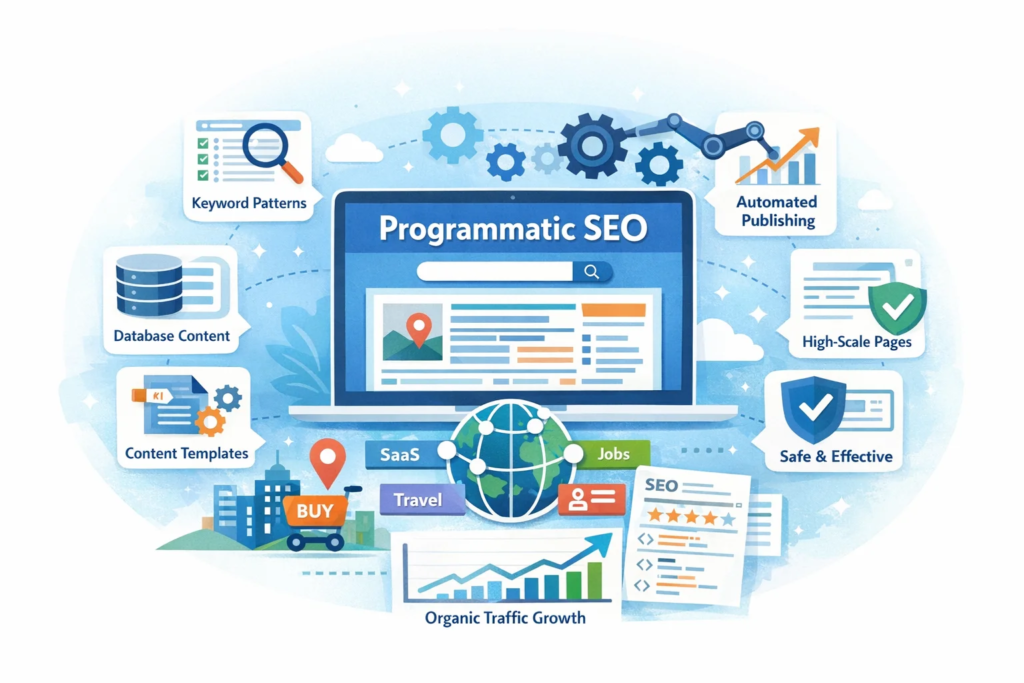
AI Programmatic SEO is no longer an experiment. It’s quietly becoming the backbone of how large websites scale traffic without increasing content teams.
A few years ago, creating 1,000 pages meant hiring writers, editors, and SEO managers. Now, with the right structure, the same output can be achieved with a lean system—if you understand how to combine automation with intent.
This isn’t about flooding Google with pages. It’s about building structured, useful content at scale that answers specific queries better than competitors.
What AI Programmatic SEO Actually Means in Practice
At its core, programmatic SEO is about generating multiple pages using a common template and a dataset.
AI simply improves the quality and efficiency of that process.
Let’s say you run a service business. Instead of creating one page for “digital marketing services,” you create hundreds of pages targeting variations like:
service + city
service + problem
service + industry
AI helps you write those pages faster, but the real strength lies in the structure behind them.
Without structure, AI content becomes noise. With structure, it becomes a growth engine.
Why Businesses Are Quietly Shifting to This Model
Most businesses don’t talk openly about it, but many high-traffic websites rely heavily on programmatic pages.
Here’s why:
Manual content do not scale beyond a particular point.
Long-tail keywords drive consistent conversions
Search intent is becoming more fragmented
AI reduces production time drastically
In markets like Toronto digital marketing services, search behavior is highly localized and intent-driven. One generic page won’t cover all variations.
You need depth, not just volume.
Difference Between AI Content and Programmatic SEO
Many people confuses AI-generated content with the programmatic SEO. They’re not the same.
AI is just a tool here actually the strategy comes first. If your keyword model is weak, no AI tool will save the outcome.
Building a Programmatic SEO System That Actually Works
This is where most businesses get it wrong. They jump into tools without planning the architecture.
A working system usually includes:
1. Keyword Pattern Identification
Instead of targeting random keywords, you identify repeatable patterns such as:
service + location
product + use case
problem + solution
For example, in Hamilton SEO services, users are often searching for very specific solutions rather than broad services.
That changes how your pages should be structured.
2. Data Layer Creation
Every programmatic system runs on data.
This could be:
City names
Service variations
Industry categories
FAQs
The quality of your dataset seems to directly affects the usefulness of your web pages. If your data is shallow, your content will be thin.
3. Template Design (The Most Underrated Step)
Templates are not just layouts. They define how value is delivered on each page.
A strong template includes:
Contextual introduction
Service-specific insights
Local or use-case relevance
FAQs based on real queries
Most failed programmatic projects usually have one issue that is the presence of thin templates
4. AI Content Layer (Used Carefully)
AI should assist, not replace thinking.
Use it for:
Expanding structured sections
Generating variations
Drafting FAQs
Avoid using it blindly for entire pages. Google doesn’t penalize AI. It penalizes useless content.
5. Internal Linking System
Programmatic pages need strong internal connections.
Without links, Google treats them as isolated pages.
A proper setup:
Links related pages together
Connects to pillar pages
Builds topical authority
Where Most Businesses Fail With AI Programmatic SEO
After working with multiple campaigns, a pattern becomes clear.
Failures usually come from:
Creating pages without search intent
Using identical content across pages
Ignoring on-page SEO basics
Publishing without indexing strategy
In competitive regions like Ontario SEO agency, poor execution doesn’t just fail—it can harm your domain authority.
Balancing Scale With Quality
There’s a misconception that programmatic SEO means low-quality content at scale.
That approach worked years ago , but not anymore.
What works now is :
Moderate scale
High relevance
Clear intent matching
Instead of building 10,000 pages one should focus on 500 strong pages that actually answers real queries.
How AI Improves Efficiency Without Killing Quality
AI becomes powerful when used in controlled workflows.
Here’s how experienced teams use it:
Drafting structured sections, not full articles
Generating multiple variations quickly
Assisting with keyword clustering
Creating FAQ sections based on search queries
The key is editing.
Raw AI output rarely performs well. Human refinement is still essential.
Real Use Cases That Work Today
You’ll notice successful implementations in:
Local service pages
SaaS landing pages
Job listing platforms
Real estate property pages
Each of these relies on structured data + scalable templates and not just
random blog content.
Programmatic SEO and Lead Generation
This is where things get interesting. Unlike traditional blogs, programmatic pages target users closer to action.
For example:
“SEO services for dentists in X location”
“Best solution for [specific problem]”
These aren’t browsing queries. These are actually decision stage searches. That is why programmatic SEO often brings better conversion rates.
A Practical Approach for Agencies
If you’re running an agency, don’t try to automate everything at once.
Start small:
Pick one service
Identify 20–30 keyword variations
Build a clean template
Test performance
Once you see traction, scale gradually.
This avoids the common mistake of launching hundreds of low-performing pages.
The Future of AI Programmatic SEO
Search engines are getting better at understanding intent, not just keywords.
This changes how programmatic SEO works.
It’s no longer about:
Exact keyword matching
Bulk page creation
It’s about:
Context
Relevance
Depth
AI will continue to evolve, but strategy will be something that will bring the difference in the result.
Final Thoughts
AI Programmatic SEO isn’t a shortcut. It’s a system.
When done right, it allows you to:
Capture long-tail traffic
Build topical authority
Generate consistent leads
When done poorly, it creates hundreds of pages that never rank.
The difference is not the tool , it’s how you think about search.
What is AI Programmatic SEO in simple terms?
AI Programmatic SEO is a method of creating multiple web pages using structured data and templates, with AI helping to generate and refine content efficiently.
Does Google penalize AI-generated content?
No, Google does not penalize AI content directly. It penalizes the content that lacks value, relevance or usefulness to the users.
How many pages should I create in programmatic SEO?
Start with a small batch, usually 20 to 50 pages. Measure performance, then scale based on results rather than assumptions.
Is programmatic SEO good for local businesses?
Yes, especially for local services where users search with specific intent It helps ti target multiple location-based queries effectively.
What tools are needed for AI Programmatic SEO?
Common tools include CMS platforms, data sheets like Airtable, automation tools, and AI writing assistants for content support.
How long does it take to see results?
It typically takes a few weeks to a few months depending on competition, indexing, and content quality.
If you’ve ever tried ranking a website using guesswork, you already know how quickly things fall apart. That’s where AI SEO tools for competitor analysis start to make a real difference. They don’t just show data—they help you interpret what your competitors are doing right (and where they’re weak).
I’ve worked on campaigns where two businesses had almost identical services, yet one dominated search results while the other barely showed up. The difference wasn’t budget. It was clarity—knowing exactly which keywords, backlinks, and content structures were driving results.
This blog breaks that down in a practical way—no fluff, no recycled theory.
Why Competitor Analysis Has Changed with AI
Traditional SEO tools use to give you the raw numbers—keywords, backlinks, rankings, useful, but incomplete. AI has changed that by connecting patterns.
Instead of asking:
“What keywords are they ranking for?”
You now ask:
“Why are they ranking for these keywords?”
“What content angle is working?”
“What’s missing that I can exploit?”
That shift is important.
For example, while working with a SEO agency in Toronto, we have noticed competitors ranking with thinner content but stronger topical clusters. AI tools helped identify that they weren’t better they were just structured better.
What AI Actually Does in Competitor Analysis
Let’s keep this grounded.
AI doesn’t magically rank your site. What it does is:
Spot keyword gaps faster
Identify content patterns
Analyze backlink quality (not just quantity)
Predict ranking difficulty more accurately
Suggest content improvements based on real SERP data
Think of it as reducing guesswork.
Top AI SEO Tools for Competitor Analysis (That Are Worth Using)
Here are tools that consistently deliver value—not just dashboards.
1. Surfer SEO
Best for content-based competitor analysis.
Compares your page with top-ranking pages
Suggests NLP keywords
Shows ideal content length and structure
In one project targeting a digital marketing agency Hamilton, we used Surfer to reverse-engineer competitor blog structures. Rankings improved within weeks—not because we wrote more, but because we wrote aligned content.
2. SEMrush (AI Features)
A strong all-rounder.
Keyword gap analysis
Traffic estimation
AI-powered content recommendations
The “Keyword Gap” tool alone can reveal hundreds of missed opportunities.
3. Ahrefs with AI Insights
Still one of the most reliable tools.
Backlink profile analysis
Content explorer
Competitor keyword tracking
What makes it powerful now is combining its data with AI interpretation—especially for spotting patterns in top-performing pages.
4. Frase
the Content research made faster :
SERP analysis
AI briefs
Competitor content summaries
Useful when you want to understand what competitors are actually saying, not just what they rank for.
5. MarketMuse
Best for deep content strategy.
Topic authority scoring
Content gaps
AI-driven optimization
This works well when you’re building authority in a niche rather than chasing short-term rankings.
How to Actually Use These Tools (Step-by-Step)
Most people use tools. Very few use them properly.
Here’s a practical workflow.
Step 1: Identify Real Competitors (Not Just Business Competitors)
Your actual competitors are:
Websites ranking for your target keywords
Not necessarily businesses offering the same service
For example, while working on a campaign in SEO services Ontario, we found blogs outranking service pages. That changed the entire approach.
Step 2: Run a Keyword Gap Analysis
This is where AI shines.
Look for:
Keywords competitors rank for but you don’t
Keywords where they rank low (easy wins)
Don’t just collect keywords. Group them by intent.
Step 3: Analyze Content Structure
Instead of the copying content , studythe following things :
Headings
Content depth
Internal linking
Use of FAQs
AI tools help identify patterns across multiple pages quickly.
Step 4: Backlink Quality Check
Not all backlinks matter equally.
Look at:
Domain relevance
Anchor text patterns
Link velocity
AI tools can now flag spammy or weak links automatically.
Step 5: Build a Better Version (Not Just Similar)
This is where most people fail.
If competitors have:
1500-word blogs → don’t just write 1600 words
Basic FAQs → answer real user questions better
Your goal is clarity, not volume.
Common Mistakes People Make with AI SEO Tools
Let’s be honest—tools don’t fail. Usage does.
1. Blindly Following Recommendations
AI suggestions are most of the time helpful, but are not context-aware.
Example:
Adding too many keywords
Over-optimizing headings
This leads to content that looks optimized but reads poorly.
2. Ignoring Search Intent
Ranking isn’t about keywords alone.
If someone searches:
“best SEO tools”
They don’t want a service page.
AI tools can show keywords—but intent still needs human judgment.
3. Overloading Content with Data
More data doesn’t mean better content.
In fact, the best-performing pages are often:
Clear
Direct
Easy to scan
4. Chasing Competitors Instead of Outthinking Them
If you only copy competitors, you’ll always stay behind.
AI helps you see gaps—use that to lead, not follow.
How AI Helps You Find Content Gaps That Others Miss
Voice search is less about keywords and more about questions.
Instead of:
“AI SEO tools competitor analysis”
Think:
“Which AI SEO tools are best for competitor research?”
So your content should:
Include natural questions
Provide short, clear answers
Use conversational tone
That’s exactly what helps with AEO (Answer Engine Optimization).
What Actually Moves Rankings (Based on Real Campaigns)
From experience, these factors matter most:
Content relevance over content length
Topical coverage instead of isolated blogs
Internal linking structure
Backlink quality, not volume
Clear answers to user queries
AI tools support these—but they don’t replace them.
How to Build a Long-Term Competitor Strategy Using AI
Short-term wins are easy. Sustained rankings are not.
Here’s what works:
1. Track Competitors Weekly
Not just rankings—look at:
New content
Backlinks
Keyword movements
2. Update Existing Content
Often easier than creating new pages.
AI tools can help to pinpoint :
Missing keywords in the page
Outdated sections in thr website.
3. Build Topic Clusters
Instead of random blogs:
Create interconnected content
Cover a topic deeply
4. Focus on Authority Signals
AI tools can guide you, but authority comes from:
Consistency
Useful content
Real expertise
Final Thoughts
AI has made competitor analysis faster, but not easier.
Because now :
Everyone has the access to the same data
The difference lies in how you use it
If you rely only on tools, your content will look like everyone else’s.
But if you combine:
AI insights
Real-world understanding
Clear execution
That’s when rankings start to move.
What are AI SEO tools for competitor analysis?
AI SEO tools for competitor analysis are platforms that use machine learning to study competitor keywords, backlinks, and content strategies, helping you identify ranking opportunities faster.
Which AI SEO tool is best for competitor research?
Tools like Surfer SEO, SEMrush, and Ahrefs are commonly used, but the best choice depends on whether you’re focusing on content, backlinks, or keyword gaps.
How do I find competitor keywords using AI?
You can use keyword gap analysis feature in tools like SEMrush or Ahrefs that helps you to identify keywords your competitors rank for but your website does not.
Can AI SEO tools improve rankings directly?
No, AI tools don’t improve rankings on their own. They provide insights that help you create better content, fix gaps, and build stronger strategies.
How often should I analyze competitors using AI tools?
A weekly check is usually enough to track down the changes in rankings, new content, and backlink activity without overcomplicating your workflow.
What is the biggest advantage of AI in SEO competitor analysis?
Speed and pattern recognition. AI helps you process large amounts of data quickly and spot trends that are difficult to identify manually.
When clients first come to me asking about AI Tools for Automated Content Creation, it’s usually after they’ve tried something and it didn’t work. Either the content didn’t rank, or worse, it ranked briefly and then dropped.
There’s a common misconception here. AI doesn’t fix bad content strategy. It only speeds up whatever system you already have—good or bad.
Over the last decade and a half, I’ve seen content evolve from keyword stuffing to intent-driven SEO. AI is just another phase in that evolution. The difference now is speed. The fundamentals, however, haven’t changed as much as people think.
What AI Content Tools Really Do (And What They Don’t)
Most AI tools for content creation are trained on large datasets and generate text based on patterns. That sounds impressive, but in practice, it means they are excellent at producing structured drafts—not finished content.
If you publish AI-generated content as it is, you’ll notice a few issues almost immediately. The tone feels flat. Sentences start sounding similar. And more importantly, it rarely aligns perfectly with search intent.
That’s why experienced marketers don’t rely on AI alone. They use it as a starting point.
Why AI Content Tools Are Becoming Standard in SEO Workflows
I’ll give you a simple example. A few years ago, creating 20 SEO pages for different services would take weeks. Today, using automated content creation tools, the initial drafts can be done in a day.
But here’s the key difference—earlier, time was spent writing. Now, time is spent refining.
Businesses targeting markets like Toronto SEO services for small businesses are using AI to scale location-based pages faster, but the ones that actually rank are the ones where someone has taken the time to adjust the messaging, add context, and align it with real user queries.
The Tools That Are Actually Worth Using
After testing in multiple platforms across client projects, a few tools consistently stand out. Not because they give perfect results , but because they fit into a practical workflow.
ChatGPT is still one of the most flexible options when it comes to structuring content. It works well for outlines, topic expansion, and even drafting FAQs. However, without proper prompts, it tends to repeat patterns.
Jasper is useful when you need marketing-oriented content—especially landing pages and ad copies. It’s faster than most tools in generating variations, although it sometimes leans toward generic phrasing.
When it comes to optimization, tools like Surfer SEO play a different role altogether. This is where AI SEO content tools become important. Writing content is one part; aligning it with ranking signals is another.
Writesonic and Copy.ai also have their place, especially when speed matters more than depth. For bulk content tasks, they save time, but they still need oversight.
Where Most People Get It Wrong
This is something I’ve seen repeatedly. People assume that using the best AI content generator automatically leads to better rankings. It doesn’t.
The real issue is not the tool—it’s how it’s used.
Publishing raw AI content without editing is the fastest way to get ignored by search engines. Not because Google detects AI, but because the content lacks depth and originality.
Another common mistake is ignoring keyword intent. Just inserting AI content marketing tools into a paragraph doesn’t mean the page satisfies what the user is actually looking for.
A Workflow That Has Consistently Worked
Instead of relying on tools blindly, a structured approach works far better.
Everything starts with keyword clarity. If the primary keyword is AI Tools for Automated Content Creation, the supporting keywords should naturally include variations like AI blog writing tools and content automation software, but they need to fit into the context—not forced into sentences.
Once the keywords are mapped, AI can be used to generate a rough structure. This saves time, especially when working on multiple pages.
The real work begins after that. Editing is where the content becomes usable. This includes adjusting tone, improving readability, and adding practical insights—things AI cannot do convincingly on its own.
Finally, optimization tools help refine the content further. This is where AI writing tools for SEO and on-page analysis platforms come into play, ensuring that the content aligns with ranking factors without over-optimization.
Voice Search Has Changed Content Expectations
A noticeable shift in recent years is how people search. They don’t type short keywords anymore; they ask full questions.
Instead of searching for “AI content tools,” users now ask things like, “Which AI tools are best for writing blog content?”
That changes how content should be written.
You don’t need overly long explanations. You need clear answers. This is where many AI content marketing tools fall short—they generate long paragraphs but miss direct responses.
How AI Supports Local SEO Without Making It Look Duplicate
For businesses targeting different cities, AI can help generate multiple versions of similar content. But this is also where it can go wrong.
If you create five pages with almost identical content and just change the location name, none of them will perform well.
For example, a page targeting Hamilton digital marketing agency services needs to feel locally relevant. That means slight changes in messaging, examples, and structure—not just swapping the city name.
AI can assist with drafts, but the localization still needs human input.
Where AI Content Still Falls Short
Even with all the improvements, there are areas where AI struggles.
It doesn’t bring real experience into the content. It cannot explain what worked in a campaign or why a certain strategy failed. That level of detail only comes from actual work.
There’s also the issue of repetition. If you generate multiple blogs using the same tool, you’ll start noticing similar sentence patterns. Over time, this affects content quality.
And then there’s nuance. AI tends to generalize. It avoids strong opinions, which makes the content safe—but not necessarily useful.
What the Future Looks Like
From what I see, AI is not replacing content creators. It’s changing what is expected from them.
Basic writing is becoming automated. What matters now is how well someone can guide the tool, refine the output, and align it with strategy.
The role is shifting from writing everything manually to managing content quality and direction.
Search engines are prioritizing direct answers. If your content doesn’t answer questions clearly, it won’t get featured—even if it’s well-written.
This is where structured responses matter. Not long explanations required, just clear and relevant answers. Take for example:
If someone asks what automated content creation tools are, they expect a simple explanation, not a detailed essay .
AI can generate content, but structuring it for AEO still requires intent and clarity.
Final Thoughts From Experience
After working with different industries and content strategies, one thing is clear—AI is useful, but only when used correctly.
It saves time, but it doesn’t replace thinking. It helps with scale, but not with originality.
If you treat it as a shortcut, results will be inconsistent. If you treat it as a support tool within a structured SEO process, it becomes valuable.
That’s the difference between content that fills pages and content that actually ranks.
What are AI tools for automated content creation?
They are platforms that use machine learning to generate written or visual content, mainly used for blogs, marketing copy, and SEO pages.
Can AI-generated content rank on Google?
Yes, but only if it is edited, optimized and the aligned with search intent. Raw AI content usually do not perform well and need some sort of improvement.
Which are the best AI tools for content creation?
ChatGPT, Jasper, and Surfer SEO are commonly used, each serving different purposes like writing, marketing, and optimization.
Are AI writing tools reliable for SEO content?
They are useful for the drafts and structure , but they still require a human editing to ensure quality and ranking potential.
How do I use AI for content marketing effectively?
Start with keyword research, generate drafts using AI, refine the content manually, and then optimize it using SEO tools.
Technical SEO rarely fails because of strategy. It usually fails because issues remain hidden in large volumes of data. That is where best AI SEO tools for technical SEO audits have started changing the way professionals approach site analysis. Instead of manually checking crawl errors, indexing problems, or page speed issues, AI-powered systems now scan thousands of pages, identify patterns, and highlight the root causes much faster.
For businesses running websites in Toronto, this shift has practical implications. Competitive markets mean that technical mistakes cost rankings quickly. AI-based auditing tools allow teams to detect structural problems early and prioritize fixes before they affect organic visibility.
This article looks at how AI supports technical SEO audits, which tools provide real value, and how experienced professionals integrate them into real workflows
Why Technical SEO Audits Matter More Than Ever
Search engines have now become an extremely sensitive to technical signals. Few years back , websites could still rank with imperfect structures. Today, a slow loading page, crawl traps, and indexing confusion will quietly reduce the visibility of your page.
A technical audit typically reviews several areas such as :
• Crawlability
• Indexing
• Site structure
• Internal linking
• Page speed of the website
• Structured data
• Mobile performance
Manually auditing these elements across hundreds or thousands of URLs can take days. AI helps compress that process dramatically.
Instead of checking issues one by one, modern tools analyze site-wide patterns and highlight problems that humans might overlook.
For example, AI can detect the following things :
• Clusters of thin the pages
• Duplicate templates causing the index dilution
• Internal linking gaps
• JavaScript rendering problems
The result is not just faster analysis but better prioritization.
What Makes AI Different From Traditional SEO Tools
Traditional SEO tools already crawl websites. However, they mostly report raw data.
AI-powered systems interpret that data.
That difference matters.
Rather than listing thousands of warnings, AI tools identify relationships between issues. For example:
A crawl error might not matter individually. But if hundreds of similar pages fail because of the same template error, AI tools can flag that pattern instantly.
This is where platforms focused on technical SEO automation have started gaining attention.
They evaluate:
• site architecture
• rendering behaviour
• internal link equity flow
• semantic page similarity
The output becomes more actionable.
Instead of overwhelming reports, SEO teams receive prioritized insights.
Key Capabilities of AI Tools for Technical SEO Audits
AI-based audit tools are useful because they handle several technical areas simultaneously.
Intelligent Crawl Analysis
Crawlers used to simply list the broken links or the missing tags.
Now, AI-driven crawlers analyze how pages interact across the site.
They identify structural problems like:
• orphan pages
• excessive crawl depth
• inefficient navigation paths
This helps maintain a strong website crawlability audit process.
Automated Indexation Monitoring
Many sites unknowingly index unnecessary pages such as :
• Filtered URLs
• Parameter duplicates
• Pagination variations
AI tools helps in studying and analyze indexing behavior and then highlight pages that dilute ranking signals. This improves search engine indexing optimization without needing manual review of every URL.
Internal Linking Pattern Detection
Internal linking influences how search engines distribute authority across pages. AI models analyze link graphs to identify :
• Pages receiving the weak internal support
• Clusters with the excessive links in it.
• Important pages that are buried deep in the structure.
JetOctopus focuses on large-scale technical analysis.
It combines crawl data with server logs and uses AI to identify crawl waste. This makes it highly effective for improving search engine crawl budget optimization.
AI-driven hints help explain why certain technical issues matter. This makes it useful for diagnosing technical SEO performance issues.
Surfer AI Audit Features
Although widely known for content optimization, Surfer’s AI analysis also detects structural issues affecting rankings.
It helps identify pages with semantic SEO relevance gaps.
How SEO Professionals Actually Use AI in Technical Audits
The biggest misconception is that AI replaces SEO expertise.
In practice, experienced professionals use AI as a diagnostic assistant
A typical workflow usually looks like this :
Crawl the entire site using an AI-enabled crawler
Identify structural anomalies and template errors
Validate findings using log data
Prioritize fixes based on impact on rankings
Monitor changes after implementation
AI seems to speeds up step one and step two significantly . But decision-making still depends on the human understanding of search behavior.
Real Example: Fixing Hidden Crawl Problems
A mid-sized e-commerce website once experienced a gradual drop in their rankings. Manual checks showed that there is no obvious errors.
But an AI crawler detected a pattern : thousands of category filter pages were being crawled and indexed.
These URLs consumed crawl budget and diluted internal link equity.
After blocking the parameters and restructuring navigation, indexing stabilized and rankings recovered within weeks.
Without AI detection, the issue would have taken far longer to identify.
Local SEO and Technical Audits
Technical SEO becomes even more important for location focused businesses.
A service provider operating in Hamilton must have to ensure that the search engines correctly understand the service pages, location signals and structured data.
AI audit tools help detect:
• incorrect schema markup
• duplicate local landing pages
• inconsistent NAP references
This improves local search visibility optimization.
The Role of AI in Future SEO Audits
Search engines are now increasingly relying on the machine learning systems.
SEO tools are adapting in the same direction. In the near future, AI auditing tools will likely to be :
• Simulating search engine crawling behavior
• Predicting ranking impact of technical changes
• Recommending architecture improvements in the website automatically.
Businesses competing in Ontario markets may have to rely heavily on these predictive insights to stay ahead in the game.
Limitations of AI in Technical SEO
Despite their advantages, AI tools are not perfect.
They may:
• misinterpret JavaScript frameworks
• misclassify page templates
• flag non-critical issues as urgent
This is why experienced SEO professionals still review audit findings manually.
AI improves efficiency. It does not replace expertise.
Practical Tips When Using AI Tools for Technical SEO Audits
Professionals who get the most value from these tools follow a few practical habits.
First, never rely on a single crawler. Different tools reveal different technical patterns.
Secondly it combines crawl analysis with a real user data .
Third is that it validates the issues using a server logs whenever its possible.
Finally, always evaluate whether a technical fix will actually influence rankings. Not every issue matters equally.
The strongest technical SEO strategy focuses on impact, not just fixing warnings.
Conclusion
Technical SEO has always required careful investigation. What has changed is the scale of modern websites and the complexity of search engine algorithms.
AI tools for technical SEO audits make it possible to analyze large websites quickly and detect patterns that would otherwise remain hidden. They assist with crawl analysis, indexing diagnostics, internal linking insights, and performance monitoring.
However, tools alone do not produce results. The real advantage comes when AI insights are combined with experienced SEO judgment and structured workflows.
For businesses competing in search results across Canada, maintaining a technically healthy website is no longer optional. It is part of staying visible in increasingly competitive search landscapes.
FAQs
What are AI tools for technical SEO audits?
AI tools for technical SEO audits are software platforms that analyze websites using machine learning. They scan pages, identify crawl issues, detect indexing problems, and highlight structural weaknesses that affect search rankings.
How do AI tools help improve technical SEO?
AI tools analyze large amounts of site data very quickly. They are quick to identify patterns such as duplicate pages, weak internal linking, or crawl budget waste, allowing SEO professionals to prioritize fixes more effectively.
Are AI SEO audit tools better than traditional SEO tools?
AI tools are not necessarily better, but they provide deeper analysis. Traditional tools mainly report data, while AI systems interpret patterns and highlight the most impactful issues.
Which AI tools are commonly used for technical SEO audits?
Some commonly used tools include Screaming Frog, JetOctopus, Sitebulb, and Surfer AI. These platforms help analyze crawlability, site structure, indexing signals, and performance metrics.
Do AI tools replace SEO experts?
No. AI tools assist with data analysis, but SEO professionals still interpret the findings and decide which optimizations will improve rankings.
Choosing the best AI content optimization tools for SEO has become an essential part of modern search marketing. Content does not suffice to rank anymore. Search engines assess relevance, semantic strength, structure, and intent behind searches. This is where AI-driven optimization services come into play.
Rather than speculating about the requirements of Google, the software analyzes high-ranking pages and suggests enhancements. They help writers structure articles better, include relevant entities, improve topical coverage, and maintain natural readability.
SEO professionals working with businesses in Toronto have started relying on AI optimization platforms to scale content production without sacrificing quality. Agencies that manage large websites particularly benefit because manual optimization across hundreds of pages becomes almost impossible.
Still, not every tool performs the same way. Some focus on semantic analysis. Others specialize in content scoring, NLP recommendations, or competitive benchmarking.
This article examines the tools that consistently deliver practical results.
Why AI Content Optimization Matters for SEO
Traditional keyword optimization used to be straightforward. Writers placed keywords in headings, added internal links, and hoped the content would rank.
That approach rarely works now.
Search engines analyze context, topic relationships, and user satisfaction signals. AI optimization tools help bridge the gap between what search engines evaluate and how content is written.
Here is what these tools typically help with:
1. Search Intent Alignment
Many pages fail because they miss the actual search intent. AI platforms analyze the pages ranking on page one and highlight what kind of information users expect.
2. Semantic Keyword Coverage
Instead of repeating one keyword, modern SEO relies on related terms and contextual signals. AI tools suggest semantically related phrases that strengthen topical authority.
3. Content Structure Improvements
Tools often recommend headings, paragraph length, and topic clusters. These adjustments help search engines understand the hierarchy of information.
4. Content Scoring Systems
Several platforms provide a score that indicates how well your content compares with competing pages.
5. Optimization at Scale
For groups that work on numerous blogs posts monthly, AI-based processes ensure that there is consistency in quality management. SEO teams in charge of regional marketing campaigns for companies based in Hamilton tend to rely on such systems.
1. Surfer SEO
Surfer SEO has built a strong reputation among SEO professionals because of its data-driven recommendations.
Instead of offering vague advice, the platform analyzes dozens of top ranking pages and extracts patterns.
One practical advantage is the editor interface. Writers receive suggestions while drafting content rather than after publishing.
This prevents over-optimization and encourages natural writing.
For agencies handling local campaigns across Ontario, Surfer’s SERP analysis provides useful insights into regional ranking trends.
2. Clearscope
Clearscope focuses heavily on semantic relevance. It identifies related terms that help search engines understand the full topic context.
Content teams appreciate its clean interface and straightforward recommendations.
What Makes Clearscope Useful
Detailed content optimization analysis
Simple grading system
Topic coverage suggestions
Strong semantic keyword insights
Unlike some platforms that overwhelm users with metrics, Clearscope prioritizes clarity. Writers can focus on improving content rather than interpreting complicated reports.
3. MarketMuse
MarketMuse approaches optimization differently. Instead of analyzing only individual pages, it evaluates the entire content ecosystem of a website.
This makes it especially useful for websites building long-term topical authority.
Core Strengths
Topic modeling
Content gap analysis
AI-driven briefs
Competitive benchmarking
MarketMuse also recommends how deeply a topic should be covered. For complex industries, this helps writers avoid shallow content.
4. Frase
Frase is widely used for creating optimized content briefs.
It gathers SERP information and compiles research automatically. Writers can see common questions, headings, and statistics appearing across ranking pages.
Useful Capabilities
AI content briefs
Question extraction from search results
SERP-based topic research
Automated outline generation
Frase is particularly helpful when preparing informational blog posts or FAQ-based articles.
5. Scalenut
Scalenut combines content research, AI writing assistance, and optimization features in one platform.
This makes it attractive for smaller marketing teams that prefer an all-in-one workflow.
Key Benefits
AI writing support
Keyword clustering
SEO scoring system
Content research reports
Many users appreciate its structured workflow that moves from research to drafting and finally to optimization.
6. NeuronWriter
NeuronWriter relies heavily on natural language processing models to analyze content structure and keyword relationships.
The platform is gaining attention because it provides strong optimization features at a lower price compared with enterprise tools.
Important Features
NLP-based keyword suggestions
Competitor analysis
Content scoring
Internal link recommendations
NeuronWriter also helps identify missing entities that competing pages mention.
How to Choose the Right AI Optimization Tool
Selecting the right tool depends on how content is produced in your organization.
Consider these practical factors.
Content Volume
Large editorial teams benefit from platforms with collaboration features and workflow automation.
Budget
Enterprise platforms often provide deeper analysis but cost significantly more.
Learning Curve
Some tools require technical SEO knowledge to interpret recommendations correctly.
Integration with Writing Platforms
Many teams prefer tools that integrate directly with Google Docs or CMS environments.
Common Mistakes When Using AI Content Optimization Tools
Despite their advantages, these platforms are often misused.
Here are several mistakes frequently seen in SEO projects.
Over-Optimization
Following every recommendation blindly can produce unnatural writing.
Search engines still evaluate readability and user engagement signals.
Ignoring Search Intent
A high optimization score does not guarantee rankings if the page fails to satisfy search intent.
Keyword Stuffing Through AI Suggestions
Some writers attempt to include every suggested keyword. This often harms readability.
The best approach is to treat AI suggestions as guidance rather than strict rules.
How AI Optimization Improves Content Strategy
The biggest advantage of AI tools is strategic clarity.
Instead of guessing what to publish next, teams can analyze content gaps and identify opportunities.
These insights influence several areas.
Topic Clustering
AI tools reveal how topics relate to each other. This helps create clusters of related articles.
Internal Linking Opportunities
Several platforms highlight pages that should link to each other based on topical similarity.
Content Refresh Decisions
Older articles can be improved by adding missing sections and updating data.
Practical Workflow for AI-Optimized Content
A structured process helps maximize the value of these tools.
Begin with a keyword research and search intent analysis
Generate a content brief using an optimization tool
Draft content naturally without obsessing over metrics
Review optimization suggestions and refine the article
Check readability and human flow before publishing
Monitor rankings and update content periodically
This workflow balances data-driven optimization with natural writing.
Because of this shift, optimization tools are evolving toward deeper semantic analysis.
Future platforms will likely focus on:
Entity recognition
Knowledge graph relationships
Intent prediction
Topic authority measurement
SEO teams that adopt these tools early gain a measurable advantage.
What are AI content optimization tools?
AI content optimization tools analyze top-ranking pages and provide recommendations that help improve SEO performance. They suggest related keywords, better content structure, and improved topic coverage.
Which AI tool is best for optimizing SEO content?
Several tools perform well depending on the workflow. Surfer SEO, Clearscope, and MarketMuse are widely used because they provide detailed content recommendations based on search engine results.
Can AI tools help improve Google rankings?
Yes. AI optimization tools help align content with search intent, improve semantic relevance, and strengthen topical authority. These factors influence how search engines evaluate pages.
Are AI SEO tools suitable for beginners?
Many tools are beginner friendly, especially platforms that provide simple content scores and clear recommendations. However, understanding basic SEO concepts still improves results.
Do AI optimization tools replace human writers?
No. These tools assist with research and optimization, but human writers are still needed to provide clarity, originality, and expertise.
Search behaviour keeps changing. What people type into Google today looks very different from what they searched three years ago. Queries are longer, more conversational, and often tied to very specific problems. Because of that shift, traditional keyword tools that only show volume and difficulty are no longer enough.
This is exactly why many marketers now rely on the best AI tools for keyword research in 2026. These tools analyse search intent, topic clusters, competitor gaps, and user questions at a depth that manual research simply cannot match.
From my own work managing SEO campaigns, one thing has become obvious: keyword research is no longer about building a list of phrases. It is about identifying topics that align with how people actually search.
Businesses competing in regional markets such as SEO services Toronto businesses search for or service queries related to digital marketing Hamilton companies rely on often benefit the most from AI-driven research. AI tools help uncover hyper-specific queries that typical keyword tools ignore
Let’s look at how AI is reshaping keyword research and which platforms are currently leading the space.
Why AI Keyword Research Matters Now
Traditional keyword tools still rely heavily on historical search data. That data is useful, but it doesn’t always reveal emerging search patterns.
AI changes this process by analysing the following things :
• Semantic relationships between the topics
• Question-based searches by the user
• Competitor ranking patterns
• Content gaps within an industry
• Evolving search intent
Instead of suggesting a handful of the keywords, modern platforms create clusters built around SEO keyword research strategies, making it easier to plan entire content ecosystems.
For agencies working with businesses targeting Ontario local SEO services, this ability to uncover niche searches often produces quicker ranking opportunities.
Another major benefit is efficiency. A research process that once took several hours can now be completed in minutes using AI powered keyword research tools.
What Makes an AI Keyword Research Tool Effective
Not every tool labelled “AI powered” actually offers meaningful insights. Some simply layer automation on top of basic keyword databases.
The tools worth using usually provide three capabilities.
1. Intent Analysis
They interpret why a user searches a phrase. This helps identify informational, transactional, or navigational queries.
2. Topic Clustering
Instead of presenting random keywords, they group related searches into structured content opportunities.
3. Competitor Intelligence
They analyse ranking pages and highlight gaps where new content can compete.
Platforms that combine these features often become the backbone of AI driven SEO strategies.
Best AI Tools for Keyword Research in 2026
Below are tools widely used by SEO teams and agencies. Each offers a slightly different approach to discovering opportunities.
Surfer SEO
Surfer SEO has grown from a content optimisation platform into a powerful research tool.
Its AI-driven keyword discovery identifies semantic phrases that frequently appear together across ranking pages. When researching topics, the tool builds clusters that can support entire blog categories rather than isolated articles.
Surfer is particularly useful when creating long-form pillar content supported by related articles.
Key strengths includethe following things :
• semantic keyword clustering
• NLP-based keyword suggestions
• competitor page analysis
• content gap insights
Many SEO teams combine Surfer with other AI SEO keyword research tools to refine strategy further.
SEMrush AI Keyword Tools
SEMrush has integrated AI features throughout its research workflow.
Its keyword platform identifies not only search volume but also emerging queries based on user behaviour and competitor trends.
For agencies managing multiple clients, the platform is valuable because it provides:
• keyword difficulty forecasting
• intent analysis
• competitor keyword gap reports
• local search data insights
These capabilities make it one of the strongest platforms for AI powered SEO keyword research.
Ahrefs Keyword Explorer with AI Insights
Ahrefs remains one of the most reliable data sources in SEO. Over the past few years, the platform has introduced AI features that improve its research workflow.
One particularly useful feature identifies parent topics. Instead of targeting dozens of minor variations, you can identify the central topic capable of ranking for multiple queries.
Ahrefs also helps uncover long tail keyword research opportunities, which often convert better than high-volume terms.
For marketers focused on content strategy, this perspective is extremely useful.
Frase
Frase focuses on understanding how users phrase their questions. This makes it particularly effective for voice-search driven research.
The platform analyses search results and extracts questions, subtopics, and conversational phrases that frequently appear in real searches.
Because of that capability, Frase is widely used for AI content research and keyword discovery.
Many writers also rely on Frase when creating FAQ sections designed to rank in featured snippets.
MarketMuse
MarketMuse approaches keyword research differently.
Rather than simply suggesting keywords, it evaluates topical authority. The platform scans a website and identifies missing content areas that competitors have already covered.
For businesses building authority in competitive industries, MarketMuse helps create structured topic cluster SEO strategies.
It is particularly helpful for identifying:
• content gaps
• topic authority scores
• competitive keyword coverage
This approach makes it ideal for long-term AI driven SEO planning.
How to Use AI Tools for Smarter Keyword Research
Owning a tool does not automatically produce results. The strategy behind the research still matters.
A simple process often works best.
Step 1: Identify Core Topics
Start with broad topics related to your industry. AI tools will expand those into clusters of related queries.
Step 2: Study Search Intent
Look at the type of content already ranking. This reveals what search engines believe users want.
Step 3: Find Content Gaps
Competitor analysis can uncover keywords that competitors rank for but your site does not.
Step 4: Build Topic Clusters
Instead of publishing isolated blog posts, organise content into clusters connected to a central pillar article.
This structure supports AI SEO content strategies that search engines increasingly favour.
The Role of Long-Tail Keywords in AI SEO
Short keywords are competitive. They attract massive search volume but often require significant authority to rank. Long-tail keywords work differently .
They use to reflect specific intent and frequently convert better. AI tools excel at identifying these opportunities because they analyse conversational search patterns.
Examples often include phrases tied to real problems, such as:
• how to improve local SEO visibility
• tools for technical SEO analysis
• keyword research for small business websites
Targeting these queries supports advanced keyword research strategies that build traffic gradually but consistently.
How AI Helps Predict Search Trends
Another advantage of AI-based keyword research is predictive analysis.
Instead of only analysing existing data, AI models detect patterns within growing search behaviour.
For example, rising interest in voice search has dramatically increased question-based queries. AI tools detect these shifts early, allowing marketers to create content before competition increases.
This proactive approach helps build future-focused SEO keyword strategies rather than reacting after trends peak.
Common Mistakes When Using AI Keyword Tools
Even experienced marketers sometimes misuse the application of these tools. One common mistake is chasing only high-volume keywords. Volume alone rarely determines value.
Another issue is ignoring search intent. A keyword may attract traffic but still fail to convert if the content does not match the user’s goal.
Finally, some teams publish too many similar articles. AI clustering features exist specifically to prevent that problem.
Effective SEO relies on structured keyword research frameworks, not scattered blog posts.
The Future of AI Keyword Research
Search engines increasingly rely on machine learning to interpret context and meaning. Because of that shift, keyword research will continue moving toward topic analysis rather than isolated phrases.
AI tools will likely expand their capabilities to include:
• predictive search modelling
• automated content gap detection
• real-time ranking probability estimates
For marketers, this means keyword research will become less about spreadsheets and more about strategy.
Understanding the user’s intent behind a query will matter far more than simply identifying the phrase itself.
What is the best AI tool for keyword research in 2026?
Several platforms are widely used, including Surfer SEO, SEMrush, Ahrefs, Frase, and MarketMuse. Each tool offers unique insights such as intent analysis, topic clustering, and competitor keyword discovery.
Can AI tools replace manual keyword research?
AI tools helps to accelerate research and uncover hidden opportunities, but human analysis still remains essential. Marketers still need to evaluate search intent, competition, and content relevance.
Are AI keyword tools useful for local SEO?
Yes. Many platforms analyse location-specific queries and reveal niche searches businesses can target, especially for regional markets and service-based industries.
How do AI tools find long-tail keywords?
AI analyses large datasets of search queries and identifies patterns in how people phrase questions. This helps uncover conversational queries that traditional keyword tools often overlook.
Do AI keyword tools improve SEO rankings?
They help identify better opportunities, but rankings still depend on content quality, site authority, and technical optimisation.
Choosing the best AI SEO tools is no longer just about saving time . For agencies and business owners, it has become a practical way to manage complex search engine strategies without expanding the team every quarter.
Search engines now process intent, context, and user behaviour far better than they did a few years ago. Because of this shift, traditional keyword stuffing and manual research simply cannot keep up. AI-assisted platforms analyze massive data sets quickly and help marketers understand what actually works.
But not every tool delivers meaningful value. Some generate generic suggestions. Others genuinely help you uncover opportunities competitors haven’t seen yet.
This article looks at the best AI SEO tools that professionals actually rely on for keyword research, content improvement, and technical optimization. The focus is not just on features but on how these tools fit into real workflows
Why AI SEO Tools Are Becoming Essential
Search engine optimization used to be mostly a manual work. You researched keywords, wrote content, built backlinks, and hoped rankings would improve over time.
Today the landscape is different.
Algorithms analyze user behavior, search patterns, and content structure. AI tools help marketers process that complexity much faster.
For example, many digital marketing teams working with local businesses in Toronto now rely on AI SEO tools to analyze thousands of keyword variations within minutes. Tasks that once took several hours can now be completed during a single strategy meeting.
More importantly, these platforms do more than suggest keywords. They evaluate:
Content gaps
Competitor rankings
Search intent patterns
On-page optimization signals
Internal linking structures
Instead of guessing what might work, marketers can work with real data.
How AI Improves Keyword Research
Keyword research used to be fairly straightforward. You would look at search volume, competition level, and then decide whether a keyword was worth targeting.
AI changes that process completely.
Modern AI keyword research tools analyze user intent and group keywords into topical clusters. This helps content teams build structured content rather than isolated blog posts.
For instance, when an agency manages a campaign targeting businesses in Hamilton, the tool might identify not just high-volume keywords but also questions users frequently ask before making a purchase decision.
These insights help shape entire content strategies instead of single articles.
Another advantage is predictive analysis. Some tools estimate which keywords are gaining momentum before search volume spikes. That allows websites to publish content early and gain rankings before competitors notice the opportunity.
AI Content Optimization: Beyond Basic Keyword Placement
Writing SEO content used to revolve around placing keywords a certain number of times.
Search engines no longer work that way.
AI tools now analyze top-ranking pages and identify semantic relationships between words. They recommend supporting phrases that help search engines understand context.
AI suggestions should guide writing, not control it. Content that blindly follows automated recommendations often sounds unnatural. Experienced SEO professionals treat AI insights as reference points while still writing content in their own voice.
Technical SEO and AI Analysis
Technical SEO is where AI tools quietly provide enormous value.
A website may look perfectly fine to users while still having issues that prevent search engines from crawling pages effectively.
Many SEO teams handling projects across Ontario rely on automated technical audits to identify issues before they affect rankings.
Without these tools, auditing large websites would take days. AI reduces the process to minutes while still highlighting the most critical issues first.
Best AI SEO Tools Used by Professionals
Below are several platforms widely considered among the best AI SEO tools available today. Each one focuses on a different part of the optimization process.
Surfer SEO
Surfer SEO is known for its content analysis capabilities. It compares your article with top-ranking pages and recommends structural improvements.
The tool analyzes elements such as:
Heading distribution
Keyword usage patterns
Content length
NLP phrases used by competitors
For writers producing large volumes of SEO content, this type of analysis helps ensure each article aligns with ranking factors.
Clearscope
Clearscope focuses on semantic optimization. Instead of simply counting keywords, it identifies related terms that help search engines understand the topic.
Many professional content teams prefer this approach because it improves readability while still strengthening SEO signals.
SEMrush AI Features
SEMrush has expanded its platform with several AI-driven features including:
Content topic generation
Keyword clustering
Automated site audits
Competitor analysis
The platform remains one of the most comprehensive tools for agencies managing multiple websites.
Ahrefs AI Insights
Ahrefs is primarily known for backlink data, but its AI capabilities now assist with keyword grouping and content analysis.
SEO professionals often combine Ahrefs with other AI SEO tools to understand both ranking opportunities and link-building strategies.
MarketMuse
MarketMuse is particularly useful for large websites with extensive content libraries.
It analyzes existing articles and recommends:
Content updates
Topic expansion
Internal linking opportunities
This makes it ideal for companies that want to strengthen topical authority rather than simply publish more posts.
How Agencies Use AI SEO Tools in Real Campaigns
Most agencies do not depend on any single platform . Instead, they build a workflow that combines several tools.
A typical process might look like this:
AI keyword research tools identify potential opportunities.
This layered approach allows marketers to make better decisions without guessing.
From experience, the biggest improvement usually comes from combining AI insights with human judgement. Tools identify patterns, but strategy still requires interpretation.
Common Mistakes When Using AI SEO Tools
While these platforms are powerful, they are not foolproof.
One common mistake is relying entirely on automated recommendations. SEO tools often suggest similar keyword sets because they analyze the same data sources .
Publishing identical content strategies rarely leads to strong rankings.
Another issue is ignoring search intent. Just because a keyword has high volume does not mean it matches the audience’s needs.
Experienced marketers treat AI tools as assistants rather than decision makers.
Choosing the Best AI SEO Tools for Your Workflow
Selecting the best AI SEO tools depends largely on how you plan to use them.
Content teams often prioritize optimization platforms like Surfer or Clearscope. Technical SEO specialists lean toward tools with advanced site auditing features.
For agencies managing multiple clients, all-in-one platforms such as SEMrush or Ahrefs usually make more sense.
The key factor is integration. Tools that work well together reduce workflow friction and help teams move faster.
The Future of AI in Search Engine Optimization
AI will continue shaping SEO in the coming years, but not in the way many people expect.
The goal is not replacing marketers. Instead, AI will likely handle repetitive analysis tasks while humans focus on strategy and storytelling.
Search engines themselves are also becoming more AI-driven. Understanding user intent, behavior patterns, and content quality will matter far more than mechanical optimization techniques.
Businesses that combine human expertise with AI-powered insights will likely have the strongest advantage.
What are the best AI SEO tools for beginners?
Some of the most widely recommended options include Surfer SEO, SEMrush, Clearscope, and Ahrefs. These platforms help with keyword research, content optimization, and technical SEO analysis.
Do AI SEO tools replace human writers?
No. AI tools assist with research and optimization suggestions. High-quality SEO content still requires human expertise, industry knowledge, and natural writing.
How do AI SEO tools help with keyword research?
They analyze search data, identify related queries, group keywords by intent, and highlight opportunities competitors may have missed.
Can AI tools improve website rankings?
AI tools do not directly improve rankings, but they help marketers identify optimization opportunities faster. When used correctly, they can significantly improve keyword targeting, content quality, and site structure.
Are AI SEO tools worth the cost?
For agencies and businesses that publish content regularly, AI SEO tools often save dozens of hours every month. The time saved on research and analysis usually justifies the subscription cost.
What is the biggest benefit of using AI for SEO?
The biggest advantage is speed. AI tools process massive amounts of search data quickly, allowing marketers to make informed decisions without spending hours on manual research.
Gemini isn’t a separate search engine. It’s Google’s reasoning layer.
That distinction matters because Gemini doesn’t replace Google Search; it sits on top of it, interpreting information, summarizing intent, and deciding what deserves to be surfaced inside AI-generated answers.
If you approach Gemini the way you approached traditional SEO, you’ll miss what’s actually happening.
This guide explains SEO for Gemini from a practical point of view: how Gemini chooses information, why some brands appear inside AI answers, and what signals matter when rankings alone no longer guarantee visibility.
How Gemini Fits Into Google Search
Gemini does not operate independently.
It pulls from:
Google’s index
Google’s knowledge graph
Google’s understanding of entities
High-confidence web sources
Context from the user’s query history
Think of Gemini as the layer that decides how Google explains things, not just where pages rank.
That means your goal isn’t just to rank. It’s to be explainable.
Gemini Is Not Looking for Pages – It’s Looking for Understanding
Traditional Google Search asked:
Which page best matches this query?
Gemini asks:
Which information best answers this question clearly and safely?
That shift changes what gets surfaced.
Gemini values:
clarity over cleverness
consistency over novelty
explanations over optimization
If your content helps Gemini think through a topic, it becomes usable.
An entity is something Google understands as a real, distinct concept:
a company
a product
a person
a location
a defined service
When Gemini includes a brand in an answer, it’s not guessing. It’s drawing from existing entity relationships.
Your visibility depends on whether Google can confidently associate your brand with:
a specific topic
a specific expertise
a stable definition
Vague positioning creates uncertainty. Uncertainty leads to exclusion.
Why Gemini Trusts Some Brands and Ignores Others
Gemini is conservative by design.
It avoids:
unclear claims
inconsistent positioning
promotional framing
speculative language
Trust is inferred when:
your content aligns with how others describe you
your explanations remain stable over time
your pages don’t contradict each other
Third-party mentions reinforce your role
Gemini doesn’t need you to be the loudest voice. It needs you to be the clearest.
Keywords Still Matter – But Only as Language Signals
Gemini still reads words. But it doesn’t reward repetition.
Keywords help Gemini:
understand topic boundaries
identify intent
connect related concepts
They do not function as ranking levers.
Over-optimization creates noise. Natural language creates understanding.
Write the way a professional explains something to another professional, not the way SEO tools suggest.
Content Depth Beats Content Volume
Gemini prefers fewer, stronger references over many shallow ones.
A single page that:
defines a concept properly
explains how it works
addresses edge cases
acknowledges tradeoffs
is far more useful than ten short posts covering fragments.
This is why thin content strategies struggle inside Gemini answers, even if they rank traditionally.
Structure Helps Gemini Reason
Gemini reads structure as logic.
Clear headings, clean sections, and orderly progression help the model understand:
what matters most
how ideas connect
where nuance belongs
Use structure to guide reasoning, not to insert keywords.
A well-structured page is easier for Gemini to summarize without distortion.
The Importance of Consistent Positioning
Gemini watches for drift.
If your brand:
changes focus frequently
shifts terminology
redefines its role across pages
it becomes difficult to place confidently.
Consistency builds recognition.
Recognition builds trust.
This applies across:
blog content
service pages
about pages
external references
Gemini connects all of it.
Why Promotional Language Backfires
Gemini avoids persuasion.
Phrases like:
“industry-leading”
“best-in-class”
“top solution”
don’t help Gemini explain anything.
In fact, they increase uncertainty.
Clear statements of what you do, how you do it, and when it applies are far more valuable than praise, especially when that praise comes from yourself.
Gemini and Freshness: What Actually Matters
Gemini cares about accuracy, not novelty.
Freshness matters when:
regulations change
products update
facts evolve
It doesn’t matter when content is rewritten without adding clarity.
A well-explained article that’s two years old can still appear if it remains accurate and useful.
Stability is a signal of confidence.
How Gemini Interprets Expertise
Expertise shows up in how you explain limits.
Gemini notices when content:
acknowledges exceptions
explains tradeoffs
avoids absolutes
answers follow-up questions implicitly
These are signals of real-world understanding.
Content that oversimplifies is easier to read-but harder to trust.
1. Is SEO for Gemini different from traditional Google SEO?
Yes, but it builds on the same foundation. Traditional SEO helps your content get indexed and understood, while Gemini evaluates whether that information is clear, consistent, and safe to use inside an AI-generated explanation. Ranking alone is no longer enough.
2. Does Gemini only show results from high-authority websites?
Not necessarily. Gemini favors sources that explain a topic clearly and consistently. Well-structured content from smaller or niche sites can appear if it reduces uncertainty better than broader, high-authority pages.
3. How important are keywords for Gemini SEO?
Keywords still matter as natural language signals, but repetition and density do not help. Gemini responds better to content that uses terminology naturally while explaining concepts in a clear, logical way.
4. How long does it take to appear in Gemini AI answers?
There’s no fixed timeline. Visibility grows as Google develops confidence in your content and entity positioning over time. Consistency across pages and external references plays a larger role than frequent updates.
5. Can promotional or sales-focused content rank inside Gemini answers?
Rarely. Gemini avoids content that feels persuasive or self-promotional. Educational, factual writing that explains how something works-without exaggeration-has a much higher chance of being surfaced.