










Category: Website Development

  • Common Mistakes to Avoid When You Create a Website Using WordPress

    Common Mistakes to Avoid When You Create a Website Using WordPress

    So you’ve decided to build your own WordPress site. Good choice. About 43% of all websites out there run on WordPress, and there’s a reason for that. It’s flexible. It’s free to start. And you don’t need to be a coder to get going.

    But here’s the thing nobody tells you. Most first-time WordPress owners mess up in the same handful of ways. I’ve watched it happen over and over. People pour weeks into their site, then wonder why it’s slow, why Google ignores it, or why it got hacked last Tuesday.

    The good news? These mistakes are all easy to avoid if someone tells you about them first. That’s what this post is for.

    Let’s go through the big ones.

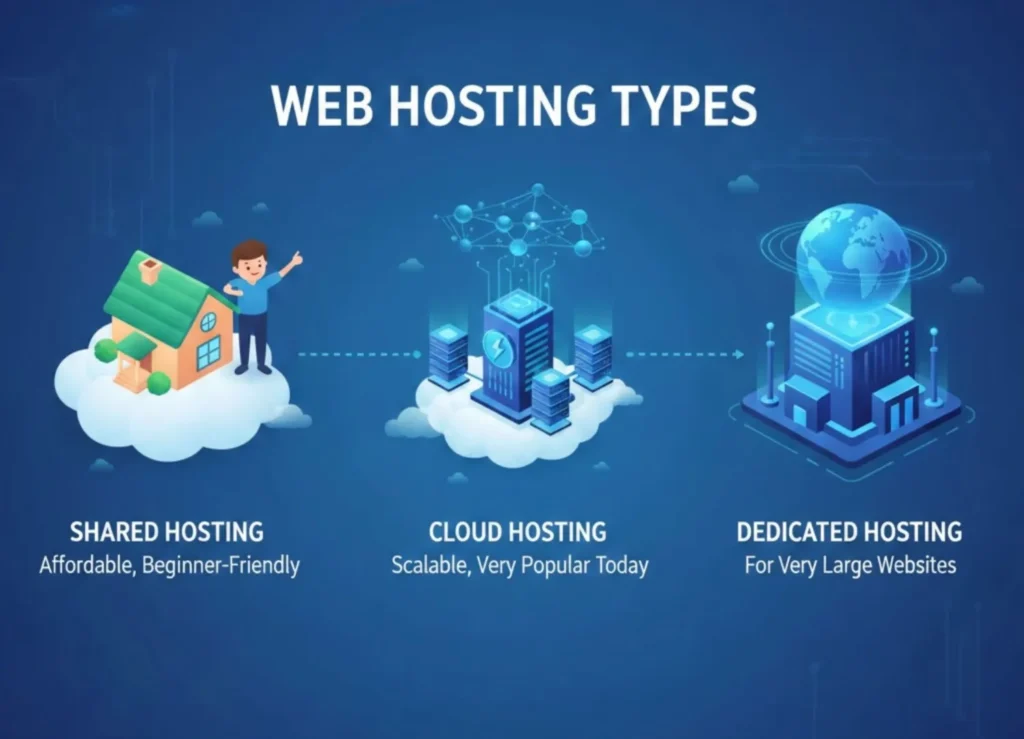
    Picking the Wrong Hosting to Save a Few Bucks

    This is where most people trip on day one. They find a hosting company charging $2 a month. It looks like a steal. They sign up and move on.

    Then their site loads like it’s dragging a suitcase uphill.

    Cheap shared hosting packs thousands of sites onto one server. Your site shares space with all of them. When another site gets busy, yours slows down. When someone else gets hacked, your site sits next door.

    For a serious project, skip the rock-bottom plans. Go with managed WordPress hosting or at least a mid-tier option. You’ll pay maybe $15 to $30 a month, but your site will load in under two seconds instead of seven. Your visitors, and Google, will thank you.

    Remember, when you create a website using WordPress, the host is the ground it stands on. Weak ground, weak site.

    Installing Every Plugin You See
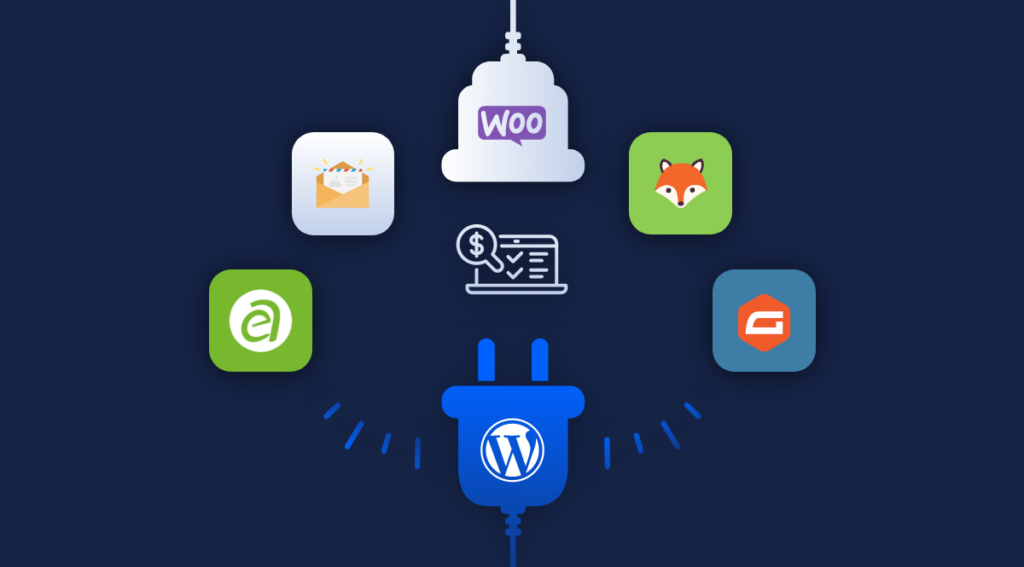
    Plugins are fun. They feel like magic. Need a contact form? There’s a plugin. Need a slideshow? Plugin. Want a pop-up? Plugin.

    Before you know it, you’ve got 40 plugins running. Your site is slow. Things randomly break. You don’t know which plugin is causing what.

    Here’s a simple rule. Every plugin you add makes your site a bit slower, a bit riskier, and a bit harder to fix when things go wrong.

    A proper WordPress plugin setup should be lean. Most sites need maybe 10 to 15 plugins total. One for SEO. One for security. One for caching. One for backups. One for forms. That’s most of it.

    Before you install anything new, ask two questions. Do I really need this? And is there a way to do it without a plugin? If the answer to the first one is no, skip it. You’ll save yourself so much grief later.

    Skipping the Security Basics

    People think hackers only target big sites. That’s wrong. Bots scan the web all day looking for easy WordPress sites to break into. Yours is on the list whether you know it or not.

    Most hacks happen because of stuff that takes ten minutes to fix. A weak password like “admin123.” A username that’s just “admin.” An outdated plugin nobody touched for two years. No two-factor login. No limit on login attempts.

    When you set up your site, do these right away. Pick a real password, something long with weird characters. Change your login username to something that’s not obvious. Install a security plugin like Wordfence or Solid Security. Turn on two-factor login. Limit how many times someone can try to log in before they get locked out.

    Ten minutes of work. Saves you weeks of cleanup later. Trust me on this one.

    Ignoring Backups Until It’s Too Late

    Backups are boring. Nobody wakes up excited to set them up. So most people don’t.

    Then one day something breaks. A plugin update crashes the site. A hack wipes content. A typo in a file takes everything down. And suddenly that boring backup would have been the only thing standing between you and starting over from scratch.

    Set up automatic backups before anything else. Use a plugin like UpdraftPlus. Send the backups somewhere safe like Google Drive or Dropbox, not just your own server. If your server crashes, a backup on that same server goes down with it.

    Back up once a week for a normal site. Daily if you post often or run a shop. Check now and then that the backups actually work. A backup you’ve never tested is a wish, not a plan.

    Picking a Theme Based on Looks Alone
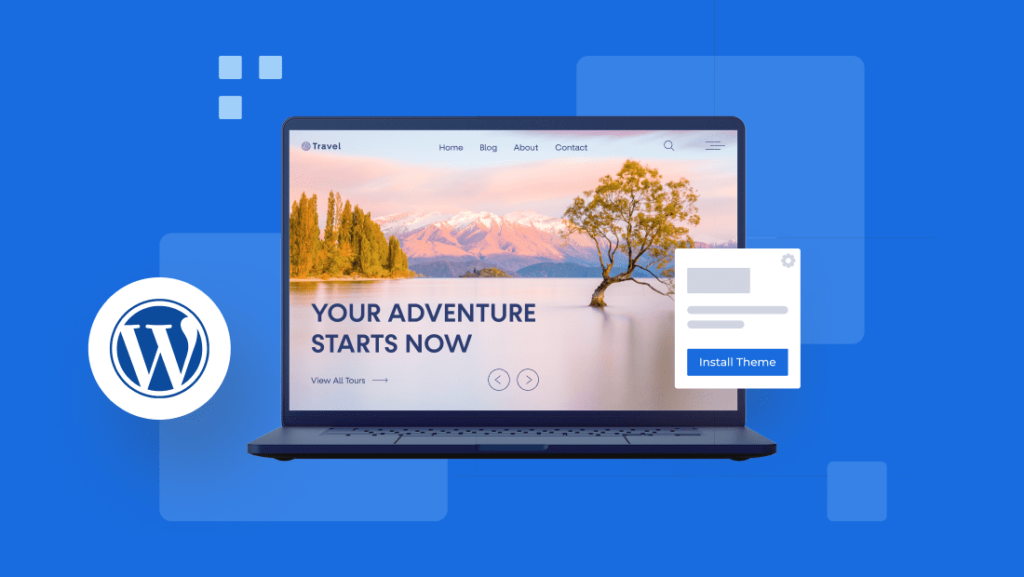
    You see a pretty theme. It has sliders, animations, and 15 demo layouts. You buy it. You install it. Your site looks amazing.

    Three months later, your pages take six seconds to load. Google drops you in the rankings. You try to change the homepage and the whole thing breaks.

    Heavy themes are a trap. The more features they cram in, the slower your site gets. Most of that pretty stuff you saw on the demo is what’s dragging you down.

    When you create a website using WordPress, pick a theme that’s light and clean first. GeneratePress, Astra, Kadence, and Blocksy are solid free options. They load fast and let you add what you need instead of forcing 50 features you don’t use.

    Or, if your budget allows, go with custom WordPress website creation. A developer can build you something light, fast, and tailored to your business. It costs more upfront but saves you headaches forever.

    Looks matter, sure. But speed and stability matter more.

    Forgetting About Mobile Users

    Check your own phone. You probably browse websites on it more than on your laptop. Everyone does.

    Yet tons of new WordPress sites still get built like it’s 2012. The desktop version looks great, and the mobile version is a mess. Buttons are too small. Text overflows. Menus don’t work right. Images crop weirdly.

    Google now ranks sites based on how they look on phones, not computers. So if your mobile site is broken, your rankings will be too.

    Every time you design a page, check it on your phone before you move on. Not just the size but how it actually feels to use. Can you tap the buttons? Does the menu open? Do the forms work?

    A quick mobile check after each page saves you from a full redesign later.

    Not Setting Up SEO From the Start

    Lots of owners finish building their site, launch it, and then go “okay, now how do I get on Google?” By then, months have been wasted.

    SEO isn’t something you sprinkle on at the end. It’s baked in from the start. Or it’s not.

    As soon as you install WordPress, install a good SEO plugin. Rank Math and Yoast are both solid. Set your permalinks to use post names instead of the ugly default with question marks and numbers. Submit your sitemap to Google Search Console. Write real meta titles and descriptions for every page.

    Also pay attention to your content. Each page should have one clear topic. Use headings to break things up. Write for real people, not search bots. If your writing helps the reader, Google usually figures it out.

    Getting the basics right from day one saves you from redoing half your site later.

    Using Tiny, Huge, or Wrong-Sized Images
    Images are tricky. Upload them too small and they look blurry. Upload them too big and they kill your page speed.

    The most common mistake? People upload photos straight from their camera or phone. A single image can be 5MB or more. On a page with ten images, that’s 50MB. Your visitor’s browser has to download all of that. It takes forever.

    Before you upload, resize your images. Most web photos only need to be 1920 pixels wide at most. Many are fine at 1200 or even 800. Use a free tool like TinyPNG or ShortPixel to shrink file sizes without losing quality.

    Then install an image plugin that converts your pictures to WebP, a newer and lighter format. Your pages will load way faster without you doing anything else.

    Not Keeping a WordPress Website Setup Guide for Yourself

    This one sounds nerdy but it matters. When you build your site, write down what you did. What hosting you used. What login info goes where. Which plugins you picked and why. What settings you tweaked.

    Six months from now, you’ll forget all of it. And when something breaks or you want to move the site, you’ll be digging around trying to remember. A simple document saved in Google Drive takes 20 minutes to make and saves you hours later.

    Treat this as your personal wordpress website setup guide. Future-you will send present-you a thank-you card.

    Launching Without Testing

    The final mistake. People rush to go live the second the site looks done. Then visitors start finding bugs the owner missed.

    Before you launch, test everything. Click every menu item. Fill out every form. Check the site on your phone, your tablet, and at least two browsers. Read every page out loud to catch typos and awkward sentences. Ask a friend to use the site and tell you where they got stuck.

    This one extra afternoon of testing catches problems that would otherwise embarrass you in front of real visitors.

    Wrapping It Up

    Building a WordPress site isn’t hard. But it’s easy to do wrong.

    The good news is that most of the mistakes above are small fixes. They just need someone to point them out. Get the hosting right. Keep your plugins lean. Lock the site down. Back it up. Pick a light theme. Think about mobile. Set up SEO early. Fix your images. Write things down. Test before you launch.

    Do these things and your site will already be ahead of most of the competition. Skip them and you’ll spend months fixing problems that never had to exist.

  • How Custom WordPress Website Development Improves Website Performance?

    How Custom WordPress Website Development Improves Website Performance?

    You open a website. It loads slowly. You leave.

    That’s pretty much the story of the modern web. People give a site about three seconds before they click away. Google watches this too. Slow sites get pushed down in search results. Fast ones go up.

    So how do you build a fast site? Most owners try plugins, fancy themes, and speed tools. Some of that helps a little. But the real fix is deeper.

    The fastest WordPress sites are not built from store-bought themes. They are built on purpose, from the ground up. This is where custom WordPress website development comes in. And it changes things in ways you might not expect.

    Let me walk you through why.

    What Does “Custom” Really Mean?

    First, let’s get this out of the way. A lot of people hear “custom WordPress site” and think it just means a unique design. That’s not the full picture.

    Many agencies buy a theme, change some colors, swap the logo, and call it custom. It isn’t. That’s just a paint job on the same car everyone else is driving.

    Real wordpress custom development is different. A developer writes the code for your site. They build only what you need. Nothing extra. No fancy sliders you won’t use. No hidden scripts loading fonts you didn’t pick.

    Think of it like getting a suit tailored. You can buy one off the rack, but it might be tight in the shoulders and loose at the waist. A tailor makes one that fits just you. Your site should fit your business the same way.

    Clean Code Just Loads Faster

    Ready-made themes are built to sell to many people. To do that, they pack in tons of features. Sliders. Page builders. Pop-up tools. Contact forms. Blog layouts. The list goes on.

    Here’s the problem. Most of that code still runs on your site, even if you don’t use those parts.

    Imagine moving into a house that has ten kitchens. You only use one. But you still pay to heat, clean, and light all ten. That’s what a bloated theme does to your site.

    A custom site only has what you actually use. The code is small. The files are light. Pages load fast.

    I’ve seen sites go from loading in 4 seconds to under 1 second just by ditching a popular theme. Same pictures. Same words. Same hosting. The only thing that changed was the code underneath.

    Google sees this too. It uses speed as a ranking signal. Faster site, better rank. Simple as that.

    Too Many Plugins Will Kill Your Site

    Open the back-end of most WordPress sites and you’ll see 30 or 40 plugins running. One for forms. One for SEO. One for backups. One for sharing. One for pop-ups. And on and on.

    Each plugin adds extra code to every page. Many of them load their stuff even on pages that don’t need it. Why is your contact form plugin running on your blog posts? It just is. That’s how these things work.

    With proper web development WordPress work, a good developer replaces many plugins with small bits of custom code. Need a contact form? Write one. Need a way to show team members? Build it right into the theme.

    This does three big things for you. Your site runs faster because there’s less junk to load. It stays safer because fewer plugins mean fewer weak spots for hackers. And it breaks less often, because you’re not waiting for 30 different people to keep their plugins updated.

    You stop playing plugin roulette every week.

    Faster Behind-the-Scenes Work

    Here’s something most people never think about. Every time someone visits your site, WordPress talks to a database. It pulls up the post, the menu, the sidebar, your settings, the comments. Dozens of little chats happen in the blink of an eye.

    Bad themes and bad plugins make too many chats. Or they ask the same thing over and over. It’s like a waiter who goes back to the kitchen ten times to get one order.

    A custom build fixes this. The developer writes smart code that asks for everything in one trip. The database responds faster. The page shows up faster. The visitor is happy.

    On a busy site, this can shave off hundreds of milliseconds. That might not sound like much. But it adds up to real money.

    Must Read: How Website Performance Impacts SEO and Conversions?

    Pictures Done Properly

    Images are the biggest thing on most web pages. They are also where most sites mess up.

    Lots of sites upload huge photos straight from the camera. Think 4000 pixels wide. Then they show these giant images to someone on a phone with a tiny screen. The phone has to download the whole thing anyway. It wastes time and data.

    Custom wordpress website development handles this the right way. Pictures get shrunk to the right size before they load. Newer formats like WebP are used, which are way smaller than old JPEGs. Images below the fold don’t load until you scroll near them.

    Most sites bolt on a plugin to try to fix this. It kind of works. Kind of. A custom setup builds this into the theme from day one. It just works, all the time, with no extra fuss.

    Fixing image problems alone can cut a full second off your load time. That’s huge.

    Caching and Hosting Stop Fighting

    Caching sounds techy, but it’s simple. It’s just your site saving a ready-made copy of each page. When someone visits, the copy is served right away instead of being built from scratch.

    The problem? Most WordPress sites have caching that fights with other caching. One plugin clears the cache. Another builds it. A third says the first one is wrong. Meanwhile, your visitors see old stuff or broken pages.

    When your WordPress website development is custom, caching is planned from the start. It all works together. You get fresh pages when you need them and cached ones when you want speed.

    The same goes for your server. A custom site can be tuned to work with the exact hosting you have. You pick the right PHP version. You set things up to match your traffic. Your hosting bill goes further because the site uses power smartly.

    Mobile Is the Real Test

    Most people browse on their phones now. Google knows this. It now ranks sites based on how they work on mobile, not desktop.

    Google also has three big speed rules it cares about. They measure how fast your main content shows up, how fast your page reacts to taps, and how much stuff jumps around while loading. If your site fails these tests, your rankings drop.

    Store-bought themes struggle here. They try to do too much. They shift around as ads and widgets pop in. They load huge fonts and scripts that kill phone performance.

    Custom sites can be built phone-first. Fonts load smart. Layouts stay still while loading. Buttons respond the second you tap them. It feels clean and quick, the way good apps feel.

    I’ve seen custom sites score in the 90s on Google’s speed tests while their old theme-based versions were stuck in the 40s.

    Why Any of This Matters for Your Money

    All this tech talk only matters if it changes real-world results. Good news. It does.

    Amazon found that every 100 milliseconds of delay cost them 1% in sales. Walmart saw sales go up by 2% for every second they cut off load time. Pinterest cut wait times and got 15% more signups.

    You’re probably not Amazon. But the same rules apply to small and medium businesses too. A local shop that cuts its load time from 5 seconds down to 1.5 can often double their phone calls in a month. An online store that fixes its speed often climbs in Google slowly but steadily over months.

    Fast sites rank better. They convert better. They cost less to run. They waste less of your time. That’s the whole pitch.

    Is This Worth It for Every Site?

    Let me be straight with you. Not always.

    If you run a hobby blog with 50 readers a month, a free theme is fine. If you’re just starting out and don’t know if your idea will even take off, spend your money somewhere else first.

    But if your website is how you make money, or it’s the face of your brand, or you want to beat your competitors in Google, the math shifts fast. Every slow page loses you a sale. Every low ranking is a customer your rival gets instead.

    Custom WordPress work is not about showing off. It’s about building something that actually works for you instead of against you.

    Wrapping Up

    Speed is not just one more feature you add to a website. It’s the ground the whole thing stands on.

    You can put a beautiful design on a slow site. Visitors will still leave. Google will still push you down. Your team will still spend Saturdays fixing plugin crashes.

    A custom build flips this. You start with speed and solid code. Then the design, content, and marketing all sit on top of something that actually works.

    If your site is slow and you’ve tried every speed plugin out there, the plugins probably aren’t the real issue. The base is. Fix the base, and everything else starts to work the way you hoped it would from the start.

  • How Much Does E-Commerce Website Development Cost?

    How Much Does E-Commerce Website Development Cost?

    In 2024, global e-commerce sales crossed $6.3 trillion, and over 75 percent of shoppers judge a business by its website experience before making a purchase. 

    In Canada alone, online retail sales continue to grow every year as more businesses move online. 

    This rapid shift has made e-commerce website development a critical investment rather than an optional one. 

    Yet one question stops many business owners right away; what will be the actual cost to develop an e-commerce website?

    The answer depends on several factors, from platform choice to features and long-term goals. 

    This guide breaks everything down in simple terms so you can budget wisely and avoid surprises.

    What Is E-Commerce Website Development?

    E-commerce website development is the process of building an online store that allows customers to browse products, add items to a cart, make payments, and track orders. 

    It includes design, coding, integrations, security, and performance optimization.

    A well-built e-commerce site does more than sell products. It builds trust, supports marketing efforts, and grows with your business. 

    Because every business has different needs, e-commerce website development costs can vary widely.

    Close-up of a laptop displaying a fashion store website with clothing discounts. Consider ecommerce website development cost.

    Average Cost of E-Commerce Website Development 

    In Canada, the cost of e-commerce website development usually falls into three main ranges.

    These ranges depend on complexity, customization, and long-term goals.

    A basic e-commerce website often costs between CAD 3,000 and CAD 7,000.

    This suits small businesses with a limited product catalog and standard features.

    A mid-range e-commerce website typically costs between CAD 8,000 and CAD 20,000.

    These sites include custom design, better performance, and added integrations.

    A large or enterprise-level e-commerce website can cost CAD 25,000 to CAD 60,000 or more. 

    These projects involve custom development, advanced security, and complex workflows.

    It is important to remember that these are development costs only. Ongoing expenses come later.

    Key Factors That Affect E-Commerce Website Development Cost

    a. Platform Choice

    The platform you choose has a big impact on cost. 

    Hosted platforms like Shopify are easier to set up and usually cost less upfront. 

    Whereas, Open-source platforms like WooCommerce give more flexibility but may cost more in development and maintenance. 

    Fully custom platforms are the most expensive but offer complete control.

    A clean, white background displaying the official logos for the Shopify and WooCommerce e-commerce platforms for business use.

    b. Design Requirements

    Using a ready-made theme is cheaper than building a custom design. 

    Custom design improves branding and user experience but adds to development time and cost. 

    Mobile responsiveness is no longer optional and must be included.

    c. Features and Functionality

    Basic features include product pages, cart, checkout, and payment processing. 

    Advanced features like subscriptions, product filters, custom shipping rules, and loyalty programs increase cost. 

    The more complex the logic, the higher the development effort.

    d. Number of Products

    A store with 20 products costs less than one with 2,000 products. 

    Large catalogs need better performance optimization, structured data, and search functionality.

    e. Integrations

    Many businesses need integrations with inventory systems, CRMs, accounting software, or marketing tools. 

    Each integration adds time and cost to e-commerce website development.

    f. Development Team

    Freelancers often charge less than agencies, but agencies usually provide better project management, testing, and long-term support. 

    Canadian agencies typically charge higher rates than offshore teams but offer local expertise and compliance support.

    Cost Breakdown by E-Commerce Website Type

    Website TypeTypical Cost Range CADBest For
    Basic Store3,000 to 7,000Startups and small shops
    Mid-Size Store8,000 to 20,000Growing businesses
    Enterprise Store25,000 to 60,000+Large brands and B2B
    Custom Platform40,000+Unique business models

    Note: These prices are just an average estimate and can vary as per project needs and budget

    Ongoing Costs After Development

    Building the website is only the first step. Running an e-commerce business involves ongoing expenses.

    Hosting can cost between CAD 20 and CAD 300 per month, depending on traffic and performance needs. 

    Domain names usually cost under CAD 20 per year.

    Platform subscription fees for Shopify or similar tools range from CAD 50 to CAD 500 per month.

    Plugins and extensions may add another CAD 30 to CAD 200 per month.

    Maintenance and updates are often overlooked. 

    Businesses typically spend CAD 1,000 to CAD 5,000 per year on updates, security, and bug fixes.

    Marketing, SEO, and paid ads are separate costs but closely tied to how well your e-commerce website performs.

    Hidden Costs You Should Know About

    Many businesses underestimate hidden costs in e-commerce website development.

    Payment gateways charge transaction fees that range from 2 to 3 percent per sale. Premium plugins often renew annually.

    Scaling also costs money. 

    As traffic grows, you may need better hosting, caching, or a content delivery network. 

    Security upgrades and compliance tools can add extra expenses.

    Planning for these early helps avoid budget stress later.

    Custom vs Template-Based E-Commerce Websites

    Template-based websites cost less and launch faster. They work well for simple stores with standard needs. 

    However, customization is limited.

    Custom e-commerce website development costs more but offers flexibility, better performance, and unique branding. 

    It also supports complex business rules and future growth.

    If your business relies heavily on online sales or has unique workflows, custom development often provides better long-term value.

    Online shopping banner template showing a happy woman with bags, stylish botanical graphics, and a green shop button options.

    How to Reduce E-Commerce Website Development Costs?

    – Start with a clear project scope and focus only on essential features in the beginning

    – Build a minimum viable product first and add advanced features later as your business grows

    – Choose an e-commerce platform that fits your current business size and budget

    – Avoid overbuilding or adding complex features that are not immediately needed

    – Reuse reliable tools and plugins instead of custom-building everything from scratch

    How Much Should You Budget for Your Business?

    If you are a small business just starting, budgeting CAD 4,000 to CAD 6,000 is realistic.

    Growing businesses should plan for CAD 10,000 to CAD 15,000 to support scaling.

    Enterprises or B2B companies often need budgets above CAD 30,000 to handle security, integrations, and performance needs.

    Your budget should reflect your revenue goals, not just current size.

    Conclusion

    E-commerce website development is an investment that shapes how customers experience your brand online. 

    The cost depends on your goals, platform, features, and growth plans. 

    By understanding where the money goes, you can make smarter decisions and avoid hidden expenses.

    For businesses planning their next steps, teams like Adsagenz often recommend starting with clear goals, realistic budgets, and scalable planning so the website supports long-term growth without unnecessary complexity.

    FAQs

    a. How long does e-commerce website development usually take?

    Most basic e-commerce websites take four to six weeks to complete. Mid-size projects usually take two to three months. Large or custom platforms can take four to six months, depending on complexity and testing requirements.

    b. Is e-commerce website development a one-time cost?

    No, it is not a one-time cost. While development is a major upfront expense, businesses must also pay for hosting, maintenance, updates, and platform fees over time. These ongoing costs are essential for security and performance.

    c. Can I lower costs by building the website myself?

    DIY platforms can reduce initial costs, but they often limit customization and scalability. Many businesses later spend more time fixing performance issues or redesigning the site. Professional e-commerce website development usually delivers better long-term results

    d. Why do e-commerce website development prices vary so much?

    Prices vary because every project is different. Platform choice, features, integrations, design complexity, and developer experience all affect the final cost. There is no single fixed price for all businesses.

  • How Website Performance Impacts SEO and Conversions?

    How Website Performance Impacts SEO and Conversions?

    Last day, I opened a jewellery website to shop for some of the latest jewellery collections for my friend. 

    I have heard that the collection on this website is very unique, and the prices are also reasonable within budget.

    But you know, as soon as I typed in the website on search bar, to my surprise, the website took so long to load, I guess almost 30 secs

    I thought that I might be having some internet issue on my wifi but when I switched to mobile data, the same issue continued, and this time it took almost a minute.

    You know my complete experience of visiting the website was almost ruined by the slow loading speed of the website.

    We don’t think much about this, but honestly speaking, website performance matters a lot.

    In 2023, Google revealed that 53 percent of mobile users abandon a website if it takes longer than three seconds to load, and research from Deloitte showed that even a 0.1-second improvement in site speed can increase conversion rates by up to 8 percent. 

    These numbers highlight a true reality that many businesses still underestimate. 

    Website Performance is no longer optional or something that can be delayed. 

    It directly affects search visibility, user trust, and revenue potential.

    Search engines and users now expect fast, stable, and responsive websites. 

    When website performance suffers, rankings slip, and conversions drop. 

    Now, let’s understand the impacts and solutions of website performance closely.

    What Website Performance Really Means?

    Users expect speed. Not “reasonably fast.”

    If your site takes more time to load, visitors start losing trust before they even see your content.

    Google and other search engines evaluate performance using a combination of technical and user-focused metrics. 

    The most important among them are Core Web Vitals, which measure loading speed, interactivity, and visual stability. 

    These metrics reflect how real users experience a website rather than how it performs in a controlled environment.

    Performance also varies across devices, browsers, and network conditions. 

    A site that feels fast on a desktop with high-speed internet may feel slow on a mobile device using a slower connection. 

    That difference plays a significant role in both SEO rankings and conversion outcomes.

    How Website Performance Impacts SEO?

    SEO is all about how well your website appears on search engines, and to appear on search engines perfectly, your website’s performance needs to be excellent.

    Google’s primary goal is to deliver the best possible results to users, and performance is a key indicator of whether a website can meet that expectation. 

    When a site loads quickly, responds smoothly, and remains stable, it creates a positive experience that search engines are more likely to reward with higher visibility.

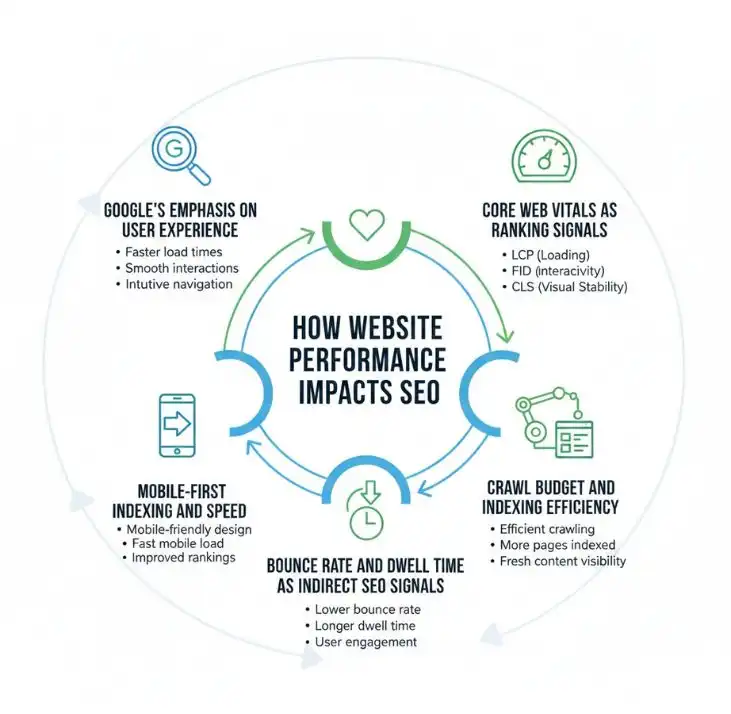
    An educational infographic diagram titled "How Website Performance Impacts SEO." It features a circular flow connecting five key factors: Google's emphasis on user experience, Core Web Vitals as ranking signals, crawl budget efficiency, bounce rate/dwell time, and mobile-first indexing.

    a. Google’s Emphasis on User Experience

    Google has slowly shifted its ranking algorithms toward user experience. 

    Beyond relevant content, search engines now check how easily users can access and interact with that content. 

    Slow-loading pages can frustrate users and prevent them from finding information efficiently. 

    As a result, websites with strong performance are more likely to align with Google’s goal of delivering helpful and satisfying search results.

    b. Core Web Vitals as Ranking Signals

    Core Web Vitals are Google’s primary performance metrics and are officially confirmed ranking signals. 

    These metrics measure loading speed, interactivity, and visual stability based on real user data.

    Websites that meet recommended guidelines are more likely to benefit from improved rankings, particularly in competitive search results.

    While strong Core Web Vitals alone do not guarantee top positions, poor scores can hold a site back even when content quality is high. 

    Improving these metrics helps ensure that technical limitations do not undermine SEO efforts.

    c. Crawl Budget and Indexing Efficiency

    Each website is allocated a limited crawl budget by search engines. 

    This determines how many pages a search engine bot can crawl within a given time. 

    When a website’s performance is poor, crawlers spend more time loading pages, which reduces the number of URLs they can access.

    Faster websites allow search engines to crawl and index content more efficiently. 

    d. Mobile-First Indexing and Speed

    Google uses mobile-first indexing, meaning it primarily evaluates the mobile version of a website when determining rankings. 

    Mobile performance is therefore essential for SEO success. 

    Pages that load slowly or are poor on mobile devices risk losing visibility, even if the desktop experience is strong.

    Mobile users often access websites on slower networks, making speed optimization even more critical. 

    A well-optimized mobile experience signals quality and reliability to search engines and users alike.

    e. Bounce Rate and Dwell Time as Indirect SEO Signals

    Although bounce rate and dwell time are not direct ranking factors, they reflect how users interact with search results. 

    Poor website performance often leads to higher bounce rates because users leave before engaging with the content. 

    Short dwell times suggest that visitors did not find the experience useful or accessible.

    When users stay longer, scroll, and interact with a page, it signals satisfaction. 

    Strong website performance supports positive engagement patterns, which indirectly reinforce a site’s SEO strength over time.

    How Website Performance Affects Conversions?

    Website performance has a direct and measurable influence on conversion rates. 

    Every second of delay increases the chances that users will complete a desired action. 

    Modern users expect fast, responsive experiences, and when those expectations are not met, conversions decline regardless of how strong the offer or messaging may be.

    a. Statistics on Speed vs. Conversion Rates

    Multiple studies confirm the relationship between speed and conversions. 

    Research from Google shows that as page load time increases from one to three seconds, the probability of a bounce rises by more than 30 percent. 

    Portent’s analysis found that websites loading in one second convert significantly better than those loading in five seconds. 

    Even small improvements in website performance can lead to noticeable gains in conversion rates, making speed optimization one of the highest-impact improvements businesses can make.

    b. Impact on Lead Generation Forms

    Lead generation forms are highly sensitive to performance issues. 

    Slow-loading pages reduce trust and increase abandonment before users even reach the form.

    Delays during form submission or validation often cause users to abandon the process entirely.

    Strong website performance ensures that forms load quickly, respond instantly, and feel reliable, which increases completion rates and improves lead quality.

    c. Impact on E-commerce Checkout Processes

    E-commerce conversions depend heavily on smooth and fast checkout experiences.

    Performance delays during cart loading, payment processing, or order confirmation create anxiety and frustration. 

    Even brief pauses can lead users to question transaction security or abandon their purchase.

    d. Impact on CTA Clicks and Engagement

    Calls to action rely on momentum and timing. 

    When a page feels slow or unresponsive, users hesitate to click buttons or engage with interactive elements. 

    Delayed animations or lagging responses break the flow of interaction. 

    Strong website performance ensures that CTAs feel immediate and responsive, which increases engagement and encourages users to take the next step.

    e. Mobile Performance and Conversion Drop

    Mobile users are particularly sensitive to performance issues due to smaller screens and varying network speeds. 

    Slow mobile experiences lead to higher abandonment rates and lower conversion potential.

    Google reports that mobile users are more likely to leave a site if it takes longer than a few seconds to load. 

    Optimizing website performance for mobile devices helps reduce drop-offs and supports consistent conversion rates across devices.

    In every stage of the user journey, website performance influences decision-making.

    Faster, more responsive websites remove barriers, build trust, and create the conditions necessary for higher conversion rates.

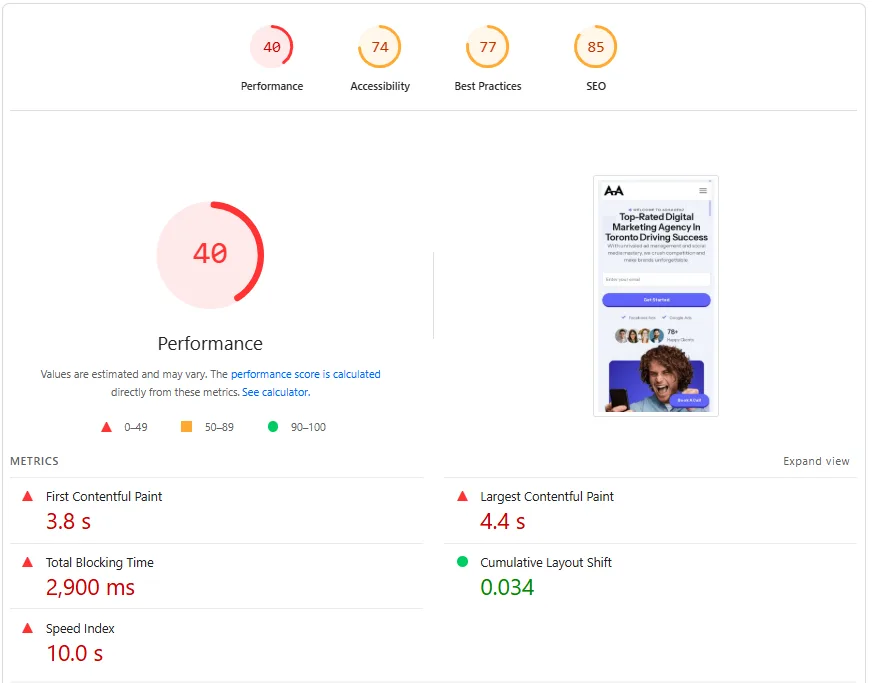
    A Lighthouse performance report for a mobile website showing an overall performance score of 40 out of 100. Specific metrics listed in red include a 4.4-second Largest Contentful Paint, a 2,900ms Total Blocking Time, and a 10-second Speed Index.

    Common Website Performance Issues

    Below is the list of common website performance issues that cause serious harm to seo and conversions

    a. Unoptimized Images and Media

    Images and media files are among the largest assets on most websites. 

    When they are uploaded without compressing, proper sizing, or modern formats, they start to slow down page load times. 

    High-resolution images displayed at smaller sizes waste bandwidth and increase loading delays. 

    Poorly optimized videos can also block rendering and affect overall responsiveness. 

    Optimizing images ensures faster delivery without compromising visual quality.

    b. Excessive JavaScript and CSS

    Heavy use of JavaScript and CSS can block page rendering and delay interactivity. 

    Large scripts, unused code, and multiple external files force browsers to process more resources before displaying content. 

    This results in slower load times and delayed user interactions. 

    Reducing file sizes, removing unused code, and prioritizing critical resources improve website performance and responsiveness.

    c. Poor Hosting or Server Response Times

    Server performance plays a major role in how quickly a website loads. 

    Slow hosting environments increase Time to First Byte, which delays every subsequent step in the loading process. 

    Shared hosting, outdated infrastructure, or misconfigured servers often struggle to handle traffic efficiently. 

    Reliable hosting and proper server optimization are foundational to strong website performance.

    d. Lack of Caching or CDN Usage

    Without caching, browsers and servers must repeatedly load the same resources for returning visitors. 

    This increases load times and unnecessary server strain. 

    Similarly, the absence of a content delivery network forces users to fetch assets from a single server location, which increases latency for users farther away. 

    Caching and CDN usage improve load speed, reduce server load, and create a more consistent experience across regions.

    d. Third-Party Scripts and Plugins

    Third-party scripts such as analytics tools, tracking pixels, chat widgets, and plugins often add hidden performance costs. 

    Each additional script increases the number of requests and processing time required to load a page. 

    Poorly optimized plugins can significantly slow down websites and introduce stability issues.

    Regularly auditing and minimizing third-party scripts helps maintain strong website performance without sacrificing functionality.

    Best Practices to Improve Website Performance

    Focusing on proven best practices helps create faster, more reliable experiences that support both SEO and conversions.

    a. Image Optimization and Modern Formats

    Images often makes for the largest portion of page weight. 

    Optimizing them reduces load times without sacrificing visual quality. 

    This includes resizing images to the exact dimensions needed, compressing files, and using modern formats such as WebP or AVIF where supported. 

    Proper image optimization ensures faster rendering and improves overall website performance, especially on mobile devices and slower networks.

    b. Minification and Compression

    Minification removes unnecessary characters from CSS, JavaScript, and HTML files, reducing file size without affecting functionality. 

    Compression techniques like Gzip or Brotli further shrink file sizes before they are sent to the browser. 

    Together, minification and compression reduce bandwidth usage and speed up content delivery, making pages load more quickly for users.

    c. Lazy Loading Strategies

    Lazy loading delays the loading of images, videos, and other non-essential resources until they are needed. 

    Instead of loading everything at once, content appears as users scroll. This approach improves initial page load time and enhances perceived performance. 

    Lazy loading is especially effective for content-heavy pages and long-form websites.

    d. Using CDNs and Performance-Focused Hosting

    A content delivery network distributes website assets across multiple geographic locations, allowing users to load content from the server closest to them. 

    This reduces latency and improves load times for global audiences.

    Performance-focused hosting providers also offer optimized server configurations, faster response times, and better scalability. 

    Together, these solutions form a strong foundation for consistent website performance.

    e. Reducing Third-Party Scripts

    Third-party scripts often introduce performance delays that are difficult to detect. 

    Each script adds network requests and processing overhead. 

    Auditing and removing unnecessary scripts helps reduce load times and improve stability. 

    For essential tools, choosing lightweight alternatives or deferring their loading can significantly improve website performance without compromising functionality.

    By applying these best practices, businesses can build websites that load faster, feel smoother, and perform reliably across devices and network conditions.

    Tools to Measure Website Performance

    The following tools are widely used because they combine real user data, technical audits, and actionable insights. 

    a. Google PageSpeed Insights

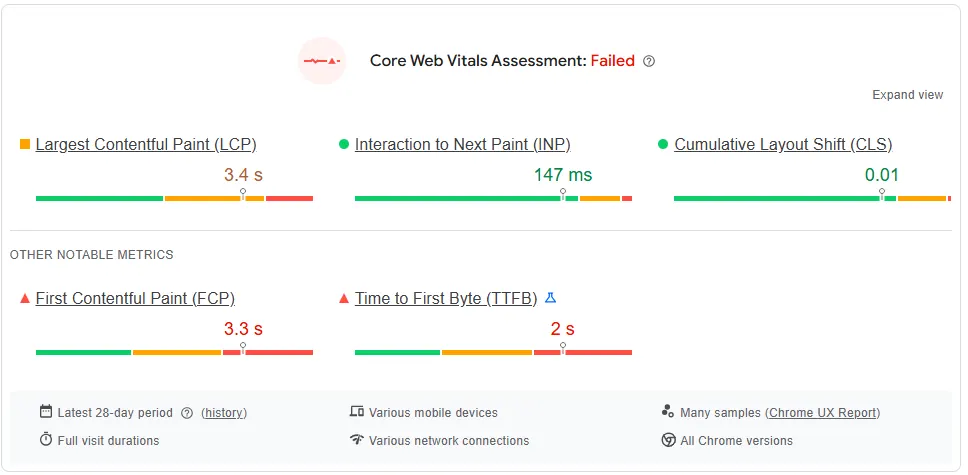
    Google PageSpeed Insights analyzes website performance using both lab data and real user data from the Chrome User Experience Report. 

    It highlights Core Web Vitals, loading speed, and optimization opportunities. 

    The tool is especially useful for understanding how Google evaluates website performance and where improvements can have the greatest SEO impact.

    A Google PageSpeed Insights dashboard showing a failed Core Web Vitals Assessment. The report highlights a "Needs Improvement" score for Largest Contentful Paint at 3.4 seconds and "Poor" scores for First Contentful Paint at 3.3 seconds and Time to First Byte at 2 seconds.

    b. Lighthouse

    Lighthouse is an open-source auditing tool built into Chrome DevTools. 

    It evaluates website performance, accessibility, SEO, and best practices in a controlled environment. 

    Lighthouse is valuable for diagnosing technical issues such as render-blocking resources, unused JavaScript, and inefficient image delivery that affect website performance.

    c. GTmetrix

    GTmetrix provides detailed performance reports that include page load time, total page size, and request counts. 

    It allows testing from different locations and devices, helping identify regional or mobile-specific performance issues. 

    GTmetrix also offers visual timelines that show how a page loads, making it easier to pinpoint bottlenecks.

    d. WebPageTest

    WebPageTest offers advanced testing options, including multiple browser types, network speeds, and geographic locations. 

    It provides granular insights into Time to First Byte, rendering milestones, and content loading sequences. 

    This tool is particularly useful for diagnosing complex website performance issues and testing optimization changes.

    e. Google Search Console Core Web Vitals Report

    Google Search Console aggregates real user performance data across your entire website. 

    The Core Web Vitals report groups URLs by performance status and highlights pages that need improvement. 

    This tool is essential for monitoring website performance trends over time and understanding how performance impacts search visibility at scale.

    Regularly using these tools helps ensure that website performance remains aligned with SEO goals and user expectations.

    Conclusion

    Website Performance sits at the intersection of SEO, user experience, and conversions.

    It influences how search engines rank pages and how users interact with them in real time.

    A fast, stable, and responsive website builds trust, improves visibility, and supports sustainable growth.

    Businesses that treat performance as an ongoing priority are better positioned to adapt to evolving search algorithms and user expectations.

    If you are evaluating how performance fits into your broader digital strategy, teams like Adsagenz often emphasize performance-first thinking as part of long-term optimization efforts.

    Taking the time to assess and improve Website Performance today can create meaningful results across search visibility and conversion outcomes tomorrow.

    FAQs

    1. How does website performance affect SEO?

    Website performance affects user behavior and Core Web Vitals, both of which influence search rankings and visibility.

    2. What is website speed optimization?

    Website speed optimization involves improving load times and responsiveness through better asset management, code efficiency, and caching.

    3. Which website performance metrics matter most?

    Page load time, LCP, INP, and CLS are the most impactful metrics for SEO and user experience.

    4. Does a faster website speed increase conversions?

    Yes. Faster sites reduce friction, increase trust, and lead to higher conversion rates.

    5. How often should website performance be checked?

    At least quarterly, or after major updates. Ongoing monitoring helps prevent performance regressions.

  • Is WordPress a Good Choice in 2026?

    Is WordPress a Good Choice in 2026?

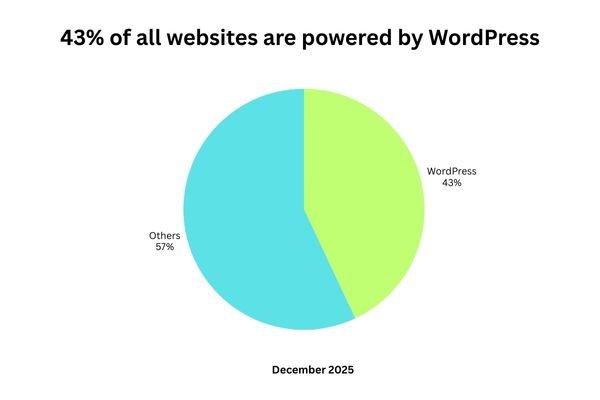
    According to data, more than 43% of all websites on the internet are powered by WordPress in 2025. That surpasses the combined market share of Joomla, Wix, Squarespace, and Shopify. 

    Surprisingly, more than 62% of content management systems globally are powered by WordPress. 

    Just these figures raise important questions for many individuals as we proceed. 

    Is WordPress a good choice in 2026, or is it eventually losing momentum to more modern, eye-catching platforms?

    With AI tools reshaping content creation, no-code builders growing rapidly, and performance expectations higher than ever, choosing the right website platform is no longer a casual decision. 

    Businesses, creators, and developers need clarity. This article takes a grounded, future-focused look at WordPress in 2026 to help you decide whether it still deserves its crown.

    But let’s first answer the main question!

    A pie chart titled "43% of all websites are powered by WordPress" dated December 2025. The chart shows two segments: WordPress at 43% (represented in light green) and Others at 57% (represented in light blue)

    Is WordPress a Good Choice in 2026?

    Yes, WordPress is still a good choice in 2026, but it is not a one-size-fits-all solution.

    WordPress today is very different from what many people used years ago. 

    It has evolved into a flexible, AI-compatible, and enterprise-ready platform that supports modern technologies like artificial intelligence, headless setups, and advanced performance optimization. 

    This ability to adapt is the main reason WordPress continues to stay relevant while many platforms become restrictive or outdated.

    At the same time, WordPress comes with real challenges that cannot be ignored. 

    It requires regular maintenance, careful plugin management, and a basic level of technical understanding to run smoothly and securely. 

    For users who want a completely hands-off experience, this can feel demanding.

    Ultimately, whether WordPress is a good choice in 2026 depends on your needs. If you value flexibility, scalability, content ownership, and long-term growth, WordPress remains an excellent option. 

    If simplicity and zero maintenance are your top priorities, other platforms may be a better fit.

    Why WordPress Shines in 2026?

    1. Large Market Dominance and Community Support

    WordPress being one of the oldest web development platforms, it has a large community of developers, designers, SEO experts, and content creators that readily contributes. 

    When problems arise, solutions already exist. 

    From documentation to forums and tutorials, WordPress offers a depth of support that proprietary platforms simply cannot match.

    2. AI Compatibility and Integration

    One of the biggest misconceptions is that AI will replace WordPress. 

    In reality, WP is becoming more AI-enabled than ever.

    In 2026, WordPress supports AI through plugins and integrations that assist with content creation, SEO optimization, image generation, chatbots, personalization, and analytics.

    Popular AI tools integrate seamlessly without locking users into closed ecosystems.

    This makes WordPress highly attractive for AI-driven search visibility, especially as generative search engines increasingly rely on structured, well-optimized content.

    3. Perfect for SEO

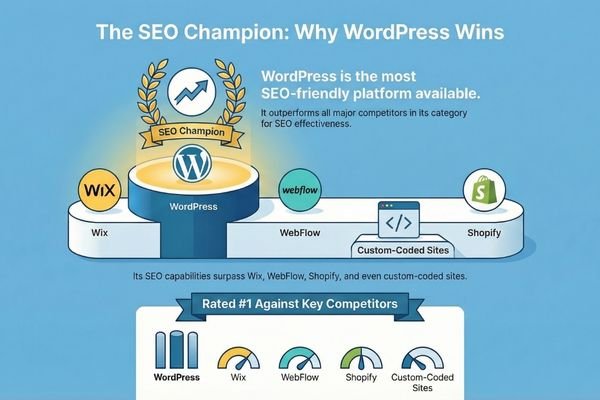
    When we compare all the CMS platforms like WordPress, Wix, WebFlow, or Shopify or even custom coded websites, WordPress is the most SEO friendly platform among all.

    An infographic titled "The SEO Champion: Why WordPress Wins." It features a WordPress logo on a pedestal with a gold trophy. A comparison bar and gauges at the bottom rank WordPress as #1 for SEO effectiveness, followed by lower ratings for Wix, Webflow, Shopify, and Custom-Coded Sites.

    With ample options of plugins, user-friendly interface. WordPress dominates the SEO approach in web development.

    For businesses aiming for organic growth in 2026, this alone makes WordPress a compelling option.

    4. Flexibility for Any Use Case

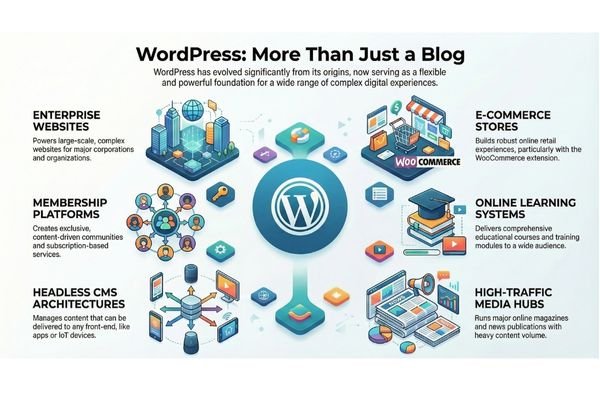
    WordPress is no longer just a blogging platform. In 2026, it powers:

    a. Enterprise websites
    b. E-commerce stores with WooCommerce
    c. Membership platforms
    d. Online learning systems
    e. Headless CMS architectures
    f. High-traffic media publications

    A conceptual diagram titled "WordPress: More Than Just a Blog." A central WordPress logo is surrounded by six icons representing its diverse uses: Enterprise Websites, E-commerce Stores (WooCommerce), Online Learning Systems, High-Traffic Media Hubs, Headless CMS Architectures, and Membership Platforms.

    This versatility allows businesses to scale without migrating to a new platform later, which saves time, money, and technical risk.

    5. Ownership and Control

    Unlike many website builders, WordPress gives users full ownership of their content, data, and infrastructure. 

    You are not locked into pricing changes, feature removals, or platform shutdowns.

    As data privacy laws tighten and businesses prioritize digital independence, this control becomes increasingly valuable.

    The Challenges of Using WordPress

    Despite its strengths, WordPress is not perfect. 

    Understanding its limitations is crucial for making a smart decision.

    1. Maintenance Responsibility

    WordPress requires ongoing updates for themes, plugins, and the core system. 

    Without proper maintenance, websites can become vulnerable or slow.

    This is not an issue for teams with technical knowledge or managed hosting, but beginners may find it overwhelming at first.

    2. Plugin Overload Risks

    There are benefits and drawbacks to the plugins.  

    Installing too many poorly coded plugins can harm performance, security, and stability.

    In 2026, smart plugin selection and performance audits are essential for a healthy WordPress site.

    3. Learning Curve Compared to Builders

    Platforms like Wix and Squarespace offer faster initial setup with fewer decisions. 

    WordPress offers more freedom, but that freedom requires learning.

    Users who want a website to live in a single afternoon with minimal customization may feel frustrated.

    4. Security Depends on Configuration

    WordPress itself is secure, but its popularity makes it a frequent target. 

    Security depends heavily on hosting quality, plugin choices, and user practices.

    With proper setup, WordPress can be extremely secure, but it is not entirely hands-off.

    WordPress vs. Top Alternatives: Comparison Table

    Below is a clear comparison to help you evaluate WordPress against leading alternatives in 2026.

    FeatureWordPressWixShopifySquarespaceWebflow
    Ease of UseModerateVery EasyEasyEasyModerate
    CustomizationVery HighLowModerateLowHigh
    SEO ControlExcellentLimitedGoodLimitedVery Good
    AI IntegrationExtensiveBasicModerateBasicModerate
    ScalabilityExcellentLimitedHigh for ecommerceLimitedHigh
    OwnershipFull OwnershipPlatform ControlledPlatform ControlledPlatform ControlledPartial
    Cost FlexibilityHighSubscription BasedMonthly FeesMonthly FeesHigher Cost
    Best ForAny website typeSmall sitesOnline storesPortfoliosDesigners

    Conclusion: Should You Choose WordPress in 2026?

    WordPress is not fading. It is evolving.

    In 2026, WordPress remains one of the most powerful, adaptable, and future-ready platforms available. 

    It supports AI-driven content, scales from personal blogs to enterprise systems, and provides unmatched control over digital assets.

    That said, it is not the easiest platform, and it does require responsibility. 

    For users willing to invest in proper setup and maintenance, WordPress offers long-term value that few competitors can match.

    If you are planning a website with growth in mind, WordPress is still a strong foundation. 

    For those exploring strategy, performance, or visibility in an AI-driven web environment, teams like Adsagenz often emphasize thoughtful platform selection as a starting point for sustainable digital success. 

    Choosing the right foundation today can save years of rebuilding tomorrow.

    FAQs

    1. Is WordPress still popular in 2025?

    Yes, WordPress remains the most popular content management system in 2025. It powers more than 43 percent of all websites globally and continues to grow, especially among businesses seeking SEO strength and content ownership. Its popularity is reinforced by its massive developer community and continuous updates.

    2. Is there a future in WordPress?

    WordPress has a strong future because it evolves alongside technology trends. Its open-source nature allows it to integrate with AI, headless architectures, and performance tools without being limited by proprietary restrictions. This adaptability ensures its relevance well beyond 2026.

    3. Will AI replace WordPress?

    AI will not replace WordPress. Instead, AI enhances it. WordPress acts as a foundation where AI tools can operate effectively, helping with content creation, optimization, personalization, and analytics. AI needs structured platforms like WordPress to function at scale.

    4. Is there any better than WordPress?

    No single platform is universally better. Some alternatives may be better for very specific needs, such as quick portfolios or simple online stores. However, when flexibility, scalability, SEO, and ownership are considered together, WordPress remains difficult to outperform.

    5. Is Wix or WordPress better?

    Wix is better for beginners who want speed and simplicity with minimal customization. WordPress is better for users who want long-term growth, advanced SEO, and full control over their website. The better choice depends on goals, not popularity.

  • Mastering Modern Website Development – A Complete 101 Guide

    Mastering Modern Website Development – A Complete 101 Guide

    Website development is one of the most essential digital skills of the modern era. Whether you’re an entrepreneur, student, freelancer, or simply someone curious about how the web works, understanding website development opens doors to infinite opportunities. 

    Today, we rely on websites for everything: learning, buying, socializing, working, and consuming information. And behind every website lies a blend of creativity, logic, technology, and problem-solving.

    This comprehensive guide breaks down the fundamentals of website development in simple terms. No complicated jargon. No advanced-level assumptions.

    Just a clear roadmap to help you understand how websites work, what tools developers use, and how you can build your first website step by step.

    Understanding How Websites Work?

    Before diving into code, every developer must understand the invisible machinery powering websites. At its core, the web operates on the client–server model, which governs how browsers and servers communicate. 

    When a user enters a URL, the browser sends a request to a remote server, asking for the page’s content.

    The server processes the request, gathers all necessary resources such as HTML, CSS, JavaScript, images, and data, and sends them back to the browser. The browser then interprets the files and renders the final output.

    What Is a Website?

    A website is a collection of web pages stored on a server and accessible through a web browser, such as Chrome, Firefox, or Safari.

    Each page contains content — text, images, videos, buttons, links, and animations — all structured using code.

    When you enter a URL like www.example.com, you are requesting a specific file or resource that lives on a remote computer called a web server.

    How Browsers Communicate With Servers?

    Let’s simplify how the browser fetches a website:

    1. You type a URL into your browser.
    2. The browser sends a request to the DNS (Domain Name System) to find the server’s IP address.
    3. The server receives the request.
    4. The server sends the correct files back to the browser.
    5. The browser reads and displays those files for you.

    This back-and-forth communication follows a set of rules known as HTTP or HTTPS.

    What Is Hosting?

    If a website is a home, hosting is the land it stands on.

    Hosting providers store the code and files that make up your website on their servers. When visitors access your site, they’re retrieving these files from your hosting space.

    Common hosting types include:

    • Shared hosting (affordable, beginner-friendly)
    • VPS hosting (more power, for growing sites)
    • Cloud hosting (scalable, very popular today)
    • Dedicated hosting (for very large websites)
    Illustration showing three web hosting types: Shared Hosting (affordable, beginner-friendly), Cloud Hosting (scalable, popular), and Dedicated Hosting (for very large websites), essential components of website development.

    What Is a Domain Name?

    A domain name is the web address people type to visit your site — like google.com, yourcompany.com, or blogonline.net. It’s your website’s identity on the internet.

    A domain is mapped to your server’s IP, so users never need to memorize numbers.

    Together, domain + hosting make your website accessible to the world.

    Core Building Blocks of the Web

    Every website depends fundamentally on three technologies: HTML, CSS, and JavaScript. These might seem basic, but mastering them deeply will set you apart as a strong developer.

    A smiling man working on a laptop surrounded by speech bubbles indicating various web technologies like JS (JavaScript), C++, CSS, PHP, HTML, and CMS, representing modern website development.

    a. HTML – The Structure

    HTML (HyperText Markup Language) is the structural skeleton of any webpage. Modern HTML emphasizes the use of semantic tags, which give meaning to content.. Modern HTML emphasizes:

    • Semantic tags like <header>, <main>, <footer>, <article>
    • Accessibility improvements through proper labels
    • SEO boosts with a structured layout
    • Clean code structure that is easy to read and maintain

    Good HTML is the backbone of every successful website.

    b. CSS – The Styling

    CSS breathes life into HTML. From color to spacing to layout, CSS defines the visual presentation.

    Important concepts include:

    • Box model
    • Selectors and inheritance
    • Flexbox and Grid, the modern layout systems
    • Variables and functions such as var(), clamp(), and modern responsive units
    • Media queries & container queries for responsiveness

    Tools like Tailwind CSS, Sass, and PostCSS have transformed how CSS is written today.

    c. JavaScript – The Interactivity

    JavaScript turns static pages into engaging, dynamic experiences.

    Core skills every developer should learn:

    • ES6+ modern syntax: let/const, arrow functions, classes, modules
    • DOM manipulation
    • Fetching data using Fetch API or Axios
    • Working with JSON
    • Event handling and state management

    JavaScript is the gateway to using frameworks, APIs, and backend technologies.

    Modern Frontend Website Development

    More advanced website development require more advanced tools. This is where frontend frameworks and libraries enter the picture.

    Instead of writing everything from scratch, developers now use frameworks like React, Vue, and Svelte to build reusable, interactive user interfaces quickly. 

    These frameworks rely on component-driven architecture, where the UI is broken into small units like buttons, modals, or navigation bars.

    Each component manages its own data, logic, and appearance, making large applications easier to manage.

    a. Frameworks & Libraries

    Popular choices include:

    • React – component-based, large ecosystem
    • Vue – approachable, flexible, great developer experience
    • Svelte – fast, compiler-based, minimal boilerplate

    These frameworks help build reusable, scalable UIs.

    b. Component-Driven Architecture

    A modern website is built with reusable components:

    • Buttons
    • Forms
    • Cards
    • Navigation menus
    • Product listings

    Components increase maintainability, reduce code duplication, and enable faster development.

    c. UI Styling Approaches

    Developers now use:

    • Tailwind CSS (utility-first)
    • Bootstrap (traditional framework)
    • CSS-in-JS solutions like styled-components
    • Design systems like Material UI

    These tools streamline design and enforce consistency.

    d. Frontend Tooling

    Modern development requires tools that improve workflow:

    • npm, yarn, pnpm for package management
    • Vite for lightning-fast bundling and development
    • ESLint & Prettier for code quality
    • TypeScript for predictable code

    These tools ensure developers ship clean, optimized, production-ready applications.

    Backend Website Development Essentials

    The backend is where data, logic, and user interactions are processed.

    Backend website development encompasses server-side languages like JavaScript (Node.js), Python (Django or Flask), PHP (Laravel), Ruby, and Go. 

    The choice of language often depends on the project’s needs, existing infrastructure, and developer preference.

    Backend developers build APIs (Application Programming Interfaces) that handle tasks such as user authentication, data storage, session management, and business logic execution.

    A well-designed backend ensures the website remains secure, scalable, and reliable. 

    Modern backend website development often involves RESTful APIs or GraphQL, both of which define structured ways for the frontend to request data from the server.

    a. Server-Side Programming

    Popular backend languages:

    • JavaScript (Node.js)
    • Python (Django, Flask)
    • PHP (Laravel)
    • Go (Gin, Fiber)

    Backend responsibilities include:

    • Processing requests
    • Managing authentication
    • Handling business logic
    • Sending emails, notifications, and background tasks

    REST APIs and GraphQL power modern data-driven applications.

    b. Databases

    Two main types:

    SQL Databases (Structured)

    • PostgreSQL
    • MySQL
    • SQLite

    NoSQL Databases (Flexible)

    • MongoDB
    • Redis
    • Firestore

    Developers use ORMs like Prisma, TypeORM, and Mongoose to interact with databases more easily.

    c. Modern Backend Patterns

    Modern architecture focuses on scalability:

    • Microservices break apps into smaller services
    • Serverless functions like AWS Lambda reduce server maintenance
    • API gateways improve security and performance

    Knowing these patterns prepares you for real-world production systems.

    Full-Stack Development Pathways

    Full-stack developers bring together both the frontend and backend worlds.

    Popular stacks include MERN (MongoDB, Express, React, Node), MEVN (MongoDB, Express, Vue, Node), and frameworks like Next.js or Nuxt, which combine server-side rendering with modern frontend capabilities. 

    These frameworks simplify complex tasks such as routing, API management, authentication, and data fetching by providing a unified development environment.

    As a result, developers can build full-scale applications faster and with cleaner architecture.

    A focused woman wearing glasses working on a computer screen displaying code and data, representing a professional engaged in full stack website development.

    Popular stacks:

    • MERN (MongoDB, Express, React, Node)
    • MEVN (Vue instead of React)
    • Next.js (React + server-side rendering)
    • Nuxt (Vue + SSR)
    • Remix, SvelteKit, and others

    Full-stack frameworks simplify routing, data fetching, API creation, and deployment—all in one system.

    Version Control & Collaboration

    Version control is vital for both personal and team-based development. Git allows developers to track changes, manage branches, roll back mistakes, and collaborate easily.

    Hosting platforms like GitHub and GitLab add features such as pull requests, code reviews, and automated deployments. 

    Learning Git is non-negotiable for any serious developer; it safeguards your progress and enables efficient teamwork.

    Important concepts:

    • Initializing repositories
    • Branching and merging
    • Handling pull requests
    • Understanding conflicts
    • Working with GitHub or GitLab

    Version control enables teamwork, rollback, and safe experimentation.

    DevOps & Deployment

    Deploying a website means making it publicly accessible. Modern developers must understand hosting options ranging from simple shared hosting to powerful cloud platforms. 

    Services like Vercel and Netlify have become favorites because they automate builds, optimize performance, and streamline deployment for frontend applications.

    More complex applications may require services like AWS, DigitalOcean, or Render.

    DevOps principles such as Continuous Integration and Continuous Deployment (CI/CD) are also crucial.

    These practices automate tasks like testing, building, and deploying code whenever updates are pushed. 

    This reduces human error and accelerates release cycles. Equally important is performance optimization—compressing assets, reducing JavaScript bundle sizes, caching strategically, and improving Core Web Vitals.

    A fast website retains visitors and boosts search engine rankings.

    a. Hosting Options

    Today’s hosting options include:

    • Vercel and Netlify for frontend frameworks
    • DigitalOcean and AWS for full server environments
    • Render and Railway for backend deployment
    • Static hosting for simple sites

    Each platform balances convenience and control differently.

    b. CI/CD (Continuous Integration / Continuous Deployment)

    Modern teams automate:

    • Testing
    • Building
    • Deployment
    • Monitoring

    CI/CD ensures faster releases with fewer bugs.

    c. Website Performance Optimization

    Performance matters for SEO and user experience.

    Key optimizations:

    • Minifying code
    • Lazy loading images
    • Using CDN delivery
    • Caching strategies
    • Image optimization
    • Reducing JavaScript bundle size

    Google’s Core Web Vitals (LCP, FID, CLS) are now essential measurements.

    Security Best Practices

    With increasing cyber threats, securing your website is more important than ever. Developers must protect their applications from attacks like XSS, SQL injection, CSRF, and brute-force attempts. 

    This involves validating user inputs, sanitizing data, securing APIs, using HTTPS, encrypting passwords, and implementing rate limits.

    Security is not optional; it protects both users and your brand reputation.

    Close-up of hands typing on a laptop with a glowing digital overlay featuring a shield icon and security-related icons (globe, users, documents, settings/gear), symbolizing securing your website, a key part of website development.

    Common risks include:

    • XSS (Cross-Site Scripting)
    • CSRF (Cross-Site Request Forgery)
    • SQL Injection
    • Brute-force attacks

    Best practices:

    • Always validate and sanitize user input
    • Use secure HTTP headers
    • Hash and salt passwords (never store plain text)
    • Enable HTTPS everywhere
    • Use rate limiting for APIs

    Security is not optional; it’s mandatory.

    Building for Mobile & Accessibility

    Most users browse on mobile devices, so modern websites must be responsive. Responsive design ensures your website adjusts to different screen sizes gracefully.

    Techniques such as fluid layouts, flexible images, and media queries help create mobile-friendly experiences.

    Accessibility is equally essential. There a millions of users who rely on assistive technologies like screen readers.  

    Developers must ensure their websites follow WCAG guidelines by providing descriptive alt text, proper labels, keyboard navigation support, and high-contrast visuals.

    Progressive Web Apps (PWAs) take this further by enabling offline access, push notifications, and app-like functionality.

    a. Responsive Design

    Use flexible layouts, fluid grids, and dynamic units. Test on different screen sizes.

    b. Progressive Web Apps (PWA)

    PWAs allow websites to behave like mobile apps:

    • Offline access
    • Push notifications
    • Home screen installation

    c. Accessibility (A11y)

    Following WCAG guidelines ensures everyone—including users with disabilities—can access your site.

    Key principles:

    • Proper ARIA labels
    • Keyboard navigation support
    • High-contrast color palettes
    • Alt text for images

    Accessibility is a moral, legal, and usability requirement.

    Modern Design & UX Principles

    User experience (UX) and user interface (UI) design influence how visitors perceive and interact with your website. Good design establishes trust, improves usability, and increases engagement. 

    Modern UX focuses on clarity, simplicity, visual hierarchy, and intuitive navigation. Typography choices influence readability, while color theory affects emotional response. 

    Wireframing and prototyping tools like Figma help visualize interfaces early, saving development time and preventing design flaws.

    A person designing a user interface (UI) and user experience (UX) on a laptop, with floating holographic app elements, showing a crucial step in modern website development.

    Essential UX concepts:

    • Visual hierarchy
    • Gestalt principles
    • Spacing and alignment
    • Color theory and consistent palettes
    • Typography and readability
    • Wireframing before designing
    • Interactive prototypes

    Tools like Figma, Sketch, and Adobe XD help streamline UI/UX workflows.

    Testing Your Website

    No website is complete without proper testing. Bugs are inevitable, and testing ensures they don’t ruin the user experience.

    Developers perform unit tests to validate small pieces of code, integration tests to ensure components work together, and end-to-end tests to simulate user actions. 

    Tools like Jest, Cypress, and Playwright automate much of this process.

    Testing reduces risks and creates confidence in your final product.

    Types of tests:

    • Unit tests check small pieces of code
    • Integration tests check interactions
    • End-to-end tests simulate real user behavior
    • Performance tests ensure responsiveness

    Tools like Jest, Mocha, Cypress, and Playwright are industry standards.

    Roadmap for Beginners

    For beginners, the journey to mastering web development should be structured and progressive. Start with HTML, CSS, and JavaScript, building small projects to solidify your understanding. 

    Once you feel confident, learn a frontend framework like React or Vue. Gradually transition to backend concepts, learning Node.js or Python, and connect your applications to a database. 

    Explore full-stack frameworks, then learn Git and deployment techniques. Over time, focus on best practices, security, performance, and advanced ecosystem tools.

    Growth happens through consistent practice, curiosity, and building real projects.

    1. Start with fundamentals

    HTML → CSS → JavaScript
    Learn deeply, not quickly.

    2. Build small projects

    Start with landing pages, to-do apps, and portfolio sites.

    3. Learn a framework

    React, Vue, or Svelte.

    4. Move to backend

    Learn Node.js or Python and build CRUD apps.

    5. Add databases

    Learn SQL + NoSQL basics.

    6. Explore full-stack frameworks

    Next.js, Remix, or SvelteKit simplify modern development.

    7. Learn Git and deployment

    Push to GitHub and deploy projects online.

    8. Keep improving

    Stay updated, follow tutorials, join communities, and contribute to open-source.

    Conclusion

    Modern website development is an ever-evolving field that blends creativity, logic, and problem-solving. As technology continues to advance, developers must stay curious, adaptable, and committed to learning. 

    Mastering the fundamentals of HTML, CSS, and JavaScript, understanding backend technologies, exploring full-stack frameworks, and staying updated with design and performance standards will enable you to build fast, professional, and user-friendly websites. 

    Whether you want to pursue a career in tech or build something meaningful for yourself, this guide serves as your comprehensive starting point. 

    And if you ever need expert help bringing your ideas to life, Adsagenz offers professional website development services to support your journey from concept to a fully functional, high-performance website.

    FAQs

    1. What is the difference between frontend and backend development?

    Frontend focuses on what users see and interact with—layout, design, responsiveness, and interactivity (HTML, CSS, JS, frameworks like React).

    Backend handles data, logic, authentication, APIs, and communication with databases (Node.js, Python, PHP, SQL/NoSQL).

    2. Do I need hosting and a domain to publish a website?

    Yes.
    Hosting stores your website’s files on a server.
    – Domain is your website’s unique address (e.g., yoursite.com).
    Both work together to make your site accessible online.

    3. How long does it take to develop a website?

    The timeline depends on the project’s complexity.
    – Simple websites: 5–10 days
    – Business/portfolio websites: 2–4 weeks
    – E-commerce or custom web applications: 1–3 months

    We provide a project timeline after understanding your requirements.

    4. How much does a professional website cost?

    Costs vary based on features, design complexity, pages, and integrations. A basic website may start from affordable packages, while advanced or e-commerce sites require a higher budget. We offer customized quotes based on your needs.

    5. Do you provide website maintenance after development?

    Yes. We offer ongoing maintenance, including updates, backups, security checks, performance monitoring, and content changes to keep your website running smoothly.

    6. Will my website be SEO-friendly?

    Yes. We follow SEO best practices such as clean code, fast loading speed, mobile optimization, proper metadata, and structured content to improve your visibility on search engines.