











Category: Uncategorized

  • ChatGPT Advertising: How Businesses Can Leverage AI Ads for Growth (2026 Guide)

    ChatGPT Advertising: How Businesses Can Leverage AI Ads for Growth (2026 Guide)

    Businesses working with a digital marketing agency in toronto are already beginning to rethink how advertising works in an AI-first world. The shift isn’t gradual anymore it’s happening fast, and platforms like ChatGPT are at the center of it.

    Over the past few years, user behavior has changed significantly. Instead of just typing short keywords into search engines, people are now asking for the full questions, comparing options and also making decisions through conversations with the AI. In response to this shift, ChatGPT has started introducing advertising in such a way that feels native to how users interact with the platform.

    For businesses, this opens up a new kind of opportunity. Instead of interrupting users, ads can now appear exactly when someone is actively thinking about a problem or looking for a solution.

    What Are ChatGPT Ads?

    ChatGPT ads are sponsored placements that appear within the conversational interface, typically just below the AI’s response. They are designed to match the context of what a user is asking/want rather than relying only on the keywords or browsing history of the user.

    What is ChatGPT Advertising?

    ChatGPT advertising is a form of AI-driven advertising where sponsored content is shown based on the intent and context of a user’s conversation inside ChatGPT.

    This is what makes it fundamentally different from traditional formats. In most digital channels, ads compete for attention. Here, they are placed within an ongoing interaction. That changes how users perceive them.

    Instead of being intrusive, these ads feel more like suggestions—appearing at the exact moment someone is already exploring a topic.

    Why OpenAI Introduced Ads in ChatGPT

    The introduction of ads is not surprising when you look at the scale of AI usage today. Running large language models requires significant infrastructure, and offering free access to millions of users comes with real costs.

    Advertising provides a way to support that ecosystem without restricting access. It also creates a new revenue stream that can fund further development.

    At the same time, it positions ChatGPT as more than just an assistant. It becomes part of the broader advertising landscape, competing with search and social platforms.

    How ChatGPT Advertising Works

    At its core, ChatGPT advertising is built around context.

    How does ChatGPT advertising work?

    ChatGPT advertising works by analyzing what a user is asking and placing relevant sponsored content below the response, without influencing the answer itself.

    When someone asks a question—say about buying property, choosing software, or finding a service—the system identifies the intent behind that query. Based on that, a relevant ad can appear underneath.

    What’s important here is that the ad doesn’t shape the AI’s response. It sits separately, clearly labeled, and is selected because it fits the topic being discussed.

    This approach is closer to intent-based targeting than traditional audience targeting. It relies less on who the user is and more on what they are trying to solve in that moment.

    Who Sees Ads in ChatGPT?

    Not every user will see ads, at least for now. The rollout is still controlled and limited.

    Ads are primarily shown to users on free or entry-level plans, while those on paid subscriptions such as Plus, Pro, or Enterprise typically have an ad-free experience.

    There are also basic conditions around age and region, since the feature is still being tested in selected markets. As the platform expands, this is likely to change.

    Privacy & Data Safety in ChatGPT Ads

    One of the biggest concerns around any advertising platform is how user data is handled. ChatGPT takes a different approach compared to many traditional platforms.

    Do ChatGPT ads use personal data?

    No, ChatGPT ads do not rely on sharing personal conversations with advertisers. Targeting is based on general context rather than individual identity.

    This means advertisers are not accessing private chats. Instead, they are working with aggregated signals—essentially understanding what category of topic is being discussed.

    For users, this creates a more privacy-conscious environment. For businesses, it means learning to rely on relevance and messaging rather than heavy tracking.

    Benefits of ChatGPT Advertising for Businesses

    The biggest advantage of ChatGPT advertising is timing. Businesses are reaching users when they are actively thinking, not passively scrolling.

    When someone asks a question inside ChatGPT, they are already in a decision-making mindset. That makes the interaction more valuable than many traditional impressions.

    There is also a clear advantage for early adopters. Because the platform is still new, competition is lower, and there is more room to experiment without high costs.

    Another important factor is engagement. Ads placed within a conversation tend to feel more natural, which can lead to better interaction compared to formats that interrupt the user experience.

    ChatGPT Ads vs Google Ads vs Meta Ads

    Each platform still serves a different purpose, but the differences are becoming more interesting.

    Google Ads are built around keywords. They work well when users know what they are searching for. Meta Ads, on the other hand, rely on interests and behavior, often appearing when users are not actively looking for something.

    ChatGPT sits somewhere in between, but leans closer to intent. It captures users who are exploring, comparing, and asking questions in real time.

    This ability to understand full conversations gives it an edge in situations where traditional keyword targeting falls short.

    How Businesses Can Prepare for ChatGPT Ads

    Even if full access to ChatGPT ads is still limited, the preparation can start now. The first step is to rethink how messaging is written. Traditional ad copy often focuses on short, punchy lines.

    In a conversational environment, that approach feels out of place. Messaging needs to sound more natural, more helpful, and more aligned with how people actually ask questions.

    Content strategy also plays a role. Businesses that already create useful, question-based content will have an advantage. This is where alignment with SEO becomes important.

    If you’re already investing in structured content, this connects directly with broader strategies like ai marketing agency ontario positioning and long-term organic visibility.

    At the same time, paid strategies will evolve. Businesses familiar with performance-driven campaigns—especially those working with a PPC marketing agency toronto—will find it easier to adapt once AI ad platforms become more accessible.

    Use Cases: Where ChatGPT Advertising Works Best

    Some industries are naturally better suited for this format.

    In real estate, for example, users often ask detailed questions before making decisions. This creates an ideal environment for ads that appear during that research phase.

    Local businesses can also benefit, especially when users are looking for recommendations or comparing options nearby.

    SaaS companies and service providers have another advantage. Their customers tend to evaluate multiple options, and ChatGPT becomes a space where those comparisons happen naturally.

    Agencies, particularly those evolving into a performance marketing agency toronto model, can use this as an opportunity to offer new capabilities to clients.

    Future of AI Advertising
    AI advertising is still in its early stages, but the direction is clear.

    We are now moving towards a model where the conversations don’t just inform decisions—they complete them. Booking a service, purchasing a product, or comparing options could all happen within a single interaction.

    This will likely change how businesses think about the entire funnel. Instead of separating awareness, consideration, and conversion, everything may happen in one continuous experience.

    For agencies transitioning into a marketing agency toronto ecosystem focused on AI, this shift is not just an opportunity—it’s a necessity.

    Conclusion

    ChatGPT advertising is not just another channel to test. It represents a broader shift in how the users interact with information and how businesses will connect with them.

    This move from keywords to conversations change the rules completely. It rewards more relevance, clarity, and timing over volume and visibility alone.

    Businesses that start adapting now—whether through content, messaging, or strategy—will be in a stronger position as the platform evolves.

    The early stages of any advertising platform tend to offer the greatest advantage. ChatGPT is no different. The difference is that this time, the change is not just about a new platform—it’s about a new way of thinking.

    FAQs

    Can businesses run ads on ChatGPT right now?

    ChatGPT ads are currently in a limited testing phase and not yet fully available worldwide.

    How are ChatGPT ads different from Google Ads?

    They rely on the conversational context instead of catching keywords, which allows for a deeper intent targeting.

    Do ChatGPT ads use my personal data?

    No, they are based on general context rather than personal conversations or identity.

    Will ChatGPT ads be available globally soon?

    A wider rollout is expected, although the exact timelines have not been officially confirmed.

    How can businesses prepare for ChatGPT advertising?

    By focusing on conversational content, improving messaging, and aligning with AI-driven strategies.

    Are ChatGPT ads better than Meta ads?

    ChatGPT have a different purpose which is focusing more on intent rather than discovery.

    Which industries benefit the most from ChatGPT ads?

    Real estate, SaaS, local services, and consulting-based businesses tend to benefit the most.

    Is AI advertising the future of digital marketing?

    Yes, it is becoming a central part of how businesses reach and convert users in an AI-driven environment.
  • Best AI SEO Tools in 2026 for Keyword Research, Content Optimization, and Technical SEO

    Best AI SEO Tools in 2026 for Keyword Research, Content Optimization, and Technical SEO

    Choosing the best AI SEO tools is no longer just about saving time . For agencies and business owners, it has become a practical way to manage complex search engine strategies without expanding the team every quarter.

    Search engines now process intent, context, and user behaviour far better than they did a few years ago. Because of this shift, traditional keyword stuffing and manual research simply cannot keep up. AI-assisted platforms analyze massive data sets quickly and help marketers understand what actually works.

    But not every tool delivers meaningful value. Some generate generic suggestions. Others genuinely help you uncover opportunities competitors haven’t seen yet.

    This article looks at the best AI SEO tools that professionals actually rely on for keyword research, content improvement, and technical optimization. The focus is not just on features but on how these tools fit into real workflows

    Why AI SEO Tools Are Becoming Essential

    Search engine optimization used to be mostly a manual work. You researched keywords, wrote content, built backlinks, and hoped rankings would improve over time.

    Today the landscape is different.

    Algorithms analyze user behavior, search patterns, and content structure. AI tools help marketers process that complexity much faster.

    For example, many digital marketing teams working with local businesses in Toronto now rely on AI SEO tools to analyze thousands of keyword variations within minutes. Tasks that once took several hours can now be completed during a single strategy meeting.

    More importantly, these platforms do more than suggest keywords. They evaluate:

    • Content gaps
    • Competitor rankings
    • Search intent patterns
    • On-page optimization signals
    • Internal linking structures

    Instead of guessing what might work, marketers can work with real data.

    How AI Improves Keyword Research

    Keyword research used to be fairly straightforward. You would look at search volume, competition level, and then decide whether a keyword was worth targeting.

    AI changes that process completely.

    Modern AI keyword research tools analyze user intent and group keywords into topical clusters. This helps content teams build structured content rather than isolated blog posts.

    For instance, when an agency manages a campaign targeting businesses in Hamilton, the tool might identify not just high-volume keywords but also questions users frequently ask before making a purchase decision.

    These insights help shape entire content strategies instead of single articles.

    Another advantage is predictive analysis. Some tools estimate which keywords are gaining momentum before search volume spikes. That allows websites to publish content early and gain rankings before competitors notice the opportunity.

    AI Content Optimization: Beyond Basic Keyword Placement

    Writing SEO content used to revolve around placing keywords a certain number of times.

    Search engines no longer work that way.

    AI tools now analyze top-ranking pages and identify semantic relationships between words. They recommend supporting phrases that help search engines understand context.

    This process is often referred to as AI content optimization.

    When used correctly, it improves:

    • Content depth
    • Topic coverage
    • Readability
    • Search intent alignment

    But there is an important caveat.

    AI suggestions should guide writing, not control it. Content that blindly follows automated recommendations often sounds unnatural. Experienced SEO professionals treat AI insights as reference points while still writing content in their own voice.

    Technical SEO and AI Analysis

    Technical SEO is where AI tools quietly provide enormous value.

    A website may look perfectly fine to users while still having issues that prevent search engines from crawling pages effectively.

    AI-powered site audit tools scan websites and detect problems such as:

    • Broken internal links
    • Duplicate metadata
    • Slow page load speeds
    • Improper heading structures
    • Missing schema markup

    Many SEO teams handling projects across Ontario rely on automated technical audits to identify issues before they affect rankings.

    Without these tools, auditing large websites would take days. AI reduces the process to minutes while still highlighting the most critical issues first.

    Best AI SEO Tools Used by Professionals

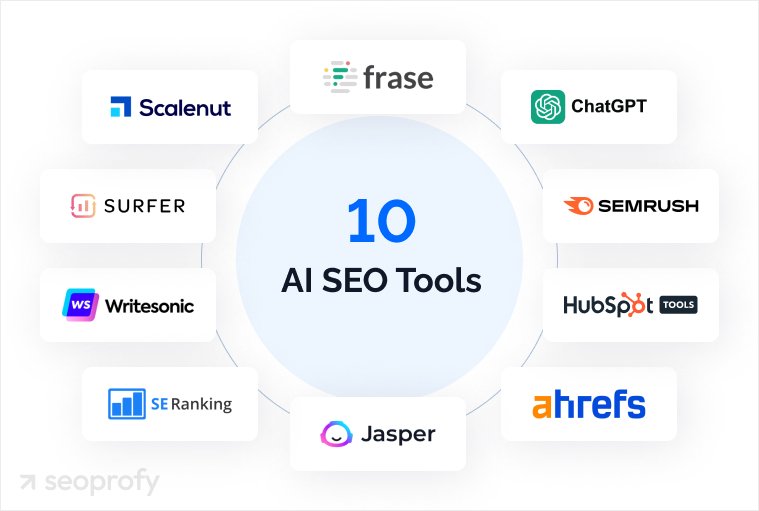
    Below are several platforms widely considered among the best AI SEO tools available today. Each one focuses on a different part of the optimization process.

    Surfer SEO

    Surfer SEO is known for its content analysis capabilities. It compares your article with top-ranking pages and recommends structural improvements.

    The tool analyzes elements such as:

    • Heading distribution
    • Keyword usage patterns
    • Content length
    • NLP phrases used by competitors

    For writers producing large volumes of SEO content, this type of analysis helps ensure each article aligns with ranking factors.

    Clearscope

    Clearscope focuses on semantic optimization. Instead of simply counting keywords, it identifies related terms that help search engines understand the topic.

    Many professional content teams prefer this approach because it improves readability while still strengthening SEO signals.

    SEMrush AI Features

    SEMrush has expanded its platform with several AI-driven features including:

    • Content topic generation
    • Keyword clustering
    • Automated site audits
    • Competitor analysis

    The platform remains one of the most comprehensive tools for agencies managing multiple websites.

    Ahrefs AI Insights

    Ahrefs is primarily known for backlink data, but its AI capabilities now assist with keyword grouping and content analysis.

    SEO professionals often combine Ahrefs with other AI SEO tools to understand both ranking opportunities and link-building strategies.

    MarketMuse

    MarketMuse is particularly useful for large websites with extensive content libraries.

    It analyzes existing articles and recommends:

    • Content updates
    • Topic expansion
    • Internal linking opportunities

    This makes it ideal for companies that want to strengthen topical authority rather than simply publish more posts.

    How Agencies Use AI SEO Tools in Real Campaigns

    Most agencies do not depend on any single platform . Instead, they build a workflow that combines several tools.

    A typical process might look like this:

    1. AI keyword research tools identify potential opportunities.
    2. Competitor analysis platforms evaluate ranking difficulty.
    3. Content optimization tools guide article structure.
    4. Technical audit tools monitor site health.

    This layered approach allows marketers to make better decisions without guessing.

    From experience, the biggest improvement usually comes from combining AI insights with human judgement. Tools identify patterns, but strategy still requires interpretation.

    Common Mistakes When Using AI SEO Tools

    While these platforms are powerful, they are not foolproof.

    One common mistake is relying entirely on automated recommendations. SEO tools often suggest similar keyword sets because they analyze the same data sources .

    Publishing identical content strategies rarely leads to strong rankings.

    Another issue is ignoring search intent. Just because a keyword has high volume does not mean it matches the audience’s needs.

    Experienced marketers treat AI tools as assistants rather than decision makers.

    Choosing the Best AI SEO Tools for Your Workflow

    Selecting the best AI SEO tools depends largely on how you plan to use them.

    Content teams often prioritize optimization platforms like Surfer or Clearscope. Technical SEO specialists lean toward tools with advanced site auditing features.

    For agencies managing multiple clients, all-in-one platforms such as SEMrush or Ahrefs usually make more sense.

    The key factor is integration. Tools that work well together reduce workflow friction and help teams move faster.

    The Future of AI in Search Engine Optimization

    AI will continue shaping SEO in the coming years, but not in the way many people expect.

    The goal is not replacing marketers. Instead, AI will likely handle repetitive analysis tasks while humans focus on strategy and storytelling.

    Search engines themselves are also becoming more AI-driven. Understanding user intent, behavior patterns, and content quality will matter far more than mechanical optimization techniques.

    Businesses that combine human expertise with AI-powered insights will likely have the strongest advantage.

    What are the best AI SEO tools for beginners?

    Some of the most widely recommended options include Surfer SEO, SEMrush, Clearscope, and Ahrefs. These platforms help with keyword research, content optimization, and technical SEO analysis.

    Do AI SEO tools replace human writers?

    No. AI tools assist with research and optimization suggestions. High-quality SEO content still requires human expertise, industry knowledge, and natural writing.

    How do AI SEO tools help with keyword research?

    They analyze search data, identify related queries, group keywords by intent, and highlight opportunities competitors may have missed.

    Can AI tools improve website rankings?

    AI tools do not directly improve rankings, but they help marketers identify optimization opportunities faster. When used correctly, they can significantly improve keyword targeting, content quality, and site structure.

    Are AI SEO tools worth the cost?

    For agencies and businesses that publish content regularly, AI SEO tools often save dozens of hours every month. The time saved on research and analysis usually justifies the subscription cost.

    What is the biggest benefit of using AI for SEO?

    The biggest advantage is speed. AI tools process massive amounts of search data quickly, allowing marketers to make informed decisions without spending hours on manual research.

  • What Are LLMs in 2026? A Complete Guide to Large Language Models, Real-World Use Cases & Business Impact

    What Are LLMs in 2026? A Complete Guide to Large Language Models, Real-World Use Cases & Business Impact

    Artificial Intelligence has evolved rapidly over the past few years, but nothing has transformed the digital ecosystem quite like Large Language Models. In 2026 businesses, marketers  developers and even enterprises across industries are leveraging LLMs in 2026 to automate communication, generate insights, improve customer experiences, and optimize search visibility.

    If you’ve been hearing terms like AI language models, Generative AI systems, and enterprise LLM solutions but still feel unclear about what they truly are, this in-depth guide will break everything down in simple, practical terms.

    This blog covers how LLMs work, why they matter, their architecture, use cases, limitations, future trends, and how businesses across Canada AI adoption trends are integrating them into daily operations.

    What Are Large Language Models?

    Large Language Models are advanced artificial intelligence systems trained on massive volumes of text data to understand, generate, and predict human-like language. These models use deep learning techniques and are built on neural network architectures capable of recognizing patterns in language at scale.

    Unlike traditional rule-based systems, modern language processing AI learns context, grammar, tone, and even intent.

    In simple terms:

    An LLM reads billions of words, learns how language works, and then predicts the next most relevant word in a sentence with remarkable accuracy.

    That prediction ability allows it to write articles, answer questions, summarize documents, translate languages, and even assist with coding.

    How Do LLMs Work?

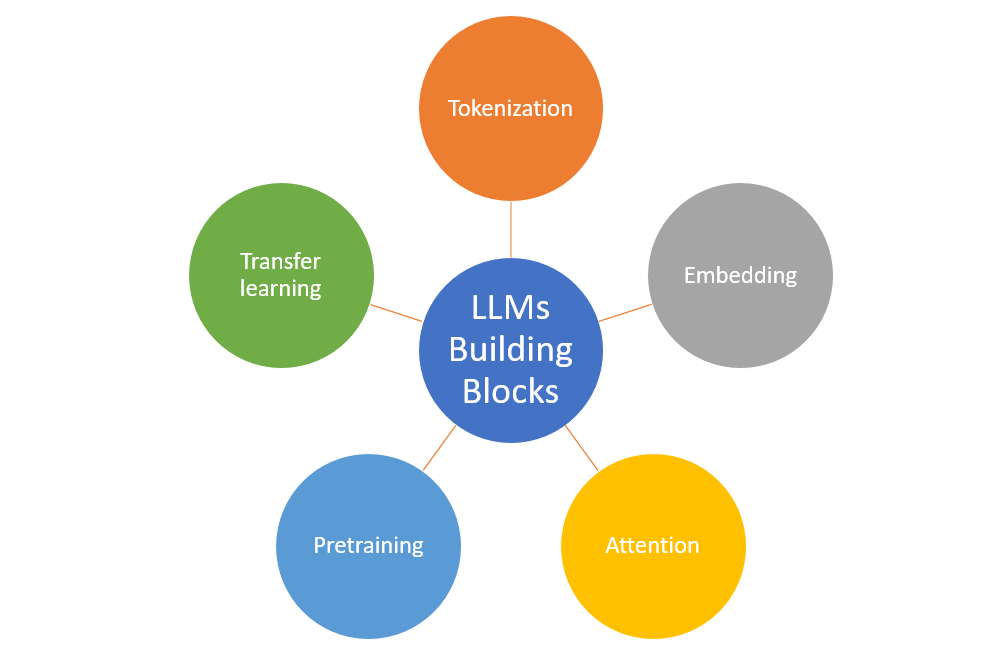
    To understand how Large Language Models work, we need to explore three core components:

    1. Transformer Architecture

    Most advanced LLMs are built using the Transformer architecture in the AI, which depends on the attention mechanisms. Instead of processing text word-by-word in sequence, transformers analyze relationships between words simultaneously.

    This allows:

    • Better contextual understanding
    • Long-form reasoning
    • Improved semantic accuracy

    2. Pretraining on Massive Data

    LLMs undergo unsupervised language model training using :

    • Books
    • Websites
    • Research papers
    • Articles
    • Code repositories

    During training, the system predicts missing words in sentences. Over time, it learns patterns, tone, and structure.

    3. Fine-Tuning & Alignment

    After pretraining, models go through AI fine tuning processes where they are optimized for specific tasks such as

    • Customer support
    • Medical documentation
    • Legal summarization
    • Marketing copy generation

    This improves safety, accuracy, and usability.

    Types of Large Language Models in 2026

    LLMs today vary based on size, specialization, and access model.

    TypeDescriptionUse Case
    General Purpose LLMsTrained on broad datasetsChatbots, writing tools
    Domain-Specific ModelsFine-tuned for industriesHealthcare, finance
    Multimodal AI ModelsUnderstand text + images + audioAdvanced assistants
    On-Premise LLM DeploymentsHosted internallyEnterprise security

    Businesses in regions like Toronto AI technology companies are increasingly investing in customized models for secure deployment.

    Key Capabilities of LLMs

    1. Natural Language Understanding

    LLMs greately excels at Natural Language Processing advancements, allowing them to :

    • Interpret user intent
    • Answer contextual questions
    • Generate meaningful responses

    2. Content Generation

    They power:

    • Blog writing
    • Ad copy
    • Email marketing
    • Technical documentation

    This is why marketing teams widely adopt AI content generation tools.

    3. Semantic Search & AEO

    With the rise of AI-driven search engines, LLMs help optimize for:

    • Answer Engine Optimization strategies
    • Featured snippets
    • Conversational search

    Companies that are adopting GEO targeted AI marketing approaches are leveraging this capability to improve visibility in specific regions without relying solely on traditional SEO.

    4. Code Assistance

    LLMs assist developers in debugging, suggesting improvements, and generating documentation through AI coding assistants.

    Real-World Applications of LLMs

    Healthcare

    Hospitals that uses an AI powered medical documentation systems to summarize patient records and reduce administrative load.

    Finance

    Banks leverage financial AI language processing to analyze risk documents and customer communications.

    E-commerce

    Retail brands use AI product description generation to scale catalog content efficiently.

    Education

    Schools and universities can integrate adaptive AI tutoring systems for their personalized learning experiences .


    Across Ontario artificial intelligence ecosystem, startups are building niche LLM-powered applications for industry-specific needs.

    Why LLMs Matter for Businesses in 2026

    Businesses are no longer asking whether to use AI — they are asking how fast can we implement it?

    Here’s  are the reason why:

    1. The Cost Efficiency

    Automation of repetitive communication reduces the overall operational costs.

    2. Personalization at Scale

    LLMs enable hyper personalized customer engagement AI, making each user interaction feel unique.

    3. Data Insights

    Through AI driven data interpretation tools, companies extract actionable insights from large datasets.

    4. Competitive Advantage

    An early adoption of the enterprise generative AI platforms provides measurable performance gains.

    Organizations exploring innovation hubs like Hamilton tech startup growth are particularly focused on scalable LLM integration.

    The Technical Backbone: LLM Architecture Explained

    This layered structure allows deep learning language networks to model complex patterns across millions of parameters.

    Challenges & Limitations of LLMs

    While Large Language Models are very powerful but they’re not flawless. Like any technology, they come with a few important limitations businesses should keep in mind:

    1. Hallucinations

    Sometimes, LLMs can produce answers that sound very confident—but are actually incorrect or partially inaccurate. This usually happens because they have predicted the language patterns rather than truly “understanding” facts.

    2. Bias

    Since these models are trained on vast amounts of internet data, they can unintentionally reflect existing biases present in that data. Without proper monitoring and fine-tuning, this can impact fairness and neutrality.

    3. Data Privacy Concerns

    For many businesses, privacy will always be the most important consideration. Before integrating LLMs into the workflows, it is important to evaluate safe deployment methods along with data handling policies and compliance requirements to protect the sensitive information .

    4. High Computational Costs

    Developing and running an advanced LLMs usually requires a very significant computing power. This can lead to higher infrastructure costs, especially for organizations deploying models at scale.
    In short, LLMs offer huge opportunities but thoughtful implementation and oversight are key to using them responsibly and effectively.

    This is why many organizations in Canada digital transformation strategy initiatives are opting for hybrid AI solutions.

    LLMs and the Future of Search (SEO, AEO & GEO)

    Search has evolved from keyword matching to intent understanding.

    LLMs are central to:

    • Conversational AI search engines
    • Voice-based search queries
    • Predictive information retrieval

    To stay competitive, brands must integrate:

    • AI powered search visibility optimization
    • Conversational query optimization methods
    • Semantic content structuring frameworks

    Businesses targeting markets like Toronto digital marketing AI services are restructuring content to answer real questions rather than just rank for phrases.

    This shift from task-based systems to multi task generative AI systems marks a fundamental evolution in computing.

    How Companies Are Implementing LLMs in 2026

    Implementation typically follows this roadmap:

    1. Define business objective
    2. Choose model type
    3. Customize with domain data
    4. Test for bias and safety
    5. Deploy via API or private server

    Organizations focusing on AI adoption in Canada and other location businesses are increasingly combining LLMs with automation platforms.

    Ethical Considerations

    Responsible AI use includes:

    • Transparent disclosures
    • Bias mitigation protocols
    • Data protection compliance
    • Human oversight

    Regulators across Canadian AI governance policies are shaping standards for responsible development.

    The Future of Large Language Models

    By the year 2026 and beyond, we will be seeing:

    • Smaller but more effective models
    • Improved reasoning abilities of the models
    • Better factual grounding
    • Multimodal expansion
    • Real-time personalization

    Emerging innovation clusters in Ontario AI innovation hubs are accelerating this growth.

    Final Thoughts

    In the year 2026 , Large Language Models are not just only  any technological innovations but they are the foundational digital infrastructure. From the marketing automation to a customer experience and even from semantic search to enterprise analytics, LLMs are now reshaping how businesses operate.

    As adoption accelerates across regions like Toronto, Ontario, Hamilton, and across Canada more broadly, companies that strategically integrate language-based AI systems will gain long-term competitive advantage.

    Understanding the mechanics, capabilities, and limitations of LLMs ensures smarter, safer, and more profitable implementation.

    The future belongs to organizations that learn how to collaborate with intelligent systems — not compete against them.

    What is a Large Language Model in simple terms?

    A Large Language Model is an artificial intelligence system trained on vast text data that can understand, generate, and respond in human-like language.

    How are LLMs different from traditional AI models?

    Traditional models perform narrow tasks, while LLMs can handle multiple language-based tasks such as writing, summarizing, translating, and answering questions.

    Are businesses in Canada using LLMs actively?

    Yes, many companies across various industries are adopting language-based AI systems to automate workflows, improve customer service, and optimize digital visibility.

    Can LLMs replace human writers?

    LLMs are helping the writers by improving the speed and structure but human creativity, strategy, and judgment remain essential for high-quality content.

    Is it expensive to implement enterprise LLM solutions?

    Costs can vary depending on the infrastructure, customization level and even the deployment method. Cloud-based APIs are generally more accessible than building models from scratch.

     What industries benefit most from LLM integration?

    Healthcare, Finance, education, marketing and e-commerce are currently seeing the highest impact from AI-driven language systems.

     How do LLMs impact SEO and search visibility?

    They shift focus toward intent-based content, structured answers, and conversational query optimization.

    Are LLMs secure for handling sensitive data?

    Security depends on deployment model. Private hosting and strict data governance frameworks are recommended for sensitive industries.