










The digital trading scene has been experiencing a digital tsunami in the past few years. By 2026, the question to the entrepreneur is not about online selling, but which partner they can trust to conduct their business with AI-armored discovery, multifaceted international logistics and hyper-personalized customer experiences.
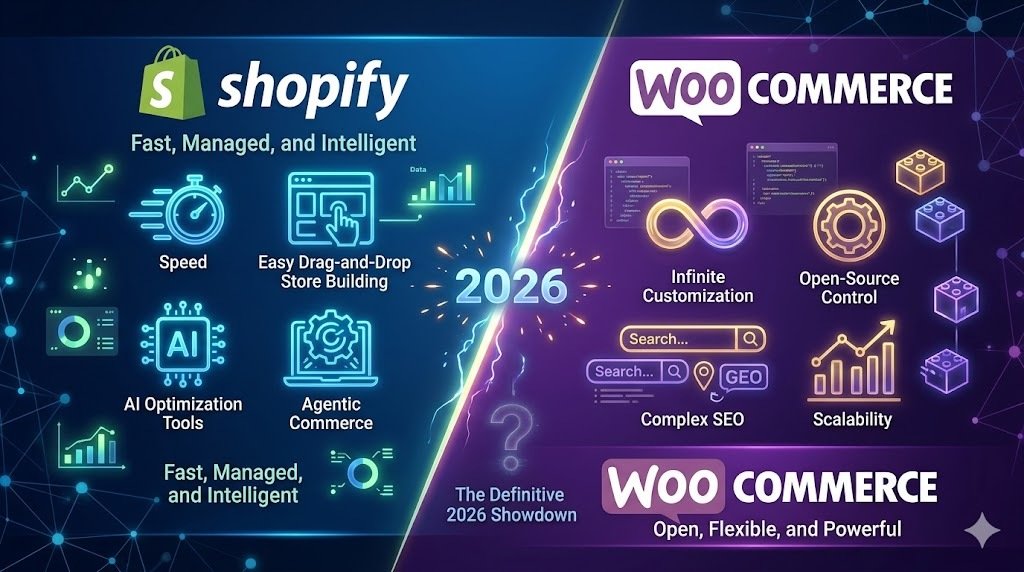
The Shopify vs WooCommerce dispute is top of mind when dealing with the heavyhitters. The two platforms have also densely changed to have advanced automation and even with agentic commerce features that were only a far-fetched dream a few years ago.
Which of them is the most suitable platform to do ecommerce in your type of business model? In this ultimate Shopify vs WooCommerce comparison, we will dissect the features, costs as well as the performance metrics that you should know so that you can make a well-informed decision this year.
Ease of Use: Speed to Market vs. Creative Control
In 2026, “time to value” is a critical metric.
Shopify remains the most easy to use option. What used its “ Sidekick 3 AI helper fully developed into a proactive co-pilot You can fire up a professional shop in hours. Shopify takes care of the hosting, security and technical maintenance so that you can focus on brand building.
WooCommerce, which is an open-source WordPress, provides a variation of freedom. Although the setup curve is steeper, in that you will need to come up with your own hosting and perform upkeep, it means unlimited creative control. WooCommerce is the best to own all the code, all the bytes of the data.
- Winner for Beginners: Shopify
- Winner for Developers: WooCommerce
Pricing and Total Cost of Ownership (TCO)

The most common question that arises in every Shopify vs WooCommerce comparison is: Which one is the cheapest? In 2026, the response to this question has become less obvious.
Shopify Costs
Shopify is based on a monthly plan. Although it consists of hosting and SSL, the prices can grow with your triumph.
- Basic: ~$39/month
- Shopify: ~$105/month
- Advanced: ~$399/month
- Hidden Cost: You pay a fee to use the payment option other than Shopify Payments (0.5% to 2%), and monthly subscription to apps.
WooCommerce Costs
This free software has no charge, and the operating cost is real.
- Hosting: between 20 and 100/month high-performance managed hosting.
- Security & Backups: Sometimes dissimilar charges (300+/year).
- Plugins: Let’s talk about the number of them; numerous apps are one-time, so in comparison with the monthly fees collected by Shopify they might be more affordable within a period of 3 years.
Also Read: How to Optimize Product Pages for Higher Conversions?
Comparison of Shopify and WooCommerce Features 2026 Tech Stack
This year, the list of features has been rewritten using Artificial Intelligence in Shopify vs WooCommerce.
Shopify’s AI Edge
Shopify has favored hard towards Agentic Commerce. Your products can be easily read and suggested by an outer AI agent and LLM supplied by their new Agentic Storefronts (such as Gemini or ChatGPT). When someone requests their AI to locate the most environment-friendly yoga mat, organized data presented by Shopify will be forward at the top of the list.
SEO/Content Dominance of WooCommerce
WooCommerce is the king of Search Engine Optimization (SEO), because it is overlaid on top of WordPress. Customer Acquisition Cost (CAC) remains the best way to reduce in 2026, but it is through content. WooCommerce can be deep and technologically optimized using deep SEO modifications and Generative Engine Optimization (GEO) that cannot be compared to Shopify because the ecosystem is closed.
Scalability and Performance

Expanding business needs infrastructure that will not collapse under the strain.
Shopify is designed in the Flash Sale age. Regardless of the number of visitors (100 or 100,000), the servers with Shopify scale automatically. You will never need to fear getting your site taken down in a Black Friday spike.
The scaling of WooCommerce is all about your hosting. In case you have a low-end shared server, your site will crawl. But WooCommerce can also support very high volume with enterprise-grade managed hosting (such as WP Engine or Kinsta), and at a significantly lower transaction rate than Shopify Plus.
Customization and Flexibility
Shopify is ideal should your business model be out of the box. It provides an edited collection of apps which are assured to interact. But, when you wish to modify the checkout process or make a very individual user interface, you might be bumping into a glass ceiling.
WooCommerce does not include such ceiling. The uncapped number of plugins (more than 60,000) and huge developer base worldwide allow you to create a multi-vendor marketplace, a sophisticated subscription site, or a customized B2B portal with no limitations to the platform.
Final Thoughts
It does not objectively exist that WooCommerce or Shopify is better than the other in the battle of the shops.
- Use Shopify in case: You prioritize speed, security and convenience of use. In case you desire a platform that simply works, and offers state-of-the-art AI technology, with you not even having to write a single line of code, then Shopify is the most suitable platform to support your ecommerce.
- Select WooCommerce when: You need complete control over your information and can tailor each aspect of your store. It is the best option when the content is intensive and when the company does not wish to fall into the SaaS trap of making subscription payments.
After all, it is up to choice which between a expensive and controlled apartment (Shopify) and a custom-built house (WooCommerce). They both can be beautiful; it only depends on how much of the heavy lifting you wish to do on your own.