
Artificial intelligence systems powered by large language models are now embedded in everyday tools—search engines, chatbots, writing assistants, and enterprise automation platforms. Yet the conversation around AI often focuses only on what these models can do, not where they struggle.
Understanding LLM limitations and hallucinations is critical for organizations that rely on AI to produce content, automate support, or analyse information. Even the most advanced models can generate incorrect facts, fabricate sources, or misinterpret context.
For companies exploring AI adoption in Toronto, this issue is more than theoretical. When a model produces inaccurate information in customer-facing environments, the consequences can affect trust, compliance, and brand credibility.
To work responsibly with AI, businesses must understand why these limitations occur and how they can be managed.
What Are LLM Hallucinations?

Before discussing limitations, it helps to understand what hallucinations actually are.
A hallucination occurs when a large language model produces information that sounds plausible but is factually incorrect or entirely fabricated. The model is not “lying.” It is simply predicting the most likely sequence of words based on its training data.
This is why hallucinated answers often appear confident and detailed. The model has learned patterns of language, not verified knowledge.
Some Common hallucination examples have been shared below :
• Fabricated academic citations
• Incorrect statistics
• Imaginary product features
• Wrong historical facts
• Misinterpreted technical explanations
These errors become especially noticeable when users rely on AI-generated content for decision-making or research.
Why Large Language Models Hallucinate
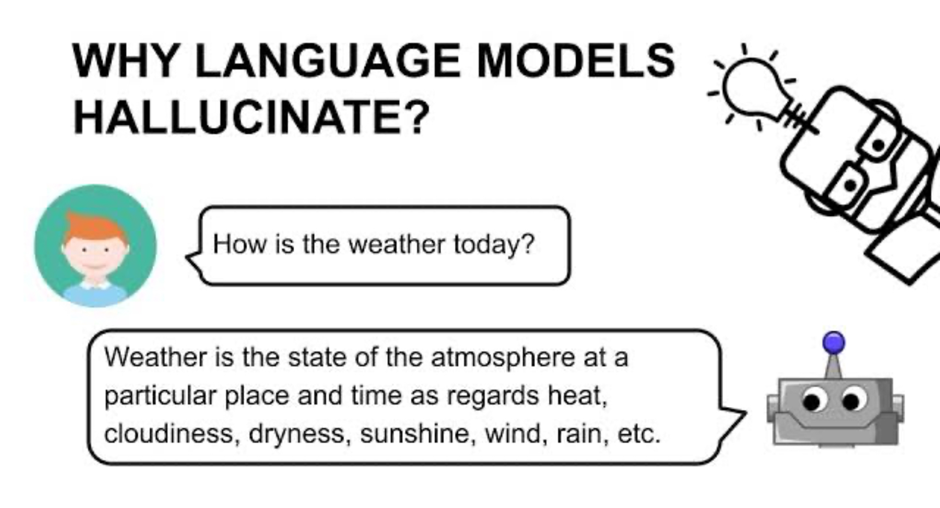
Many people assume hallucinations occur because the AI system is broken or poorly trained. In reality, hallucinations are a natural consequence of how large language models operate.
These models work by predicting the next word in a sequence. They do not “know” information in the same way a human expert does. Instead, they identify statistical relationships in enormous datasets.
Several factors contribute to hallucinations:
Predictive nature of language models
An LLM predicts likely words rather than verifying truth. If a question resembles patterns from its training data, it will generate a response—even when certainty is low.
Incomplete training data
No dataset contains every fact. When information is missing, the model fills the gap with patterns that resemble existing knowledge.
Ambiguous prompts
When a question lacks context, the model may interpret it incorrectly and generate a confident but wrong response.
Over-generalization
If a model learns a rule that works in many situations, it may apply that rule even when it should not.
For companies adopting enterprise AI solutions in Hamilton, these factors highlight why human review remains essential.
7 Real Limitations of Large Language Models
LLMs are powerful tools, but they have boundaries. Understanding those boundaries prevents unrealistic expectations.
Below are several limitations that appear consistently across AI systems.
1. Lack of Real Understanding
Despite impressive output, LLMs do not truly understand language. They recognise patterns.
This difference becomes clear when the model encounters complex reasoning or unfamiliar scenarios. The system can generate a convincing explanation while misunderstanding the underlying concept.
For businesses experimenting with AI automation in Ontario, this limitation often appears when models handle nuanced customer questions.
2. Fabricated References and Citations
Academic users frequently notice this issue first. When asked for references, a model may generate realistic-looking journal articles that do not exist.
The titles appear credible. Author names may even resemble real researchers.
However, the sources are invented.
This happens because the model has learned how citations are structured but cannot verify whether a specific paper actually exists.
3. Weakness in Numerical Accuracy
Large language models are not designed for complex mathematics or financial calculations.
While simple arithmetic often works, multi-step calculations can produce inconsistent results.
In many workflows, combining AI language models with deterministic systems such as calculators or databases produces more reliable outcomes.
4. Outdated Knowledge
Most LLMs are trained on data collected during a specific time period. Unless connected to real-time information sources, their knowledge eventually becomes outdated.
For example, policy changes, market data, or product updates may not appear in the model’s responses.
Companies using AI tools for digital marketing in Toronto sometimes notice this when the system references outdated search algorithms or platform features.
5. Sensitivity to Prompt Wording
Small changes in a prompt can produce dramatically different responses.
A vague question may generate speculation, while a structured prompt produces a clear answer.
This behaviour has led to the rise of prompt engineering, where users design prompts carefully to guide the model’s reasoning.
6. Context Window Constraints
Language models have a limit to how much information they can process at once. This is known as the context window.
When conversations become long, earlier information may drop out of memory. The model might then repeat questions or contradict previous statements.
For customer support chatbots built with AI conversational systems in Hamilton, managing context effectively becomes important.
7. Overconfidence in Uncertain Answers
One of the most challenging aspects of AI output is confidence.
LLMs often deliver responses with the same tone regardless of certainty. A guess may appear as confident as a verified fact.
Without external validation, users may assume the information is accurate.
This is why companies deploying AI knowledge assistants in Ontario frequently combine them with curated internal databases.
How Businesses Can Reduce LLM Hallucinations
Although hallucinations cannot be eliminated completely, several strategies reduce their frequency.
Organizations that integrate AI into daily operations usually adopt a layered approach.
Retrieval-augmented generation
This technique connects the language model to a verified knowledge base. Instead of relying purely on training data, the model retrieves information from trusted sources before generating a response.
Structured prompts
Clear prompts improve accuracy. Providing context, examples, or constraints helps the model stay within reliable boundaries.
Human review systems
For high-stakes outputs—legal documents, financial advice, or technical content—human validation remains essential.
Model fine-tuning
Some companies train models on proprietary datasets. This process aligns responses more closely with company-specific knowledge.
Why Understanding LLM Limitations Matters for SEO and Content
Content teams increasingly use AI to accelerate writing and research. Hallucinations can subtly introduce factual inaccuracies into published material. Search engines are becoming better at detecting unreliable content. If inaccurate information appears repeatedly, it can affect credibility signals and search visibility.
Teams producing AI-assisted SEO content in Toronto often build editorial workflows that include fact checking and subject-matter review.
Similarly, agencies offering AI content optimisation services in Hamilton focus on balancing automation with human expertise.
This hybrid model tends to produce the most reliable results.
The Future of AI Reliability
AI systems are improving rapidly. New model architectures reduce hallucination rates and improve reasoning.
Researchers are also exploring approaches such as :
• Grounded language models
• Verifiable AI systems
• Multi-agent reasoning frameworks
• Hybrid symbolic-neural models
These methods are aimed to combine the statistical language prediction with structured knowledge.
Organizations investing in AI adoption strategies in Ontario are watching these developments closely because reliability will determine how widely AI can be trusted in mission-critical applications.
Final Thoughts
Large language models represent a remarkable step forward in human-computer interaction. They write, summarize, translate, and explain complex ideas in seconds.
Yet they remain imperfect tools.
Understanding LLM limitations and hallucinations allows businesses to adopt AI responsibly rather than blindly. When combined with human oversight, structured data, and clear workflows, these systems become far more dependable.
Companies that treat AI as a collaborator—rather than an infallible authority—usually extract the most value from it.
What are LLM hallucinations?
LLM hallucinations occur when a large language model generates information that sounds convincing but is incorrect or fabricated. The model predicts language patterns rather than verifying facts.
Why do AI language models hallucinate?
Hallucinations happen because AI language models rely on statistical predictions. If the model lacks reliable information about a topic, it may generate a plausible answer instead of admitting uncertainty.
Can hallucinations in AI be prevented?
Hallucinations cannot be removed entirely, but techniques like retrieval-augmented generation, better prompts, and human review significantly reduce them.
Are LLM hallucinations dangerous for businesses?
They might be to some extent. If an AI systems provide inaccurate information in customer support, legal documentation, or financial reports, the errors may affect credibility or compliance.
How can companies use AI safely?
Businesses often combine AI language models with verified databases, internal knowledge systems, and human oversight to ensure accuracy.
About Author: