











PPC is generally considered a form of performance marketing because it delivers measurable, trackable results. While performance marketing focuses on paying for specific actions like sales or leads, PPC charges per click. However, when optimized for conversions and ROI, PPC functions as an effective performance marketing channel.
Introduction
If you’re managing digital advertising budgets, you’ve probably heard the terms PPC and performance marketing used interchangeably.
But are they really the same thing? Understanding this distinction matters more than you might think, especially when you’re trying to maximize your return on investment.
PPC, or Pay-Per-Click advertising, is a digital advertising model where you pay each time someone clicks on your ad.
Think Google Ads, Facebook ads, or LinkedIn sponsored content.
You bid on keywords or audience targeting, and when users click, you pay.
Performance marketing, on the other hand, is a broader approach where advertisers only pay when specific actions are completed.
These actions might include sales, leads, sign-ups, or downloads.
The question of whether PPC qualifies as performance marketing isn’t just academic.
It affects how you budget, measure success, and structure your digital marketing strategy.
For business owners and marketers, knowing where PPC fits helps you make smarter decisions about where to invest your advertising dollars and how to track real business results.
Is PPC Considered Performance Marketing?
The short answer is yes, but with important qualifications.
PPC is widely considered a type of performance marketing because it shares the fundamental characteristics that define the category.
Both are measurable, trackable, and focused on delivering specific outcomes that you can tie directly to your investment.
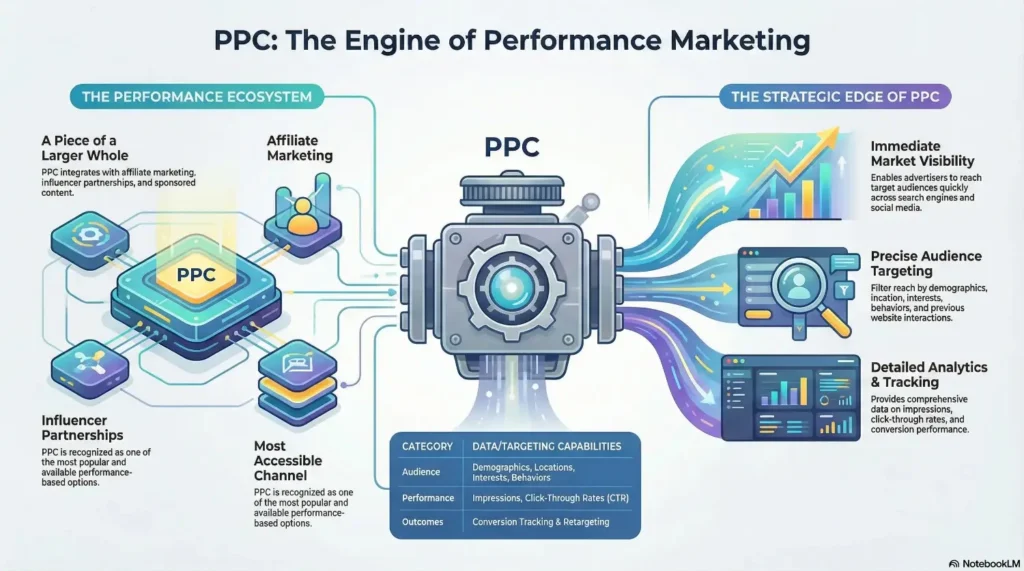
Here’s how PPC fits into the performance marketing ecosystem:
a. Part of a larger framework: Performance marketing encompasses various channels including affiliate marketing, influencer partnerships, sponsored content, and paid advertising.
PPC sits within this larger framework as one of the most popular and accessible performance channels.
b. Immediate visibility and reach: PPC gives advertisers immediate visibility on search engines and social media platforms, allowing you to reach your target audience quickly.
c. Precise targeting options: You can target specific demographics, locations, interests, behaviors, and even people who have previously visited your website.
d. Detailed analytics: PPC platforms provide comprehensive data that shows exactly what’s working, from impression counts to click-through rates to conversion tracking.
Why PPC Naturally Fits Into Performance Marketing?
PPC (Pay-Per-Click) is built on performance by design.
With PPC:
a. You pay only when someone clicks
b. Every click is tracked
c. Costs are transparent
d. Results can be optimized daily
Platforms like Google Ads, Microsoft Ads, and Meta Ads were created around measurable actions.
That’s why most businesses experience performance marketing for the first time through PPC.
Key Differences
Understanding the differences between the two concepts helps clarify their relationship.
| Aspect | PPC | Performance Marketing |
| Definition | An advertising technique in which you pay for every click on your ads. | A marketing approach where you pay for specific, measurable actions or results |
| Scope | Specific channel (search, display, social ads) | Broader strategy encompassing multiple channels |
| Payment Model | Cost per click (CPC) | Can be CPC, CPA, CPL, CPS, or revenue share |
| Primary Metric | Clicks and click-through rate | Conversions, acquisitions, sales |
| Campaign Focus | Driving traffic to websites or landing pages | Driving specific business outcomes |
| Timeframe | Often focused on immediate clicks and traffic | Can balance short-term conversions with long-term value |
Key Metrics That Make PPC Performance-Driven
Here are the key performance indicators that matter most.
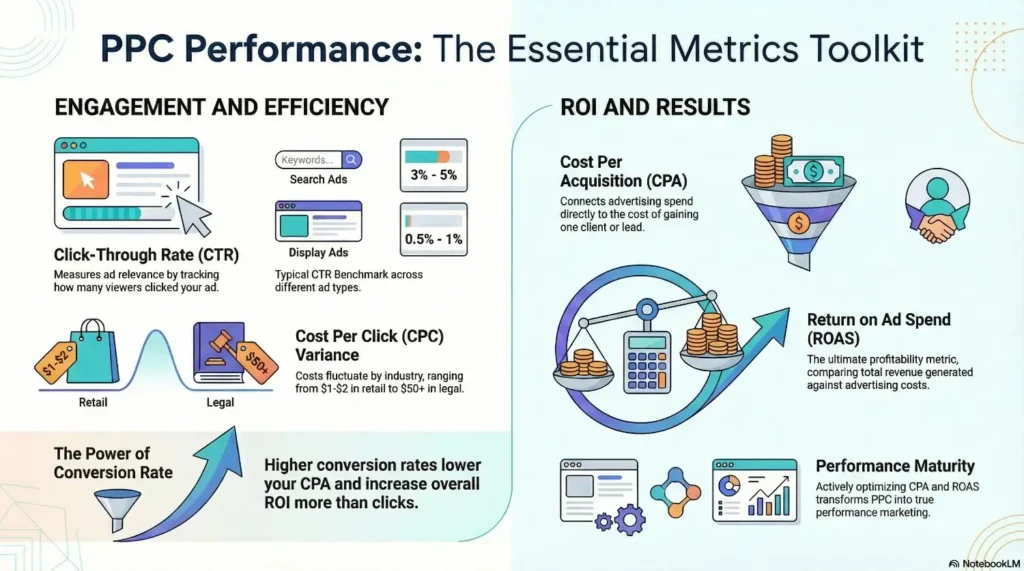
a. Click-Through Rate (CTR)
This measures how many people click your ad after seeing it. A higher CTR indicates your ad resonates with your target audience.
For search ads, a good CTR might be 3-5%, while display ads typically see lower rates around 0.5-1%.
While CTR alone doesn’t prove performance marketing success, it’s an important indicator of ad relevance and quality.
b. Cost Per Click (CPC)
This tells you exactly how much you’re paying each time someone clicks. CPC varies dramatically by industry and keyword competitiveness.
Legal services might see CPCs above $50, while retail might pay $1-2.
Understanding your CPC helps you manage budgets and identify opportunities to reduce costs while maintaining quality traffic.
c. Cost Per Acquisition (CPA)
This is where PPC truly becomes performance marketing. CPA tells you how much you pay to get a single client or lead..
If you’re spending $100 on clicks and getting 5 conversions, your CPA is $20.
This metric connects your advertising spend directly to business outcomes and helps you determine profitability.
d. Conversion Rate
This shows the percentage of clicks that turn into desired actions.
If 100 people click your ad and 5 make a purchase, you have a 5% conversion rate.
Improving conversion rate is often more impactful than getting more clicks because it lowers your CPA and increases ROI.
e. Return on Ad Spend (ROAS)
This is the ultimate performance marketing metric.ROAS compares revenue to advertising costs.
If you spend $1,000 on ads and generate $5,000 in sales, your ROAS is 5:1 or 500%.
For e-commerce and lead generation, ROAS tells you whether your campaigns are actually profitable.
When you actively track and optimize these metrics, especially CPA and ROAS, your PPC campaigns function as true performance marketing.
You’re not just buying clicks. You’re investing in measurable business results.
Conclusion
So is PPC performance marketing? The answer depends on how you use it.
PPC has all the ingredients to be an effective performance marketing channel.
It’s measurable, trackable, and can deliver clear ROI.
However, PPC only qualifies as performance marketing when you optimize for conversions and business outcomes rather than just clicks and impressions.
The most successful marketers treat PPC as part of a comprehensive performance marketing strategy.
They set up proper conversion tracking, test different approaches, analyze what drives real results, and continuously optimize based on data.
They look beyond vanity metrics like impressions and focus on what truly matters: customer acquisition costs, conversion rates, and return on investment.
If you’re looking to maximize your PPC campaigns and ensure they deliver real performance marketing results, working with experienced professionals can make all the difference.
At Adsagenz, we specialize in transforming PPC campaigns into powerful performance marketing engines.
Our team helps businesses set up sophisticated tracking, optimize for conversions, and achieve measurable ROI from every advertising dollar spent.
Whether you’re just starting with PPC or looking to improve existing campaigns, we can help you drive the results that matter most to your business.
FAQs
a. Is performance marketing and PPC the same?
No, performance marketing and PPC are not the same, though they’re closely related. Performance marketing is a broad marketing philosophy where advertisers pay based on specific measurable actions like sales, leads, or sign-ups. PPC is a specific advertising model where you pay each time someone clicks your ad. PPC can be used as part of a performance marketing strategy, but performance marketing includes many other channels beyond just paid clicks.
b. Is pay-per-click performance marketing?
Pay-per-click can definitely be considered performance marketing, especially when campaigns are optimized for conversions rather than just traffic. While traditional PPC charges you for clicks regardless of outcomes, modern PPC campaigns often use conversion tracking and optimization to function as true performance marketing.
c. What comes under performance marketing?
Performance marketing includes any marketing channel where payment is tied to measurable results. This encompasses PPC advertising, affiliate marketing, influencer partnerships with commission structures, email marketing campaigns, sponsored content with performance bonuses, native advertising, and social media advertising when optimized for conversions. It can also include SEO when tied to specific performance goals, content marketing with clear conversion metrics, and partnership marketing.
d. What type of marketing is PPC?
PPC is a form of digital advertising and paid media marketing. More specifically, it’s a direct response marketing channel that allows businesses to place ads on search engines, social media platforms, and websites, paying only when users click on those ads. PPC falls under the broader category of search engine marketing when used on platforms like Google, and social media marketing when used on platforms like Facebook or LinkedIn.