AI Programmatic SEO is no longer an experiment. It’s quietly becoming the backbone of how large websites scale traffic without increasing content teams.
A few years ago, creating 1,000 pages meant hiring writers, editors, and SEO managers. Now, with the right structure, the same output can be achieved with a lean system—if you understand how to combine automation with intent.
This isn’t about flooding Google with pages. It’s about building structured, useful content at scale that answers specific queries better than competitors.
What AI Programmatic SEO Actually Means in Practice

At its core, programmatic SEO is about generating multiple pages using a common template and a dataset.
AI simply improves the quality and efficiency of that process.
Let’s say you run a service business. Instead of creating one page for “digital marketing services,” you create hundreds of pages targeting variations like:
- service + city
- service + problem
- service + industry
AI helps you write those pages faster, but the real strength lies in the structure behind them.
Without structure, AI content becomes noise. With structure, it becomes a growth engine.
Why Businesses Are Quietly Shifting to This Model
Most businesses don’t talk openly about it, but many high-traffic websites rely heavily on programmatic pages.
Here’s why:
- Manual content do not scale beyond a particular point.
- Long-tail keywords drive consistent conversions
- Search intent is becoming more fragmented
- AI reduces production time drastically
In markets like Toronto digital marketing services, search behavior is highly localized and intent-driven. One generic page won’t cover all variations.
You need depth, not just volume.
Difference Between AI Content and Programmatic SEO
Many people confuses AI-generated content with the programmatic SEO. They’re not the same.
AI content:
- Often generic
- Lacks structure
- Doesn’t scale strategically
- Built on keyword patterns
- Uses structured templates
- Focuses on intent clusters
AI is just a tool here actually the strategy comes first. If your keyword model is weak, no AI tool will save the outcome.
Building a Programmatic SEO System That Actually Works
This is where most businesses get it wrong. They jump into tools without planning the architecture.
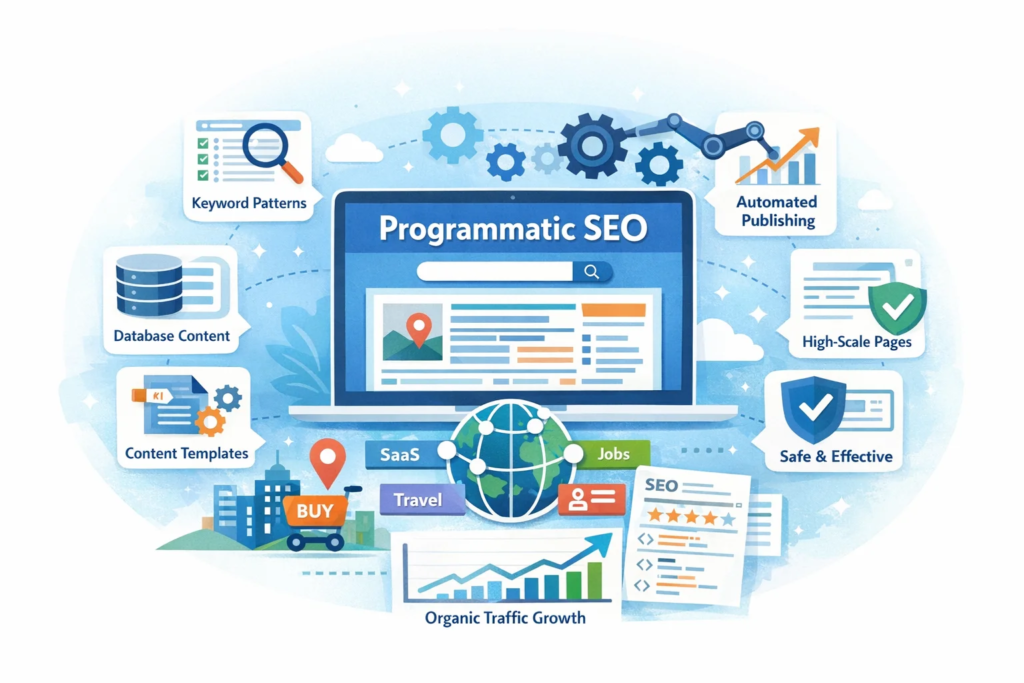
A working system usually includes:
1. Keyword Pattern Identification
Instead of targeting random keywords, you identify repeatable patterns such as:
- service + location
- product + use case
- problem + solution
For example, in Hamilton SEO services, users are often searching for very specific solutions rather than broad services.
That changes how your pages should be structured.
2. Data Layer Creation
Every programmatic system runs on data.
This could be:
- City names
- Service variations
- Industry categories
- FAQs
The quality of your dataset seems to directly affects the usefulness of your web pages. If your data is shallow, your content will be thin.
3. Template Design (The Most Underrated Step)
Templates are not just layouts. They define how value is delivered on each page.
A strong template includes:
- Contextual introduction
- Service-specific insights
- Local or use-case relevance
- FAQs based on real queries
Most failed programmatic projects usually have one issue that is the presence of thin templates
4. AI Content Layer (Used Carefully)
AI should assist, not replace thinking.
Use it for:
- Expanding structured sections
- Generating variations
- Drafting FAQs
Avoid using it blindly for entire pages. Google doesn’t penalize AI. It penalizes useless content.
5. Internal Linking System
Programmatic pages need strong internal connections.
Without links, Google treats them as isolated pages.
A proper setup:
- Links related pages together
- Connects to pillar pages
- Builds topical authority
Where Most Businesses Fail With AI Programmatic SEO
After working with multiple campaigns, a pattern becomes clear.
Failures usually come from:
- Creating pages without search intent
- Using identical content across pages
- Ignoring on-page SEO basics
- Publishing without indexing strategy
In competitive regions like Ontario SEO agency, poor execution doesn’t just fail—it can harm your domain authority.
Balancing Scale With Quality
There’s a misconception that programmatic SEO means low-quality content at scale.
That approach worked years ago , but not anymore.
What works now is :
- Moderate scale
- High relevance
- Clear intent matching
Instead of building 10,000 pages one should focus on 500 strong pages that actually answers real queries.
How AI Improves Efficiency Without Killing Quality

AI becomes powerful when used in controlled workflows.
Here’s how experienced teams use it:
- Drafting structured sections, not full articles
- Generating multiple variations quickly
- Assisting with keyword clustering
- Creating FAQ sections based on search queries
The key is editing.
Raw AI output rarely performs well. Human refinement is still essential.
Real Use Cases That Work Today
You’ll notice successful implementations in:
- Local service pages
- SaaS landing pages
- Job listing platforms
- Real estate property pages
Each of these relies on structured data + scalable templates and not just
random blog content.
Programmatic SEO and Lead Generation
This is where things get interesting. Unlike traditional blogs, programmatic pages target users closer to action.
For example:
- “SEO services for dentists in X location”
- “Best solution for [specific problem]”
These aren’t browsing queries. These are actually decision stage searches. That is why programmatic SEO often brings better conversion rates.
A Practical Approach for Agencies
If you’re running an agency, don’t try to automate everything at once.
Start small:
- Pick one service
- Identify 20–30 keyword variations
- Build a clean template
- Test performance
Once you see traction, scale gradually.
This avoids the common mistake of launching hundreds of low-performing pages.
The Future of AI Programmatic SEO
Search engines are getting better at understanding intent, not just keywords.
This changes how programmatic SEO works.
It’s no longer about:
- Exact keyword matching
- Bulk page creation
It’s about:
- Context
- Relevance
- Depth
AI will continue to evolve, but strategy will be something that will bring the difference in the result.
Final Thoughts
AI Programmatic SEO isn’t a shortcut. It’s a system.
When done right, it allows you to:
- Capture long-tail traffic
- Build topical authority
- Generate consistent leads
When done poorly, it creates hundreds of pages that never rank.
The difference is not the tool , it’s how you think about search.
What is AI Programmatic SEO in simple terms?
AI Programmatic SEO is a method of creating multiple web pages using structured data and templates, with AI helping to generate and refine content efficiently.
Does Google penalize AI-generated content?
No, Google does not penalize AI content directly. It penalizes the content that lacks value, relevance or usefulness to the users.
How many pages should I create in programmatic SEO?
Start with a small batch, usually 20 to 50 pages. Measure performance, then scale based on results rather than assumptions.
Is programmatic SEO good for local businesses?
Yes, especially for local services where users search with specific intent It helps ti target multiple location-based queries effectively.
What tools are needed for AI Programmatic SEO?
Common tools include CMS platforms, data sheets like Airtable, automation tools, and AI writing assistants for content support.
How long does it take to see results?
It typically takes a few weeks to a few months depending on competition, indexing, and content quality.
About Author: