Last day, I opened a jewellery website to shop for some of the latest jewellery collections for my friend.
I have heard that the collection on this website is very unique, and the prices are also reasonable within budget.
But you know, as soon as I typed in the website on search bar, to my surprise, the website took so long to load, I guess almost 30 secs
I thought that I might be having some internet issue on my wifi but when I switched to mobile data, the same issue continued, and this time it took almost a minute.
You know my complete experience of visiting the website was almost ruined by the slow loading speed of the website.
We don’t think much about this, but honestly speaking, website performance matters a lot.
In 2023, Google revealed that 53 percent of mobile users abandon a website if it takes longer than three seconds to load, and research from Deloitte showed that even a 0.1-second improvement in site speed can increase conversion rates by up to 8 percent.
These numbers highlight a true reality that many businesses still underestimate.
Website Performance is no longer optional or something that can be delayed.
It directly affects search visibility, user trust, and revenue potential.
Search engines and users now expect fast, stable, and responsive websites.
When website performance suffers, rankings slip, and conversions drop.
Now, let’s understand the impacts and solutions of website performance closely.
What Website Performance Really Means?
Users expect speed. Not “reasonably fast.”
If your site takes more time to load, visitors start losing trust before they even see your content.
Google and other search engines evaluate performance using a combination of technical and user-focused metrics.
The most important among them are Core Web Vitals, which measure loading speed, interactivity, and visual stability.
These metrics reflect how real users experience a website rather than how it performs in a controlled environment.
Performance also varies across devices, browsers, and network conditions.
A site that feels fast on a desktop with high-speed internet may feel slow on a mobile device using a slower connection.
That difference plays a significant role in both SEO rankings and conversion outcomes.
How Website Performance Impacts SEO?
SEO is all about how well your website appears on search engines, and to appear on search engines perfectly, your website’s performance needs to be excellent.
Google’s primary goal is to deliver the best possible results to users, and performance is a key indicator of whether a website can meet that expectation.
When a site loads quickly, responds smoothly, and remains stable, it creates a positive experience that search engines are more likely to reward with higher visibility.
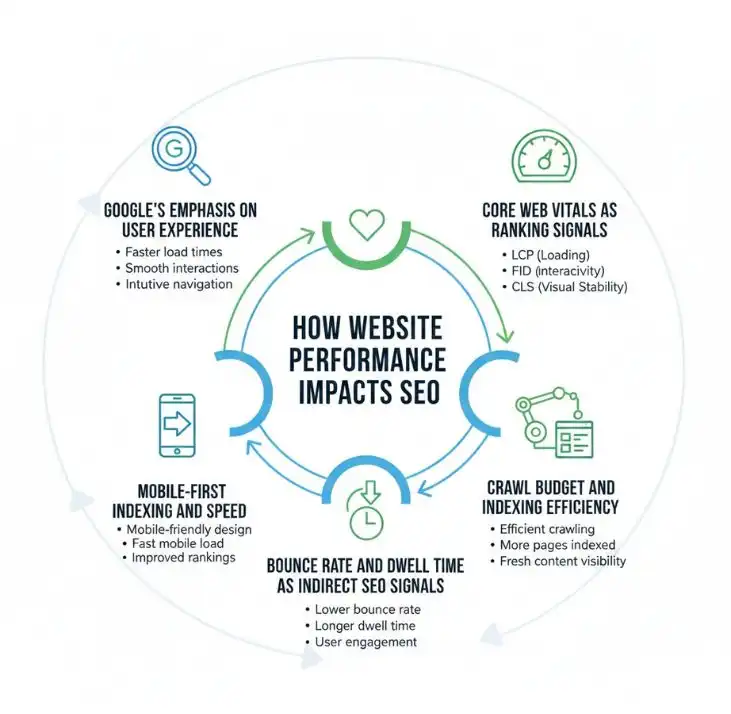
a. Google’s Emphasis on User Experience
Google has slowly shifted its ranking algorithms toward user experience.
Beyond relevant content, search engines now check how easily users can access and interact with that content.
Slow-loading pages can frustrate users and prevent them from finding information efficiently.
As a result, websites with strong performance are more likely to align with Google’s goal of delivering helpful and satisfying search results.
b. Core Web Vitals as Ranking Signals
Core Web Vitals are Google’s primary performance metrics and are officially confirmed ranking signals.
These metrics measure loading speed, interactivity, and visual stability based on real user data.
Websites that meet recommended guidelines are more likely to benefit from improved rankings, particularly in competitive search results.
While strong Core Web Vitals alone do not guarantee top positions, poor scores can hold a site back even when content quality is high.
Improving these metrics helps ensure that technical limitations do not undermine SEO efforts.
c. Crawl Budget and Indexing Efficiency
Each website is allocated a limited crawl budget by search engines.
This determines how many pages a search engine bot can crawl within a given time.
When a website’s performance is poor, crawlers spend more time loading pages, which reduces the number of URLs they can access.
Faster websites allow search engines to crawl and index content more efficiently.
d. Mobile-First Indexing and Speed
Google uses mobile-first indexing, meaning it primarily evaluates the mobile version of a website when determining rankings.
Mobile performance is therefore essential for SEO success.
Pages that load slowly or are poor on mobile devices risk losing visibility, even if the desktop experience is strong.
Mobile users often access websites on slower networks, making speed optimization even more critical.
A well-optimized mobile experience signals quality and reliability to search engines and users alike.
e. Bounce Rate and Dwell Time as Indirect SEO Signals
Although bounce rate and dwell time are not direct ranking factors, they reflect how users interact with search results.
Poor website performance often leads to higher bounce rates because users leave before engaging with the content.
Short dwell times suggest that visitors did not find the experience useful or accessible.
When users stay longer, scroll, and interact with a page, it signals satisfaction.
Strong website performance supports positive engagement patterns, which indirectly reinforce a site’s SEO strength over time.
How Website Performance Affects Conversions?
Website performance has a direct and measurable influence on conversion rates.
Every second of delay increases the chances that users will complete a desired action.
Modern users expect fast, responsive experiences, and when those expectations are not met, conversions decline regardless of how strong the offer or messaging may be.
a. Statistics on Speed vs. Conversion Rates
Multiple studies confirm the relationship between speed and conversions.
Research from Google shows that as page load time increases from one to three seconds, the probability of a bounce rises by more than 30 percent.
Portent’s analysis found that websites loading in one second convert significantly better than those loading in five seconds.
Even small improvements in website performance can lead to noticeable gains in conversion rates, making speed optimization one of the highest-impact improvements businesses can make.
b. Impact on Lead Generation Forms
Lead generation forms are highly sensitive to performance issues.
Slow-loading pages reduce trust and increase abandonment before users even reach the form.
Delays during form submission or validation often cause users to abandon the process entirely.
Strong website performance ensures that forms load quickly, respond instantly, and feel reliable, which increases completion rates and improves lead quality.
c. Impact on E-commerce Checkout Processes
E-commerce conversions depend heavily on smooth and fast checkout experiences.
Performance delays during cart loading, payment processing, or order confirmation create anxiety and frustration.
Even brief pauses can lead users to question transaction security or abandon their purchase.
d. Impact on CTA Clicks and Engagement
Calls to action rely on momentum and timing.
When a page feels slow or unresponsive, users hesitate to click buttons or engage with interactive elements.
Delayed animations or lagging responses break the flow of interaction.
Strong website performance ensures that CTAs feel immediate and responsive, which increases engagement and encourages users to take the next step.
e. Mobile Performance and Conversion Drop
Mobile users are particularly sensitive to performance issues due to smaller screens and varying network speeds.
Slow mobile experiences lead to higher abandonment rates and lower conversion potential.
Google reports that mobile users are more likely to leave a site if it takes longer than a few seconds to load.
Optimizing website performance for mobile devices helps reduce drop-offs and supports consistent conversion rates across devices.
In every stage of the user journey, website performance influences decision-making.
Faster, more responsive websites remove barriers, build trust, and create the conditions necessary for higher conversion rates.
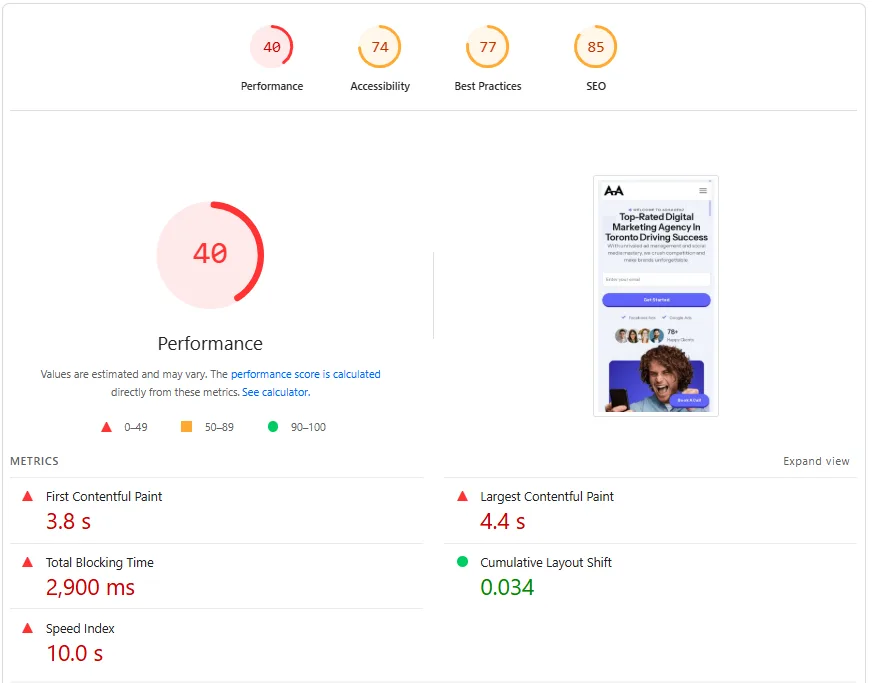
Common Website Performance Issues
Below is the list of common website performance issues that cause serious harm to seo and conversions
a. Unoptimized Images and Media
Images and media files are among the largest assets on most websites.
When they are uploaded without compressing, proper sizing, or modern formats, they start to slow down page load times.
High-resolution images displayed at smaller sizes waste bandwidth and increase loading delays.
Poorly optimized videos can also block rendering and affect overall responsiveness.
Optimizing images ensures faster delivery without compromising visual quality.
b. Excessive JavaScript and CSS
Heavy use of JavaScript and CSS can block page rendering and delay interactivity.
Large scripts, unused code, and multiple external files force browsers to process more resources before displaying content.
This results in slower load times and delayed user interactions.
Reducing file sizes, removing unused code, and prioritizing critical resources improve website performance and responsiveness.
c. Poor Hosting or Server Response Times
Server performance plays a major role in how quickly a website loads.
Slow hosting environments increase Time to First Byte, which delays every subsequent step in the loading process.
Shared hosting, outdated infrastructure, or misconfigured servers often struggle to handle traffic efficiently.
Reliable hosting and proper server optimization are foundational to strong website performance.
d. Lack of Caching or CDN Usage
Without caching, browsers and servers must repeatedly load the same resources for returning visitors.
This increases load times and unnecessary server strain.
Similarly, the absence of a content delivery network forces users to fetch assets from a single server location, which increases latency for users farther away.
Caching and CDN usage improve load speed, reduce server load, and create a more consistent experience across regions.
d. Third-Party Scripts and Plugins
Third-party scripts such as analytics tools, tracking pixels, chat widgets, and plugins often add hidden performance costs.
Each additional script increases the number of requests and processing time required to load a page.
Poorly optimized plugins can significantly slow down websites and introduce stability issues.
Regularly auditing and minimizing third-party scripts helps maintain strong website performance without sacrificing functionality.
Best Practices to Improve Website Performance
Focusing on proven best practices helps create faster, more reliable experiences that support both SEO and conversions.
a. Image Optimization and Modern Formats
Images often makes for the largest portion of page weight.
Optimizing them reduces load times without sacrificing visual quality.
This includes resizing images to the exact dimensions needed, compressing files, and using modern formats such as WebP or AVIF where supported.
Proper image optimization ensures faster rendering and improves overall website performance, especially on mobile devices and slower networks.
b. Minification and Compression
Minification removes unnecessary characters from CSS, JavaScript, and HTML files, reducing file size without affecting functionality.
Compression techniques like Gzip or Brotli further shrink file sizes before they are sent to the browser.
Together, minification and compression reduce bandwidth usage and speed up content delivery, making pages load more quickly for users.
c. Lazy Loading Strategies
Lazy loading delays the loading of images, videos, and other non-essential resources until they are needed.
Instead of loading everything at once, content appears as users scroll. This approach improves initial page load time and enhances perceived performance.
Lazy loading is especially effective for content-heavy pages and long-form websites.
d. Using CDNs and Performance-Focused Hosting
A content delivery network distributes website assets across multiple geographic locations, allowing users to load content from the server closest to them.
This reduces latency and improves load times for global audiences.
Performance-focused hosting providers also offer optimized server configurations, faster response times, and better scalability.
Together, these solutions form a strong foundation for consistent website performance.
e. Reducing Third-Party Scripts
Third-party scripts often introduce performance delays that are difficult to detect.
Each script adds network requests and processing overhead.
Auditing and removing unnecessary scripts helps reduce load times and improve stability.
For essential tools, choosing lightweight alternatives or deferring their loading can significantly improve website performance without compromising functionality.
By applying these best practices, businesses can build websites that load faster, feel smoother, and perform reliably across devices and network conditions.
Tools to Measure Website Performance
The following tools are widely used because they combine real user data, technical audits, and actionable insights.
a. Google PageSpeed Insights
Google PageSpeed Insights analyzes website performance using both lab data and real user data from the Chrome User Experience Report.
It highlights Core Web Vitals, loading speed, and optimization opportunities.
The tool is especially useful for understanding how Google evaluates website performance and where improvements can have the greatest SEO impact.
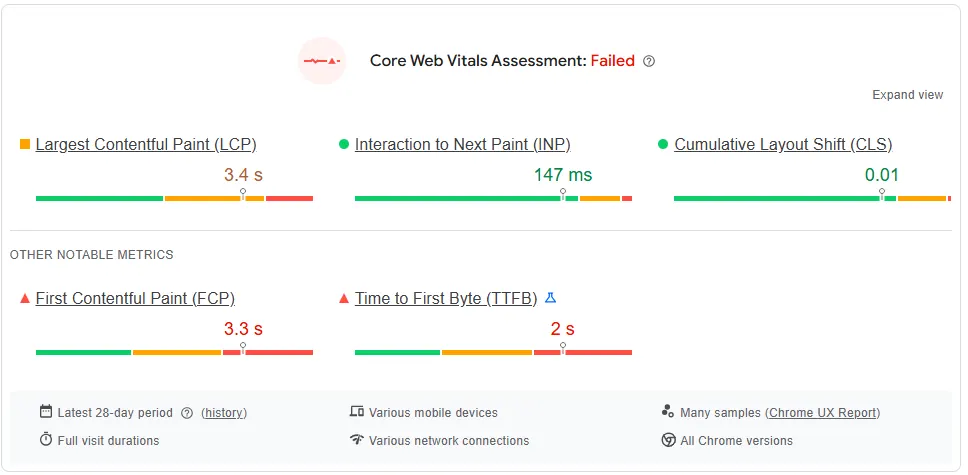
b. Lighthouse
Lighthouse is an open-source auditing tool built into Chrome DevTools.
It evaluates website performance, accessibility, SEO, and best practices in a controlled environment.
Lighthouse is valuable for diagnosing technical issues such as render-blocking resources, unused JavaScript, and inefficient image delivery that affect website performance.
c. GTmetrix
GTmetrix provides detailed performance reports that include page load time, total page size, and request counts.
It allows testing from different locations and devices, helping identify regional or mobile-specific performance issues.
GTmetrix also offers visual timelines that show how a page loads, making it easier to pinpoint bottlenecks.
d. WebPageTest
WebPageTest offers advanced testing options, including multiple browser types, network speeds, and geographic locations.
It provides granular insights into Time to First Byte, rendering milestones, and content loading sequences.
This tool is particularly useful for diagnosing complex website performance issues and testing optimization changes.
e. Google Search Console Core Web Vitals Report
Google Search Console aggregates real user performance data across your entire website.
The Core Web Vitals report groups URLs by performance status and highlights pages that need improvement.
This tool is essential for monitoring website performance trends over time and understanding how performance impacts search visibility at scale.
Regularly using these tools helps ensure that website performance remains aligned with SEO goals and user expectations.
Conclusion
Website Performance sits at the intersection of SEO, user experience, and conversions.
It influences how search engines rank pages and how users interact with them in real time.
A fast, stable, and responsive website builds trust, improves visibility, and supports sustainable growth.
Businesses that treat performance as an ongoing priority are better positioned to adapt to evolving search algorithms and user expectations.
If you are evaluating how performance fits into your broader digital strategy, teams like Adsagenz often emphasize performance-first thinking as part of long-term optimization efforts.
Taking the time to assess and improve Website Performance today can create meaningful results across search visibility and conversion outcomes tomorrow.
FAQs
1. How does website performance affect SEO?
Website performance affects user behavior and Core Web Vitals, both of which influence search rankings and visibility.
2. What is website speed optimization?
Website speed optimization involves improving load times and responsiveness through better asset management, code efficiency, and caching.
3. Which website performance metrics matter most?
Page load time, LCP, INP, and CLS are the most impactful metrics for SEO and user experience.
4. Does a faster website speed increase conversions?
Yes. Faster sites reduce friction, increase trust, and lead to higher conversion rates.
5. How often should website performance be checked?
At least quarterly, or after major updates. Ongoing monitoring helps prevent performance regressions.
About Author: