If you’ve been in business long enough, you’ve probably heard the term Search Engine Optimization (SEO) tossed around in every marketing meeting. But here’s the truth – SEO isn’t just about keywords or chasing Google’s algorithm updates. It’s about building long-term visibility, credibility, and trust online.
Whether you’re a local business trying to attract nearby customers or a growing brand competing in a crowded market, Search Engine Optimization is what helps people actually find you when it matters most.
In this complete guide, we’ll break down Search Engine Optimization for beginners in a practical, no-fluff way; covering the essentials like on-page best practices, off-page and link building, technical SEO audit checklists, Core Web Vitals, and Google’s E-E-A-T principles. By the end, you’ll not only understand what Search Engine Optimization is but also how to use it strategically to grow your business.
What Is Search Engine Optimization?
At its heart, Search Engine Optimization is about helping search engines like Google understand your website – and convincing them your content deserves to be shown first.
But more than algorithms, Search Engine Optimization is about people. It’s about understanding what your customers are searching for and how to meet those needs better than your competitors.
When done right, Search Engine Optimization turns your website into a 24/7 marketing engine that consistently brings in leads and builds brand authority.
Laying the Foundation: Keyword Research and Content Mapping
If SEO is the engine, keyword research is the fuel. The goal is to find the exact words and phrases your target audience types into search bars.
Here’s a simple process most experts use:
1. Start broad, then narrow down – use tools like Google Keyword Planner, SEMrush, or Ahrefs to find relevant search terms.
2. Analyze search intent – are people looking for information, comparison, or ready to buy?
3. Map keywords to pages – assign primary and secondary keywords to each page of your site.
This approach is called content mapping, and it ensures your website has no keyword overlap or content gaps. It’s one of the biggest secrets behind consistent organic growth.
On-Page SEO Best Practices: Building Pages That Rank
Once you’ve nailed your keywords, it’s time to optimize your actual pages.
Follow these on-page best practices to help Google (and readers) understand your content:
- Use clear, keyword-rich titles and meta descriptions.
- Structure content with H1, H2, and H3 headings for readability.
- Include keywords naturally in your first paragraph and throughout the content.
- Optimize images with descriptive alt text.
- Use internal linking to connect related pages.
- Ensure every page has a clear CTA (Call to Action).
Remember: great SEO is invisible to readers. If it feels forced or robotic, you’re doing it wrong.
Off-Page SEO and Link Building: Earning Google’s Trust
If on-page builds your foundation, off-page and link building build your reputation. Google sees links from other websites as votes of confidence – the more high-quality sites linking to you, the more authority your site gains.
Some effective link-building strategies include:
- Guest posting on relevant blogs
- Partnering with industry influencers
- Submitting to business directories
- Creating shareable content (like infographics or guides)
Avoid spammy backlinks – quality always beats quantity.
When done right, strong off-page can drastically improve your search rankings and brand credibility.
Technical SEO Audit Checklist: Keeping Your Site in Top Shape
Even the most beautiful website won’t rank if it’s technically broken. That’s where technical SEO comes in.
Here’s a technical audit checklist you should review regularly:
- Ensure your site loads fast (under 3 seconds).
- Make sure it’s mobile-friendly.
- Fix broken links and 404 errors.
- Submit an updated sitemap to Google Search Console.
- Use HTTPS for security.
- Optimize your site’s crawlability and indexation.
Think of technical SEO as the plumbing of your website – it’s hidden, but without it, nothing runs smoothly.
Technical SEO Audit Checklist Table
Purpose: To create a scannable, actionable list of technical factors to review.
| Audit Item | What to Check | Goal |
| Page Speed | Load time under 3 seconds | Improve user experience & ranking |
| Mobile-Friendly Design | Responsive layout | Ensure accessibility on all devices |
| Broken Links | Fix 404 errors | Maintain healthy site structure |
| Sitemap | Submit via Google Search Console | Improve indexing |
| HTTPS | Secure your website | Build trust and authority |
| Crawlability | Optimize robots.txt and internal linking | Help Google index pages effectively |
Core Web Vitals and Google Ranking Factors: The User Experience Connection
In recent years, Google has shifted its focus toward user experience, and that’s where Core Web Vitals come in.
These metrics – Loading Speed (LCP), Interactivity (FID), and Visual Stability (CLS) – determine how pleasant your site feels to use.
To optimize them:
- Compress large images.
- Minimize JavaScript.
- Use a reliable hosting service.
- Avoid intrusive pop-ups or shifting layouts.
A smooth, fast website isn’t just for ranking – it’s for your visitors. Google rewards sites that make life easy for users.
E-E-A-T Principles: Proving Your Site’s Credibility
Google’s E-E-A-T principles (Expertise, Experience, Authoritativeness, Trustworthiness) are now central to Search Engine success.
To build E-E-A-T:
- Showcase author credentials and experience.
- Use credible sources and cite them properly.
- Maintain consistent branding and tone.
- Encourage real customer reviews and testimonials.
- Keep your site secure (SSL certificate).

E-E-A-T signals to Google that you’re not just creating content – you’re providing value from a reliable source. And in competitive industries, that trust can be the deciding factor.
Search Engine Optimization for Beginners: A Quick Recap
If you’re just getting started, here’s what matters most:
- Focus on solid keyword research and relevant content.
- Apply on-page SEO best practices naturally.
- Build credible backlinks over time.
- Keep your site fast and technically sound.
- Prioritize user experience and E-E-A-T principles.
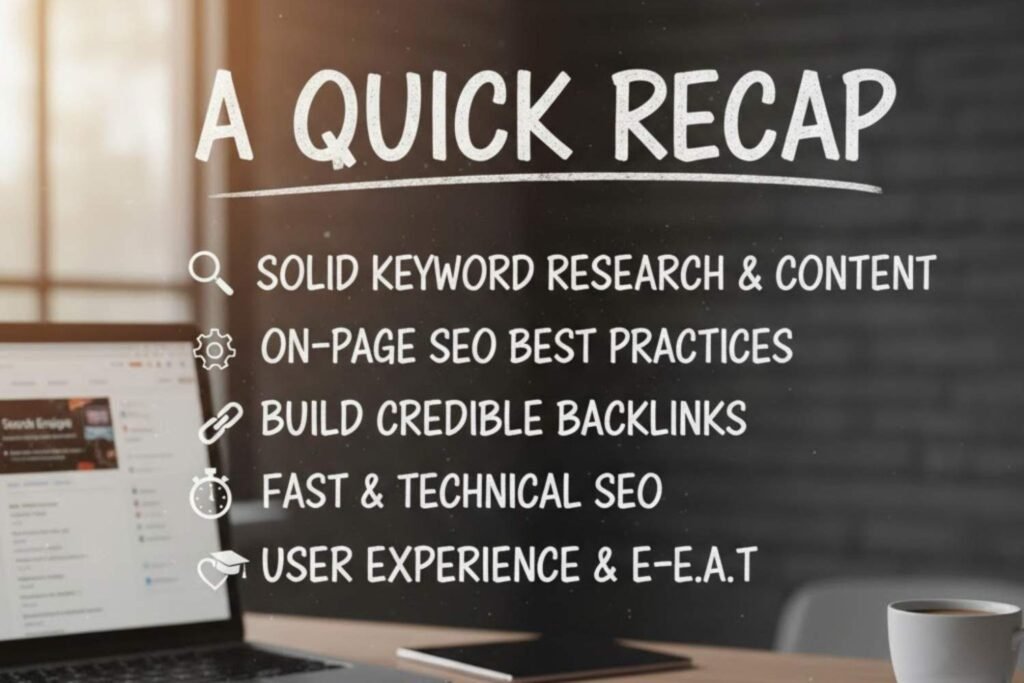
Do this consistently, and your business will not only rank higher but also attract better, more qualified customers.
Advanced Search Engine Optimization Strategies for Sustainable Growth
Once you’ve laid the foundation with keyword research, on-page optimization, and link building, it’s time to move into the advanced stage – where real business growth happens.
At this level, Search Engine Optimization becomes less about quick fixes and more about creating a system that continuously attracts, converts, and retains customers.
Let’s explore how you can move from beginner to pro by using advanced Search Engine Optimization techniques that scale with your business.
Creating Topic Clusters and Content Hubs
Gone are the days when a single blog post could rank for dozens of keywords. Today, Google values structured content ecosystems. That’s where topic clusters come in.
A topic cluster is a group of related articles centered around one main pillar page. For example:
- Pillar: “Complete Guide to Search Engine Optimization”
- Cluster posts: “On-page SEO best practices,” “Off-page SEO and link building,” “Core Web Vitals explained,” etc.
This structure helps Google understand your site’s topical authority – showing that you’re not just covering keywords but entire subjects in depth.
Use your earlier content mapping work here to organize your site into logical clusters. This is how you transform content from scattered articles into a true SEO machine.
Leveraging Analytics and Data for Smarter Decisions
Even the best strategy fails without regular measurement.
That’s why integrating tools like Google Analytics 4 (GA4) and Google Search Console is essential. They help you track:
- Which keywords are driving the most traffic
- How visitors behave on your site
- What pages have high bounce or low dwell time
Regularly analyze this data to adjust your content, improve load times, and refine your technical SEO audit checklist.
Search Engine Optimization success isn’t about guessing – it’s about learning from the numbers and adapting fast.
Automating SEO Workflows: Tools That Save You Time
Manual SEO is fine when you’re just starting out, but as your website grows, automation becomes your best friend.
Here are a few tools that streamline SEO tasks:
- SurferSEO or Frase for on-page optimization suggestions
- Ahrefs or SEMrush for keyword tracking and backlink monitoring
- Screaming Frog for technical audits
- RankMath or Yoast SEO for on-site optimization in WordPress
Use automation to handle repetitive tasks so you can focus on strategic improvements – like improving E-E-A-T or building new content clusters.
Optimizing for Core Web Vitals Continuously
We talked about Core Web Vitals – LCP, FID, and CLS. Now, let’s talk about maintaining them.
As you add new plugins, pages, or scripts, your site performance can degrade. Regularly check your metrics in Google Search Console’s “Page Experience” report and take corrective action when needed:
- Compress new images before upload.
- Defer non-critical JavaScript.
- Monitor your site’s mobile version often.
Remember, Core Web Vitals directly influence Google ranking factors. Keeping them in check means your site stays competitive long-term.
Scaling Link Building the Smart Way
By now, you probably have a few backlinks. But how do you scale it without resorting to spammy tactics?
Here’s what seasoned SEO pros do:
- Create link-worthy content – data studies, industry reports, or helpful infographics.
- Build relationships with niche bloggers and journalists.
- Repurpose content (turn blog posts into LinkedIn articles or YouTube summaries).
- Use digital PR to earn high-authority mentions naturally.
Think of off-page SEO and link building as reputation-building – not just numbers. One strong link from a trusted source often beats dozens of low-quality ones.
Aligning Search Engine Optimization with E-E-A-T and Brand Storytelling
The E-E-A-T principles (Expertise, Experience, Authoritativeness, Trustworthiness) have become the backbone of Google’s quality evaluation.
To truly master them:
- Publish content under real authors with credentials.
- Include personal experiences or data-driven insights – show real-world experience.
- Build author bio pages linking to verified profiles.
- Keep a consistent voice and ethical transparency across your content.
Your goal is to make your brand feel human and credible. When people trust your content, Google follows.
Integrating SEO and Content Marketing
Search Engine Optimization isn’t separate from content marketing – they’re two sides of the same coin.
Plan your keyword research and content mapping hand-in-hand with your editorial calendar. For instance:
- Blog topics = SEO keywords with intent.
- Videos and podcasts = repurposed SEO content.
- Social media posts = micro-content linking back to your SEO hubs.
The key is consistency. Every new piece of content should either strengthen a keyword cluster or reinforce your brand authority.
Keeping Up with Google’s Ever-Changing Algorithms
Search Engine Optimization isn’t static. Google updates its ranking systems regularly, introducing changes around Core Web Vitals, E-E-A-T, or new AI-driven models like Search Generative Experience (SGE).
To stay ahead:
- Follow reliable SEO blogs like Search Engine Journal, Ahrefs, or Backlinko.
- Revisit your SEO audit checklist quarterly.
- Keep testing – because what worked last year might not work today.
Adaptability is what separates brands that last from those that fade away.
Long-Term SEO Strategy: Building Momentum Year After Year
True SEO growth happens when your strategy compounds over time.
Here’s what a long-term approach looks like:
- Regularly update high-performing content.
- Add fresh internal links to new pages.
- Expand into new keyword clusters as your site grows.
- Maintain strong on-page SEO best practices and site health.
After 12–18 months of consistent effort, you’ll see how SEO becomes your most cost-effective marketing channel – one that keeps paying dividends long after the ads stop.
Conclusion: The Quiet Power of SEO
In the noisy world of digital marketing – filled with flashy ads, short-lived trends, and overnight “hacks” – SEO stands out as the steady, reliable force behind lasting business growth.
It takes patience, discipline, and a willingness to keep learning, but once your site earns Google’s trust, you’ll enjoy something every business dreams of – consistent, organic traffic that converts.
So, whether you’re just following your first SEO for beginners guide or conducting a full technical SEO audit, remember: every small optimization adds up. Keep refining, keep building, and let your authority grow naturally – one optimized page at a time.
Frequently Asked Questions
1. What is SEO and why is it important for business growth?
Search Engine Optimization (SEO) is the process of improving your website’s visibility on search engines like Google. It helps your business attract the right audience by ensuring your content appears when potential customers search for products or services you offer. In short, SEO builds credibility, increases organic traffic, and turns your website into a long-term lead-generating asset.
2. How do keywords influence SEO success?
Keywords are the foundation of SEO because they reflect what your target audience is searching for. By researching and mapping the right keywords to each page, you align your content with user intent. This ensures your site appears for relevant queries, avoids keyword overlap, and provides a smoother user experience, all key factors in ranking higher.
3. What’s the difference between on-page and off-page SEO?
On-page SEO focuses on optimizing your website’s internal elements like titles, headings, content, and images to make it easier for search engines to understand and rank your pages. Off-page SEO, on the other hand, involves earning credibility through backlinks, partnerships, and online mentions from other reputable sites. Together, they strengthen both visibility and trust.
4. Why is technical SEO necessary if my content is good?
Even the best content can fail to rank if your site has technical issues. Technical SEO ensures your website loads quickly, is mobile-friendly, secure, and easy for search engines to crawl and index. Think of it as the behind-the-scenes maintenance that keeps your site performing smoothly. Without it, great content may never be seen.
5. How can businesses keep up with constant Google algorithm updates?
The best way to stay ahead is to focus on fundamentals like quality content, user experience, and credibility. Regularly update your site, monitor analytics, and follow trusted SEO sources to adapt to new trends. Instead of chasing every algorithm change, prioritize E-E-A-T (Expertise, Experience, Authoritativeness, and Trustworthiness) to build long-term resilience and steady growth.
About Author: