For the past two years, AI content tools have exploded. Everyone- from bloggers to big brands- is using AI to generate articles, product descriptions, emails, and even scripts.
But one question just keeps coming up:
“Is AI generated content actually good for SEO… or does Google penalize it?”
If you’ve wondered the same, you’re not alone. The answer isn’t as simple as “AI is good” or “AI is bad.”
It depends entirely on how you use it.
In this guide, we’re breaking the topic down step-by-step so you understand the truth behind AI generated content, how Google treats it, and how you can safely use AI to improve rankings without risking penalties.
Does Google Allow AI Generated Content?
Let’s start with the truth straight from Google.
Google has repeatedly said:
- Google does NOT penalize AI generated content by default.
- It penalizes low-quality, unhelpful, spammy, or mass-produced content- whether written by humans or AI.
In other words:
AI generated content isn’t the problem. Bad content is the problem.
If you publish hundreds of bland, keyword-stuffed, low-value articles generated directly from a tool, Google will absolutely ignore or downgrade your pages.
But if you publish helpful, fact-checked, accurate, human-edited content- even if AI was involved- your content can rank perfectly well.
Google looks at E-E-A-T:
- Experience
- Expertise
- Authoritativeness
- Trustworthiness

AI doesn’t inherently provide these- but YOU can.
AI helps create structure and text, but you must provide:
- genuine insights
- real experiences
- unique opinions
- examples
- fact-checking
- accuracy
- clarity
- authority signals
When those are layered into AI generated content, the result can be extremely SEO-friendly.
Why AI Alone Cannot Guarantee Good SEO?
There’s a misconception that you can:
- generate 50 articles using AI
- paste them on your site
- and watch traffic magically grow
Unfortunately, it doesn’t work that way.
Here’s why AI-only content fails:
a. It Often Lacks First-Hand Experience
Google now prioritizes content that demonstrates real-life usage or experience.
Example:
- “I tested this product…”
- “When I tried this tool…”
- “Here’s what actually worked for me…”
AI can’t provide this. Only you can.
b. AI Repeats Known Information
AI is trained on existing data. It rarely introduces something new.
Google prefers content that brings fresh perspectives, not recycled info.
c. AI Sometimes Hallucinates
AI models can:
- invent facts
- misinterpret data
- create fake references
- misunderstand industry context
This damages trust and ranking potential.
d. AI Generates Similar Content Across the Web
If 100 creators use AI tools to write the same “Best SEO Tips” blog, the articles become clones.
Google then picks only one or two to rank- and usually NOT the pure AI ones.
How AI Can Actually Improve Your SEO (When Used Correctly)?
Here’s the fun part: AI can be a huge SEO advantage if used appropriately.
a. AI Helps Speed Up Research
AI can summarize:
- keyword data
- competitive content
- search intent
- topic gaps
- SERP patterns
This helps you create strategic content faster.
b. AI Can Build Strong Outlines
A well-structured article is half the SEO battle.
AI helps you form:
- headers
- subheadings
- topic flow
- FAQs
- content hierarchy
which makes Google’s job easier.
c. AI Helps You Scale, But Not Spam
AI lets you produce:
- cluster content
- supporting blogs
- product pages
- landing pages
…without hiring a huge team.
But ONLY if you combine AI with human editing + experience input.
d. AI Helps with Optimization
AI excels at improving:
- meta tags
- schema markup
- readability
- internal links
- keyword placement
- content refreshes
It’s like having a 24×7 SEO assistant.
What Google Rewards: AI + Human Expertise Combined
Let’s break down what actually ranks in 2025.
Google prefers content that is:
a. Helpful & Practical
Gives real value, examples, steps, or insights.
b. Written With Clear Search Intent Matching
Directly answers what the user is trying to solve.
c. Updated & Accurate
Outdated AI content will hurt you.
d. Expert-Enhanced
Your experience is the key ranking ingredient.
e. Well-Structured
Logical flow, proper headers, and clear sections.
So an ideal approach looks like this:
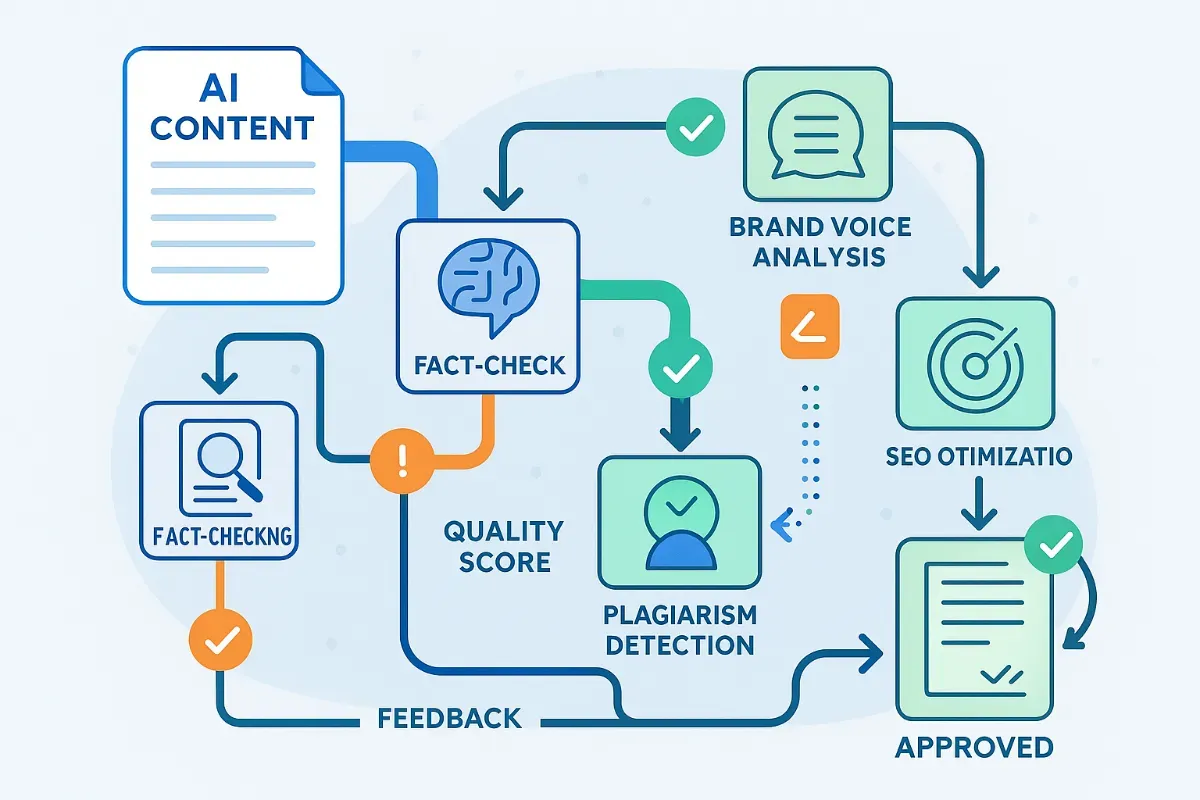
1. AI creates the draft + structure
2. You add real insights
3. You fact-check and refine
4. You optimize with SEO best practices
5. You edit for clarity and originality
This is the formula for ranking.
When AI Generated Content Can Harm SEO?
AI becomes a liability when:
a. You publish raw AI output
No editing, no facts, no expertise.
b. You mass-produce low-value posts
Quantity ≠ Quality.
c. You chase keywords without intent
Google can detect filler content easily.
d. You publish misinformation
Especially in YMYL niches (health, finance, legal).
e. You create pages with no E-E-A-T signals
Google prefers content written by people with real authority.
If any of these apply, your rankings may drop.
The Real Truth: AI Is a Tool- Not a Replacement
The best analogy?
AI is like an oven. It can bake, but YOU need to bring the recipe, ingredients, and skill.
You still need:
- strategy
- editing
- accuracy
- your voice
- your brand
- your experience
Now that we’ve covered what Google actually says about AI generated content and where most people go wrong, it’s time to get into the practical part:
How to Use AI for SEO Safely (Without Getting Penalized)?
AI is safe for SEO when you use it intelligently.
Below is a workflow used by top content teams today.
1. Start With Keyword & Intent Research (AI helps- but don’t rely only on it)
AI tools can:
- analyze keyword clusters
- summarize competing articles
- detect search intent patterns
- identify content gaps
- even suggest long-tail variations
But YOU should still confirm:
- Is the keyword relevant?
- What are people truly searching for?
- What content is already ranking?
AI is fast at collecting data, but human judgment decides if it’s meaningful.
2. Use AI to Build Content Outlines, Not Final Articles
This is where AI shines.
A strong outline ensures:
- proper hierarchy
- complete coverage
- clean flow
- correct intent match
Example outline fields AI can generate:
- H1, H2, H3
- key questions
- user pain points
- subtopics
- FAQs
Once you have it, you edit the outline, adding:
- unique insights
- personal experience
- brand tone
- missing content gaps
This is step 1 of making Google LOVE your article.
3. Use AI to Draft, But Add Human Experience in Every Section
This is mission-critical.
Google rewards:
- lived experience
- expert advice
- examples
- real use cases
- context you learned from doing
So after AI drafts a section, you add:
a. “When I tested this tool…”
b. “In my SEO audits, I often notice…”
c. “Here’s what actually worked for me…”
d. “This mistake cost me traffic once…”
e. “Most beginners miss this step…”
These are unbeatable because AI cannot replicate lived human experience.
4. Fact-Check Everything AI Writes
AI often:
- invents stats
- misquotes experts
- makes outdated claims
- mixes up data
- generalizes technical concepts
So ALWAYS search for:
- real stats
- credible sources
- updated information
- accurate explanations
This increases trust, readability, and ranking.
5. Optimize With AI, Edit With Human Logic
AI can help you:
- add internal links
- rewrite for readability
- add semantic keywords
- improve transitions
- find missing topics
- create meta descriptions
- create schema markup
But YOU should:
- check the tone
- fix awkward phrasing
- ensure the content sounds natural
- remove repetition
- improve clarity
AI gives shape. You give substance.
Writing Styles That Work Best for AI-Assisted SEO
Not all writing styles work well for AI generated content.
Here’s what works best:
1. Conversational Tone
AI can generate formal text easily- but conversational is more natural for SEO blogs.
Use:
- “you”
- “here’s why”
- “let’s break this down”
- “but here’s the twist…”
- “the truth is…”
Google sees conversational writing as more user-friendly.
2. Value-Dense Content
AI sometimes repeats itself.
Your job is to pack each section with:
- insights
- steps
- examples
- comparisons
- analogies
- practical tips
Google boosts content that gives more value per sentence.
3. Real-World Scenarios
This is where YOU stand out.
Add:
- short stories
- case studies
- personal outcomes
- client examples
- lessons you learned
Google cannot detect who wrote the content- but it CAN detect whether the writing has genuine “experience markers.”
Avoiding AI Penalties: What NOT to Do
Here’s what leads to lower rankings:
1. Don’t Publish Raw AI Output
This is a guaranteed way to produce:
- generic content
- duplicated sections
- incorrect data
- unnatural flow
Always edit.
2. Don’t Mass-Produce Thin Pages
One long, helpful article is better than ten weak, 600-word AI blogs.
Google prioritizes depth.
3. Don’t Keyword-Stuff With AI
AI can overuse keywords. Fix density manually.
Use natural variations:
- “how to rank fast”
- “SEO growth techniques”
- “optimize content for search engines”
AI is great at variety- if you direct it.
4. Don’t Ignore Search Intent
If the user wants:
- a quick answer → give it fast
- a guide → give steps
- definitions → give clarity
- product comparisons → give tables
If your content doesn’t match intent, Google won’t rank it.
AI Tools That Actually Improve SEO (2025)
Here are the best categories:
1. AI Writing Assistants
- ChatGPT
- Gemini
- Claude
- Jasper

2. AI SEO Tools
- Surfer
- NeuronWriter
- Clearscope
- RankIQ
These analyze SERPs + suggest topics + optimize content.
Read More: AI SEO Tools to Boost Rankings
3. AI Keyword Clustering Tools
- KeywordInsights
- ClusterAI
- LowFruits
Great for building topic clusters.
4. AI Analytics Tools
- Google Search Console Insights
- SEOTesting
- SearchAtlas
Helps track performance faster.
Does AI Content Rank in Real Life? (Examples)
Yes.Thousands of websites are ranking with AI generated content today.
Common examples:
a. Niche blogs
AI assists with first drafts, humans edit and add expertise.
b. Product review sites
AI helps structure comparison tables, but humans add testing insights.
c. E-commerce brands
AI helps create category descriptions, FAQs, and schema markup.
d. Local business websites
AI helps generate service pages, but humans check accuracy.
The pattern is clear:
AI + Human = Ranking
AI Alone = Weak Results
Final Verdict: Is AI Generated Content Good or Bad for SEO?
Let’s keep it brutally honest and simple.
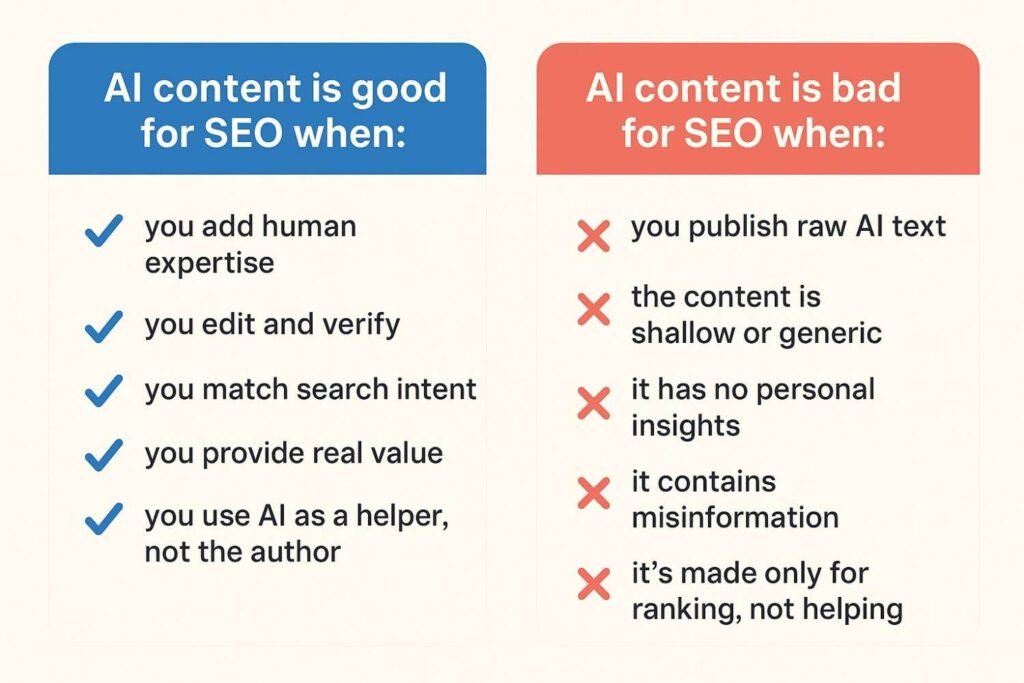
a. AI content is good for SEO when:
- you add human expertise
- you edit and verify
- you match search intent
- you provide real value
- you use AI as a helper, not the author
b. AI content is bad for SEO when:
- you publish raw AI text
- the content is shallow or generic
- it has no personal insights
- it contains misinformation
- it’s made only for ranking, not helping
So the REAL truth is:
AI generated content is not good or bad by itself. It is a neutral tool. Your approach decides the outcome.
When used properly, AI can help you:
- rank faster
- publish better content
- scale efficiently
- improve quality
- save hours of work
But human experience remains the key to standing out.
Conclusion
At the end of the day, AI generated content isn’t the enemy of SEO- it’s one of the most powerful tools we have today.
What matters isn’t whether you use AI, but how you use it.
When you combine AI’s speed, structure, and research abilities with your own experience, insights, and real-world perspective, you end up creating content that is both search-friendly and genuinely helpful.
FAQs
1. Does Google penalize AI generated content?
Google does not penalize content simply because it is created using AI. Instead, Google focuses on the overall quality, usefulness, and relevance of the content. If AI generated content is unhelpful, thin, or spammy, it can be downgraded just like low-quality human-written content. But if the content is helpful, accurate, and valuable, regardless of whether AI was involved; it can rank perfectly well.
2. Can AI-written articles rank on Google?
Yes, AI-assisted articles can rank very well on Google when they incorporate human expertise and meet quality standards. While AI can handle drafting, structuring, and research, humans must add insights, experience, clarity, and fact-checking. Content that blends AI speed with human knowledge tends to perform strongly because it delivers both depth and relevance, two things Google prioritizes.
3. Is it safe to publish AI content without editing?
Publishing raw AI content is not recommended because AI often produces generic text, outdated information, or inaccuracies. It may also lack depth, experience, and originality, all critical factors for SEO. When left unedited, AI content can weaken your site’s credibility and hurt rankings. To stay safe, always refine, verify, and personalize AI-generated drafts before publishing.
4. How can I use AI for SEO without getting penalized?
The safest way to use AI for SEO is to treat it as a supportive tool rather than the final author. Let AI handle tasks like keyword research, competitive analysis, outlines, drafts, and optimization, but ensure that you enrich the content with first-hand experience, expert insights, and fact-checked information. This balance keeps the content aligned with Google’s E-E-A-T principles and helps you avoid penalties.
5. What makes AI generated content rank better than pure AI content?
AI generated content ranks better because it combines the efficiency of AI with the authenticity of human expertise. Google rewards content that demonstrates real-world experience, practical tips, clear explanations, and unique insights, elements AI cannot generate on its own. When humans enhance AI drafts with personal perspectives, examples, and accurate information, the content becomes far more valuable and competitive in search results.