Search is not what it used to be.
Just a few years ago, ranking on Google meant squeezing keywords into your titles, building backlinks, and hoping your page landed somewhere in the top 10 results.
Today? People don’t even want “results.”
They want… answers. Direct. Clear. Instant.
They ask questions not just from Google, but from:
- ChatGPT
- Bing Copilot
- Perplexity
- Google SGE
- Voice assistants
- Smart search bars inside apps
- Auto-generated AI summaries on social media
This massive shift has given birth to a new SEO discipline that is now essential in 2026:
Answer Engine Optimization (AEO).
AEO is no longer a buzzword—it’s now the foundation of organic visibility in an AI-first world.
And in this guide, we’ll break down everything you need to know in a way that is human, simple, and genuinely useful.
What Is Answer Engine Optimization (AEO)?
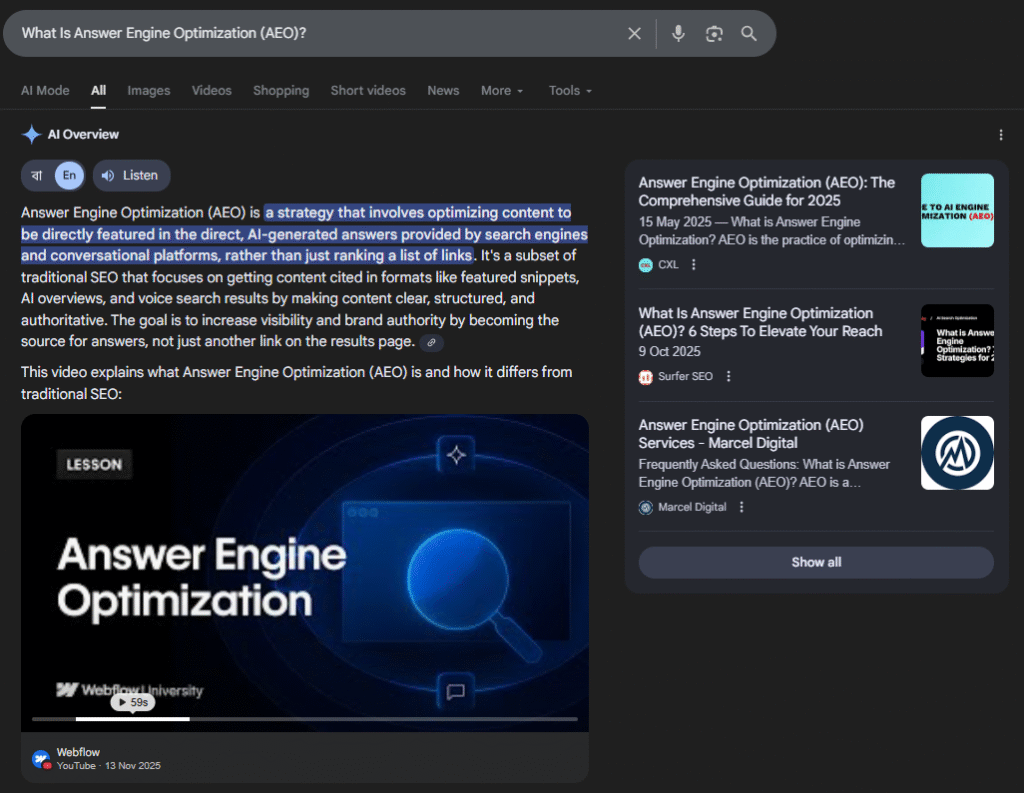
Answer Engine Optimization (AEO) is the process of optimizing your website and content so that AI search tools choose your content as the best possible answer to user questions.
Instead of optimizing only for Google’s traditional search engine, you optimize for:
- AI chatbots
- Semantic search systems
- Voice assistants
- Generative search experiences (SGE)
- Zero-click answers
- Featured snippets
- AI-powered summaries
In simple words:
SEO helps you rank. AEO helps you get selected.
It’s the difference between being one link in a list and being the answer the search tool delivers.
AEO focuses on:
- Clear, direct answers
- Strong topical authority
- Clean content structure
- Natural language
- Semantic depth
- Updated information
- Trust signals (EEAT)
So when someone asks a question like:
“What size dump trailer do I need for landscaping?”
AEO ensures that your content is what ChatGPT, Google SGE, and Bing Copilot pick to answer it.
Why AEO Matters More Than Ever in 2026?
We’re in a new era of search.
AI search tools no longer act like directories. They act like digital librarians; they read everything, understand context, and pull the best summary from the sources they trust most.
Here are the biggest reasons AEO is becoming essential:
a. AI Search Is Becoming the New Default Behavior
More and more users are turning to AI tools because:
- They want instant answers
- They don’t want to scroll
- They don’t want 20 tabs
- They trust conversational responses more
- They want “one complete answer,” not “many long options”
We’re officially entering a post-click world.
Your brand must appear in answers—not just links.
b. Google SGE Is Changing Traditional SEO Ranking
Google’s Search Generative Experience (SGE) places an AI-generated answer above the usual search results.
Sometimes, users see:
- SGE answer
- People Also Ask
- Maps
- Knowledge panels
- Video carousels
- Images
…and don’t even reach the organic results.
This means:
Even if you rank #1, you may not be seen.
But if you optimize for AEO, your content can be included inside the SGE answer, even above paid ads.
c. AI Tools Prefer Structured, Clear Content — Not Keyword Stuffing
Traditional SEO rewarded:
- Keywords
- Length
- Backlinks
- Technical optimization
AEO rewards:
- Precision
- Clarity
- Factual information
- Organized structure
- Answer depth
AI wants content that is easy to extract, easy to understand, and easy to trust.
d. Being the AI-Generated Answer Builds MASSIVE Authority
When AI says:
“According to [Your Brand]…”
…it gives you credibility that no ad or ranking can replicate.
This authority compounds over time. The more answer engines cite you, the more they trust you.
AEO vs Traditional SEO: What’s the Real Difference?
Here’s the simplest way to understand it:
- SEO wants you to rank.
- AEO wants you to be chosen.
Here’s a deeper comparison:
1. Traditional SEO
- Focuses on keywords
- Optimizes for Google’s ranking algorithm
- Long-form content often wins
- Backlinks heavily influence ranking
- User intent matters, but not as deeply
- Meta tags, alt text, speed—all important
2. Answer Engine Optimization (AEO)
- Focuses on answering real user questions
- Optimizes for AI language models
- Short, clear, direct answers win
- Clarity and structure matter more than length
- Semantic meaning > keyword density
- Strong EEAT is critical
- FAQ content performs extremely well
- Updated content wins more often
| Traditional SEO | Answer Engine Optimization (AEO) |
| Rank in Google results | Be selected as the answer |
| Keywords matter | Meaning & clarity matter |
| Long contet helps rankings | Short, direct answers win |
| Google-first | AI-first (ChatGPT, SGE, Siri, etc.) |
| Backlinks important | E-E-A-T more important |
| Meta tags & keywords | Structure, FAQs, schema |
| Slow feedback | Fast inclusion in AI answers |
How AI “Answer Engines” Actually Work?
Answer engines rely on advanced Natural Language Processing (NLP).
Instead of scanning for keywords, they scan for meaning.
Here’s what they look for:
1. Clear definitions
AI wants to pull a clean, 1–3 sentence explanation.
2. Question-based formatting
Headings that include actual questions get indexed first.
3. Lists and steps
AI extracts lists to build concise explanations.
4. Semantic relevance
AI needs content that deeply covers the topic.
5. Authority signals
Author bios, credentials, real experience, data-backed statements.
6. Freshness
AI often prioritizes updated content for accuracy.
7. Low ambiguity
AI avoids vague, confusing, overly promotional text.
If your content checks these boxes, you become a preferred source.
Also Read: Google’s AI Overview Explained
What Platforms Use Answer Engines? (More Than You Think)
AEO doesn’t just target Google.
You’re optimizing for the entire AI search ecosystem.
a. AI Chatbots
- ChatGPT
- Bing Copilot
- Perplexity
- Claude
b. Voice Search Tools
- Siri
- Alexa
- Google Assistant
c. AI-Powered Search Engines
- Google SGE
- Bing AI Search
- DuckDuckGo AI
d. Social Media AI Assistants
- Meta AI
- Snapchat MyAI
- TikTok search AI
e. E-commerce Search
Amazon and Shopify are integrating answer-style search results.
f. In-app AI systems
Banking apps, travel apps, recipe apps—everything is using AI answers.
If your brand isn’t optimized for AEO, you’re invisible across an entire ecosystem—not just Google.
How to Create AEO-Friendly Content (Core Principles)?
We’ll go deeper in Part 2, but here are the basics:
1. Start With Questions
Be the content that answers:
- What
- Why
- How
- When
- Which
- Where
AI indexes question-based headings faster.
2. Give Short, Sharp, Direct Answers First
Example:
Q: What is AEO?
AEO (Answer Engine Optimization) is the process of structuring and writing content so AI tools like Google SGE and ChatGPT can easily extract, understand, and deliver it as the best answer to user questions.
Then expand below.
This mirrors how AI structures its own responses.
3. Use Structured Formats
AI LOVES:
- Lists
- Bullet points
- Tables
- How-to steps
- Pros and cons
These are easy for AI to extract and summarize.
4. Strengthen Your EEAT
Show you are:
- Experienced
- Knowledgeable
- Authoritative
- Trustworthy
AI checks author bios, brand reputation, expertise, and consistency.
5. Use Natural Language
Write like people speak.
Not like a keyword-optimized robot.
“best dump trailer landscaping weight capacity”
is dead.
“Which dump trailer size is best for landscaping?”
is the future.
6. Update Your Content Regularly
AI hates outdated information.
Update every 60–120 days for accuracy.
7. Add FAQ Sections to Every Key Page
FAQ sections help you appear in:
- Featured snippets
- AI answer boxes
- People Also Ask
- Voice search
They are AEO gold.
8. Add Schema Markup
Especially:
- FAQ schema
- HowTo schema
- Article schema
- Product schema
Schema gives AI context, meaning, and structure—like handing it a cheat sheet.
The Real Benefits of AEO for Businesses
Let’s talk business impact—because AEO isn’t just about “being found.”
It affects trust, conversions, and brand reach.
a. Become the “Default Answer” in Your Industry
Imagine:
Someone asks ChatGPT or Google SGE:
“Best trailer dealer in Georgia?”
…and your company is included in the answer.
That’s the modern version of ranking #1.
b. Get Visibility Across Multiple Search Channels
With AEO, you appear:
- In AI chat
- In voice answers
- In search summaries
- In FAQ snippets
- In social media AI recommendations
You’re not dependent on Google ranking alone.
c. Build Brand Authority Automatically
If AI repeatedly cites your brand, it signals:
“This source is trustworthy.”
Users absorb that subconsciously.
This builds huge long-term credibility.
d. Win In a World of Zero-Click Searches
Zero-click searches are increasing because:
People get the answer immediately.
AEO helps your brand be the answer.
e. Competitive Advantage (Most Businesses Still Aren’t Doing This)
AEO is still new.
Very few businesses actively optimize for answer engines.
This means:
Brands that start in 2026 win early, easily, and massively.
Now that we’ve covered the foundations of AEO, it’s time to roll up our sleeves and talk about how to actually implement it, step by step, across different types of businesses.
We’ll dive into:
- advanced AEO techniques
- how to structure your website for answer engines
- how to write AEO-friendly content
- AEO for local SEO
- AEO for e-commerce
- tools & checklists
- examples you can follow
- and a final wrap-up
Let’s get into it.
Advanced AEO Techniques for 2026 and Beyond
Basic AEO gets you visibility.
Advanced AEO helps your site become a primary source for AI tools.
These strategies separate average websites from authoritative answer-level websites.
a. Use Semantic Clusters, Not Standalone Pages
The old way of SEO:
one keyword = one blog post.
The new way:
one topic = one cluster of interlinked articles, FAQs, definitions, guides, and supporting pages.
AI systems rely heavily on context and topic depth.
So if you want to rank as the best answer for:
“cargo trailers vs enclosed trailers”
You shouldn’t just write that one blog.
You should also have:
- What is a cargo trailer?
- Pros and cons of cargo trailers
- What is an enclosed trailer?
- Different trailer types explained
- How to choose a trailer
- Trailer sizes & uses
Together, this tells AI:
“This brand knows trailers extremely well. It is a trustworthy source.”
b. Build “Answer Blocks” in Every Major Page
An Answer Block is a 2–3 sentence, bold, direct response placed at the top of a section.
AI LOVES these.
Example:
What is Answer Engine Optimization?
AEO is the practice of structuring and writing content so AI-powered search tools—like ChatGPT, Google SGE, and voice assistants—can easily understand, extract, and present it as the best answer to a user’s question.
Then you expand below.
This is exactly how AI formats its own answers.
c. Add a “People Also Ask” Style Section to Every Blog
AI scrapes FAQs like crazy.
So, mimic the structure found in Google’s People Also Ask box:
- What is the difference between cargo and enclosed trailers?
- Are cargo trailers cheaper than enclosed trailers?
- Which trailer is better for business use?
- What should beginners buy first?
- Do you need a license to pull an enclosed trailer?
Every time you answer one of these questions, you give AI more content to pull from.
d. Use Schema Markup (Critical for AEO)
Schema is like giving AI a roadmap instead of a puzzle.
The most important types for AEO:
- FAQ schema
- HowTo schema
- Product schema
- Article schema
- Organization schema
- Breadcrumb schema
FAQ schema alone can help your site appear in:
- featured snippets
- SGE summaries
- voice assistant answers
- AI chatbot citations
This is AEO gold.
e. Keep Sentences Short & Conversational
AI prefers text written “for ears, not eyes.”
Meaning:
- short sentences
- clear structure
- everyday language
- minimal jargon
- conversational tone
If a 7th-grade student can understand it, AI can too.
f. Add Author Bios (AI Checks for EEAT)
Google and AI tools want to know who wrote the content.
Add:
- author expertise
- experience
- credentials
- industry background
- LinkedIn link
- real author photo

AI ranks content from real experts much higher.
g. Refresh Your Content Every 60–120 Days
AI hates outdated information.
Updating content helps get indexed again:
- add new stats
- fix broken links
- update examples
- rewrite weak sections
- expand FAQs
- optimize answer blocks
Every update signals freshness and relevance.
How to Write AEO-Friendly Content (Templates + Guidelines)
Here’s the exact structure AI loves:
Step 1: Start with a Question-Based Title
Example:
What Is Answer Engine Optimization (AEO)?
or
Cargo Trailers vs Enclosed Trailers: What’s the Real Difference?
Questions trigger AI indexing.
Step 2: Give a 2–3 Sentence Direct Answer at the Top
Example:
AEO (Answer Engine Optimization) is the process of structuring your content so AI search tools can understand and deliver it as the best available answer. It focuses on clarity, semantic depth, and user intent instead of keyword stuffing.
This is your “snippet magnet.”
Step 3: Expand into a More Detailed Paragraph
After the direct answer, explain the topic in simple, conversational language.
Step 4: Add Lists, Steps, Comparisons
AI LOVES structured data.
Examples:
- pros and cons
- step-by-step guides
- comparison tables
- quick definitions
- bullet lists
Step 5: Add FAQ Section
Example:
FAQs About AEO
Is AEO the same as SEO?
No—SEO helps you rank, but AEO helps your content be chosen as the direct answer.
How long does it take for AEO to work?
Usually 30–90 days depending on content quality and domain authority.
These FAQ blocks often get pulled into AI answers directly.
Step 6: Add Schema Markup to Reinforce Structure
Especially FAQ and HowTo schema.
AEO for Local Businesses (VERY Important)
Local businesses can dominate AI answers—because most industries have very weak content.
Examples:
- trailer dealerships
- salons
- restaurants
- plumbers
- consultants
- repair shops
AI needs “hyper-local answers,” such as:
- “Best trailer dealer in Atlanta”
- “Top HVAC companies in Ontario”
- “Where to buy dump trailers near me”

Conclusion: AEO Is the Future of Search
Search is no longer about links.
It’s about answers.
Businesses that adapt to AEO in 2026 will:
- appear in AI tools
- build authority
- capture zero-click searches
- stay visible in SGE
- outperform competitors still relying on 2015 SEO tactics
If SEO is visibility,
AEO is credibility + selection.
If SEO brings traffic,
AEO brings trust.
If SEO gets you seen,
AEO makes you the answer.
FAQs
1. What is Answer Engine Optimization (AEO)?
Answer Engine Optimization (AEO) is the process of optimizing your content so AI tools, voice assistants, and search engines can quickly understand and deliver your answers. Instead of ranking only on Google, AEO prepares your brand to appear as the “direct answer” on platforms like ChatGPT, Gemini, Siri, Alexa, and AI search.
2. How is AEO different from traditional SEO?
Traditional SEO focuses mainly on keyword rankings and website visibility.
AEO focuses on answer visibility — providing short, clear, structured answers that AI systems can read and deliver instantly. SEO brings traffic, while AEO brings fast, direct responses that build authority.
3. Why is AEO important in 2026?
People now use AI chatbots and voice assistants more than search engines for quick answers. If your brand doesn’t optimize for AI systems, you miss out on visibility, credibility, and leads. AEO helps your content get picked up by these new answer platforms.
4. What type of content works best for AEO?
Any content that gives clear, concise, structured answers, such as:
– FAQ pages
– How-to guides
– Step-by-step instructions
– Comparison tables
– Short definitions
– Expert Q&A blocks
– Local business information (NAP details)
This format makes it easier for AI tools to extract and deliver your answers.
5. How long does it take to see results from AEO?
AEO results can start showing in 2–6 weeks, depending on:
– Your existing website authority
– Content quality
– Consistency of publishing
– Technical setup (schema, NAP, page speed)
– Competition in your niche
Since AI systems crawl and learn quickly, clear and structured content can gain visibility much faster than traditional SEO.