











Introduction
In today’s fast-changing digital world, businesses want marketing methods that are clear, measurable, and result-driven.
This is where performance marketing for businesses has gained massive popularity.
Unlike traditional marketing, where results are often unclear, performance marketing focuses only on actions such as clicks, leads, or sales. You pay when results happen, not just for visibility.
Many business owners now ask the same question.
Is performance marketing suitable for all businesses?
When does performance marketing works best for businesses?
While performance marketing for businesses offers strong advantages, it is not a one-size-fits-all solution.
Some businesses grow fast using this approach, while others struggle to see results.
In this blog, we will explore when performance marketing for businesses is helpful, when it should be avoided, and how to decide if it fits your business goals.
The goal is to give you clear answers in simple language so you can make the right marketing decision.
Is Performance Marketing Suitable for All Businesses?
The short answer is No!
Performance marketing is powerful, but it is not suitable for every business type or stage.
Performance marketing for businesses works best when there is a clear goal, proper tracking, and a product or service that people are already searching for.
Performance marketing focuses on measurable actions.
These actions can include website visits, form submissions, app installs, phone calls, or purchases.
If your business can track these actions clearly, then performance marketing for businesses can be a strong growth tool.
However, if your business relies heavily on long-term trust, emotional branding, or offline sales, performance marketing may not give quick or consistent results.
It works best when customers can make decisions faster and when online demand already exists.
To understand this better, let us break down when performance marketing for businesses is helpful and when it is not.
When Is Performance Marketing Helpful for Businesses?
Performance marketing for businesses is most effective when certain conditions are met.
Below are the main situations where this approach works well and clearly highlights the benefits of performance marketing for growing brands.
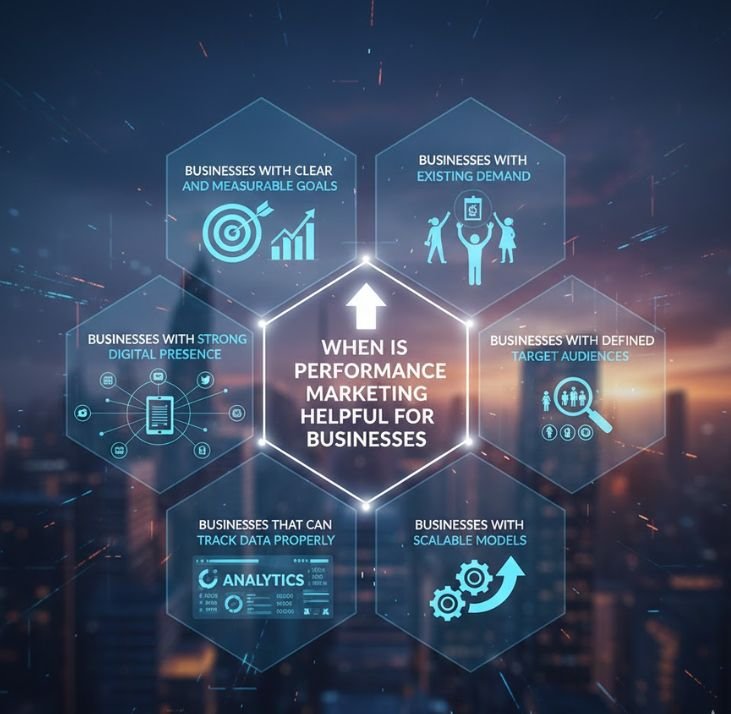
a. Businesses With Clear and Measurable Goals
Performance marketing works best when goals are specific. These goals can be lead generation, online sales, sign-ups, or bookings.
If your business knows exactly what action it wants users to take, performance marketing for businesses becomes easier to manage and optimize.
For example, an online course platform that wants student registrations can track every lead and sale.
This makes performance marketing for businesses highly effective.
b. Businesses With Existing Demand
If people are already searching for your product or service, performance marketing can capture that demand.
Search ads and social ads work well when customers are aware of the problem and are ready to act.
Industries where performance marketing for businesses works best include e-commerce, real estate, education, healthcare services, local services, and software companies.
c. Businesses With Strong Digital Presence
A well-designed website, fast loading pages, and clear calls to action are important.
Performance marketing sends traffic to your digital assets. If your website is confusing or slow, the campaign may fail even with good ads.
Performance marketing for businesses depends heavily on landing pages and conversion optimization.
d. Businesses With Defined Target Audiences
Performance marketing platforms allow precise targeting based on age, location, interests, and behavior.
Businesses that understand their audience clearly can use performance marketing for businesses to reach the right users at the right time.
e. Businesses That Can Track Data Properly
Tracking tools like Google Analytics, conversion pixels, and CRM systems play a key role.
If your business can track leads and sales accurately, performance marketing for businesses becomes more reliable and scalable.
f. Businesses With Scalable Models
Performance marketing works best when scaling is possible.
If increasing your ad budget can directly increase revenue, then performance marketing for businesses becomes a strong growth channel.
Below is a simple table that shows which business types usually benefit the most.
| Business Type | Suitability for Performance Marketing |
| E-commerce stores | Very High |
| Lead generation services | High |
| Local service providers | High |
| SaaS companies | High |
| New unknown brands | Medium |
| Luxury or niche brands | Low to Medium |
When Should Businesses Avoid Performance Marketing?
While performance marketing for businesses offers many benefits, there are situations where it may not be the right choice.
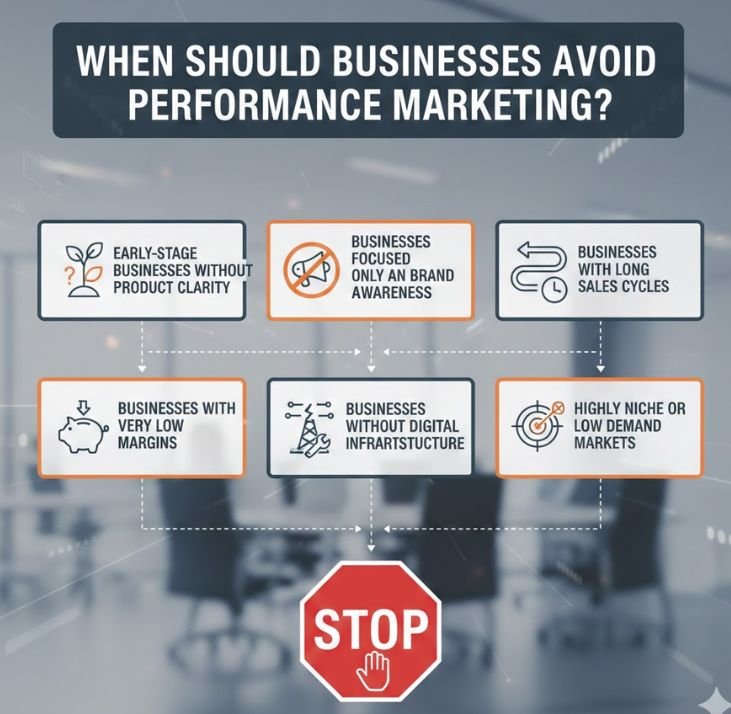
a. Early-Stage Businesses Without Product Clarity
If a business is still testing its product or pricing, performance marketing can waste money.
Ads bring traffic, but without clarity, conversions remain low. Performance marketing for businesses requires a clear offer.
b. Businesses Focused Only on Brand Awareness
If your main goal is brand building and storytelling, performance marketing may feel limiting.
Brand marketing focuses on long-term recall, while performance marketing focuses on quick actions.
Performance marketing for businesses is not ideal when success cannot be measured through direct actions.
c. Businesses With Long Sales Cycles
Some industries have long decision-making processes.
High-ticket B2B services or enterprise solutions often require months of trust-building.
Performance marketing for businesses in such cases may not show immediate returns.
d. Businesses With Very Low Margins
Performance marketing involves ad costs, testing, and optimization.
If profit margins are too low, ad spend may exceed returns.
Performance marketing for businesses needs healthy margins to stay profitable.
e. Businesses Without Digital Infrastructure
If a business does not have a website, CRM system, or tracking setup, performance marketing becomes difficult.
Running ads without proper tracking leads to poor decision-making.
f. Highly Niche or Low Demand Markets
If very few people search for your product, performance marketing may struggle.
In such cases, content marketing or partnerships may work better than performance marketing for businesses.
Conclusion
So, is performance marketing suitable for all businesses? The honest answer is no, but it is highly effective for the right businesses at the right stage.
Performance marketing for businesses works best when goals are clear, tracking is strong, and customer demand already exists.
Businesses that rush into performance marketing without preparation often feel disappointed.
But those that build a solid foundation can see predictable and scalable growth.
The key is to understand your business model, audience, and readiness before investing.
This is where expert guidance matters.
Adsagenz helps brands design and manage smart performance marketing for businesses by focusing on data, strategy, and continuous optimization.
From paid ads to conversion tracking and scaling campaigns, Adsagenz supports businesses in achieving real and measurable growth without wasting ad spend.
Also Read: The Complete Guide to Profitable Ads Management
FAQs
1. Is performance marketing expensive for small businesses?
Performance marketing for businesses can be cost-effective if managed properly. Small businesses can start with small budgets and test campaigns before scaling. The key is to focus on the right audience and track every result carefully.
2. How long does it take to see results from performance marketing?
Results from performance marketing for businesses can appear within days or weeks. However, consistent performance usually improves over time as campaigns are optimized based on data and user behavior.
3. Can performance marketing work without social media ads?
Yes, performance marketing for businesses can work through search ads, display ads, native ads, and affiliate marketing. Social media is helpful but not mandatory if other channels perform well.
4. Is performance marketing better than traditional marketing?
Performance marketing for businesses is better when measurable results are needed. Traditional marketing works well for awareness and trust-building. Many businesses succeed by using both together.
5. Do businesses need experts to manage performance marketing?
While some businesses manage it internally, expert agencies can reduce trial-and-error costs. Professional support helps performance marketing for businesses become more efficient and profitable.