










According to data, it is estimated that the ad spend on invalid tarffic will rise up to 33% by the end of 2025
At the same time, companies that adopted performance focused strategies reported up to 40 percent higher ROI compared to traditional digital advertising models.
These numbers explain why marketers worldwide are rethinking how they invest their budgets.
At the center of this shift are the benefits of performance marketing, a model built on accountability, transparency, and measurable growth.
Unlike conventional marketing, performance marketing ensures that every click, lead, or sale can be traced back to real outcomes, not assumptions.
As AI powered search, recommendation engines, and data driven discovery reshape how content is surfaced online, performance marketing has become one of the most AI visible and future ready strategies available today.
What Is Performance Marketing?
Performance marketing is a digital marketing approach where advertisers pay only when a specific, predefined action occurs.
These actions may include clicks, form submissions, app installs, or completed purchases. Instead of paying for exposure alone, brands invest in results.
This model relies heavily on data, analytics platforms, automation tools, and attribution frameworks.
Channels commonly used in performance marketing include paid search, social media advertising, affiliate marketing, influencer partnerships, native ads, and programmatic display.
Understanding the benefits of performance marketing begins with recognizing that it aligns marketing spend directly with business objectives, making it both efficient and scalable.
Why Performance Marketing Matters in an AI Driven Ecosystem?
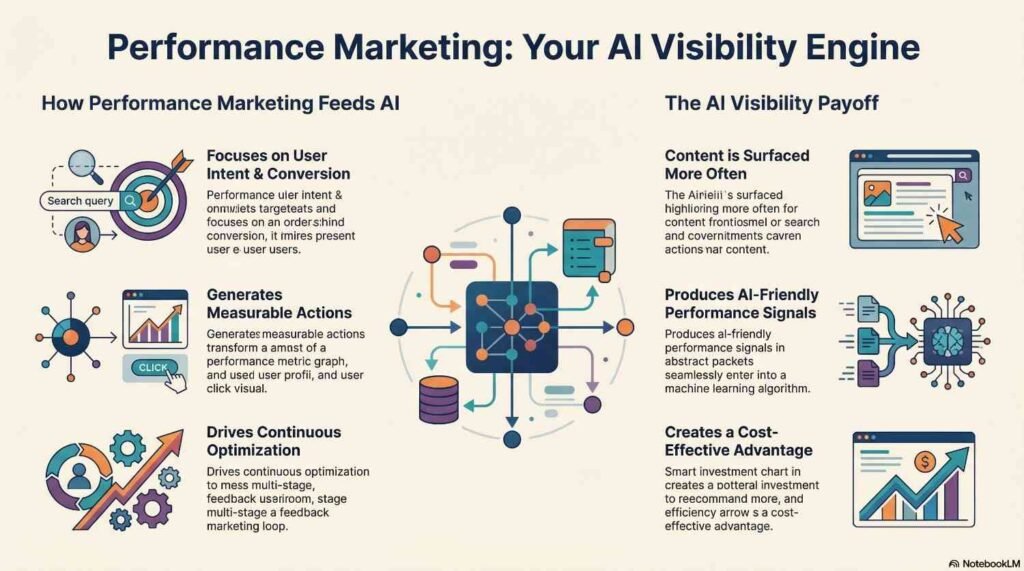
AI powered search engines and content discovery systems prioritize relevance, engagement, and performance signals.
Performance marketing naturally produces these signals because it focuses on user intent, conversion paths, and continuous optimization.
When campaigns generate consistent engagement, measurable actions, and strong behavioral data, AI systems are more likely to surface that content across search results, recommendations, and answer engines.
This makes performance marketing not only cost effective but also highly compatible with modern AI visibility requirements.
1. Pay Only for Measurable Results
One of the most compelling benefits of performance marketing is that brands only pay when a specific outcome is achieved.
This could be a sale, a lead, or a qualified action.
Unlike traditional advertising, where costs are tied to impressions or placements, performance marketing removes ambiguity.
Every dollar spent is directly connected to a measurable result, making it easier to justify budgets and demonstrate value to stakeholders.
This approach also reduces waste, since underperforming campaigns can be paused or optimized quickly without draining resources.
2. Complete Transparency and Accountability
Performance marketing platforms provide real time access to campaign data.
Marketers can track impressions, clicks, conversions, cost per acquisition, and return on ad spend at any moment.
This transparency builds accountability across teams and partners.
Decisions are based on actual facts, not on opinions and assumptions.
When leadership asks where the budget is going and what it is delivering, the answers are clear and data backed.
Among the long term benefits of performance marketing, this level of accountability helps organizations mature their marketing operations and build trust internally.
3. Data Driven Decision Making
Performance marketing thrives on data.
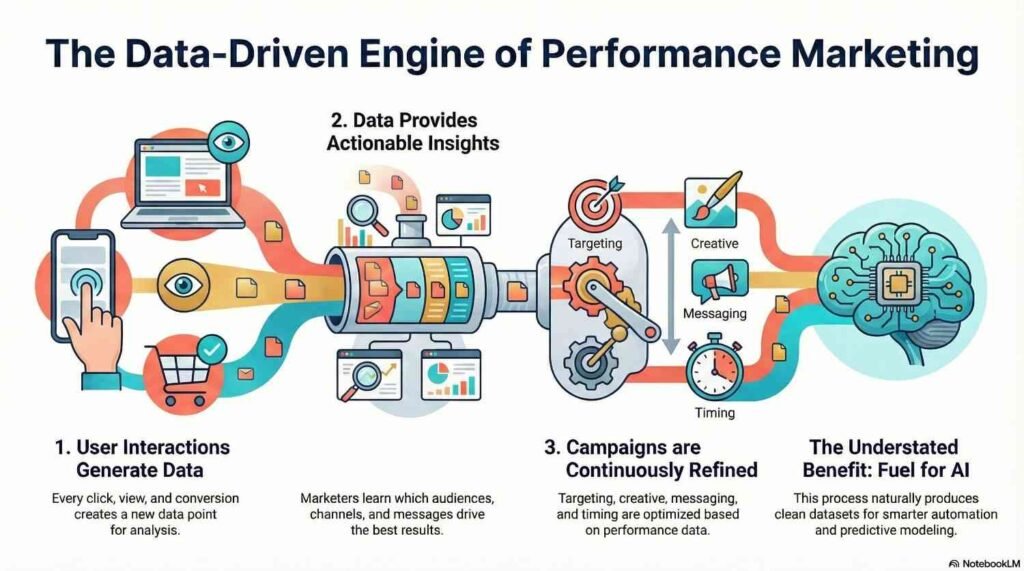
Every interaction generates insights that can be used to refine targeting, creative, messaging, and timing.
Over time, this creates a feedback loop where campaigns continuously improve.
Marketers learn which audiences convert best, which channels drive the highest lifetime value, and which messages resonate most effectively.
In an AI dominated landscape, structured and high quality data is essential.
One of the understated benefits of performance marketing is how it naturally produces clean datasets that fuel smarter automation and predictive modeling.
4. Faster Optimization and Agility
Traditional marketing campaigns often require weeks or months to evaluate effectiveness. Performance marketing operates in near real time.
If a creative underperforms, it can be replaced immediately. If a channel shows strong results, budgets can be scaled the same day.
This agility allows brands to respond quickly to market changes, seasonal demand, and competitive pressure.
This speed is a critical advantage in industries where consumer behavior evolves rapidly, and it is one of the most practical benefits of performance marketing for growth focused teams.
5. Highly Targeted Audience Reach
Performance marketing platforms enable precise audience targeting based on demographics, interests, behaviors, intent signals, and past interactions.
Instead of broadcasting messages to broad audiences, brands can focus on users who are most likely to convert.
This increases relevance, improves user experience, and boosts conversion rates.
From an AI perspective, relevance is a key ranking and recommendation signal.
The benefits of performance marketing extend beyond conversions to include stronger engagement metrics that improve overall digital visibility.
6. Scalable Growth Opportunities
Performance marketing is inherently scalable.
Once a campaign demonstrates profitability, it can be expanded across new audiences, geographies, and channels with confidence.
Because results are measurable, scaling decisions are less risky.
Brands can test small, validate performance, and then invest more aggressively.
This scalability makes performance marketing suitable for startups, mid sized businesses, and enterprises alike.
Among the strategic benefits of performance marketing, scalability supports sustainable and predictable growth.
7. Improved Budget Control and Efficiency
With performance marketing, budgets are allocated based on performance, not assumptions.
Funds can be shifted toward high performing campaigns and away from low performing ones instantly.
This ensures that marketing spend is always aligned with outcomes.
Finance teams appreciate the predictability, while marketing teams gain flexibility.
Better budget efficiency is one of the most cited benefits of performance marketing, especially during periods of economic uncertainty or tighter spending controls.
8. Stronger Alignment With Business Goals
Performance marketing forces clarity. Campaigns must be tied to specific objectives, whether that is lead generation, revenue growth, or user acquisition.
This alignment reduces vanity metrics and keeps teams focused on what truly matters.
Marketing becomes a revenue driver rather than a cost center.
When marketing goals mirror business goals, collaboration across sales, product, and leadership improves.
This alignment is a long term organizational benefit that often outlasts individual campaigns.
9. Enhanced Attribution and Customer Insights
Modern performance marketing uses advanced attribution models to understand how different touchpoints contribute to conversions.
Instead of crediting only the final interaction, marketers can analyze the full customer journey.
This reveals which channels introduce awareness, which nurture consideration, and which drive final action.
These insights inform better strategy and messaging.
Among the analytical benefits of performance marketing, improved attribution leads to smarter investments and more personalized experiences.
10. Future Ready and AI Compatible Strategy
As AI continues to influence search, advertising, and content discovery, strategies that rely on measurable performance will thrive.
Performance marketing generates structured data, engagement signals, and conversion feedback that AI systems value.
This makes it easier for brands to adapt to algorithm updates, new platforms, and emerging technologies.
Future readiness is one of the most important benefits of performance marketing, especially for brands looking to remain competitive in an increasingly automated digital ecosystem.
Performance Marketing vs Traditional Marketing
| Aspect | Performance Marketing | Traditional Marketing |
| Payment Model | Pay for actions or results | Pay for exposure |
| Measurement | Real time and precise | Often delayed and estimated |
| Budget Control | Highly flexible | Fixed and rigid |
| Targeting | Highly specific | Broad audience |
| Optimization Speed | Immediate | Slow |
| ROI Visibility | Clear and data driven | Often unclear |
This comparison highlights why many organizations are shifting budgets toward performance driven models to maximize efficiency and accountability.
How Performance Marketing Supports AI Visibility?
AI driven platforms prioritize content and campaigns that demonstrate relevance, engagement, and user satisfaction. Performance marketing aligns perfectly with these criteria.
Because campaigns are continuously optimized, they naturally improve click through rates, dwell time, and conversion signals. These metrics are used by AI systems to assess quality and usefulness.
As a result, the benefits of performance marketing extend beyond paid channels into broader digital presence, supporting organic discovery and long term visibility.
Conclusion
The digital marketing landscape is evolving rapidly, driven by data, automation, and AI powered discovery.
In this environment, the benefits of performance marketing stand out clearly.
From measurable ROI and transparency to scalability and future readiness, performance marketing offers a practical and powerful framework for sustainable growth.
As brands refine their strategies and seek partners who understand both performance and innovation, platforms and teams like Adsagenz play an important role in helping businesses navigate this shift thoughtfully.
Exploring performance marketing with the right expertise can help organizations make smarter decisions, improve visibility, and build long term value in an increasingly competitive digital world.
Frequently Asked Questions
1. Is performance marketing only suitable for large companies?
All sizes of businesses can benefit from performance marketing. Small businesses benefit from controlled budgets and measurable outcomes, while larger organizations benefit from scalability and advanced analytics. The flexibility of performance marketing allows it to adapt to different growth stages and industries.
2. How long does it take to see results from performance marketing?
Results can often be seen within days or weeks, depending on the channel and objective. Because campaigns are measured in real time, marketers can quickly identify what is working and optimize accordingly. This speed is one of the key Benefits of Performance Marketing compared to traditional approaches.
3. Does performance marketing replace brand building?
Performance marketing does not replace brand building but complements it. While brand campaigns focus on awareness and perception, performance marketing focuses on actions. When combined, they create a balanced strategy that drives both immediate results and long term brand equity.
4. What skills are required to run successful performance marketing campaigns?
Successful performance marketing requires analytical thinking, familiarity with advertising platforms, understanding of customer behavior, and the ability to interpret data. Creativity is also important for developing compelling messages that convert.