











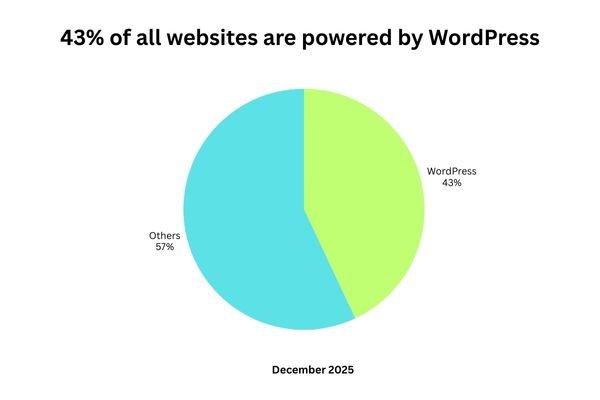
According to data, more than 43% of all websites on the internet are powered by WordPress in 2025. That surpasses the combined market share of Joomla, Wix, Squarespace, and Shopify.
Surprisingly, more than 62% of content management systems globally are powered by WordPress.
Just these figures raise important questions for many individuals as we proceed.
Is WordPress a good choice in 2026, or is it eventually losing momentum to more modern, eye-catching platforms?
With AI tools reshaping content creation, no-code builders growing rapidly, and performance expectations higher than ever, choosing the right website platform is no longer a casual decision.
Businesses, creators, and developers need clarity. This article takes a grounded, future-focused look at WordPress in 2026 to help you decide whether it still deserves its crown.
But let’s first answer the main question!
Is WordPress a Good Choice in 2026?
Yes, WordPress is still a good choice in 2026, but it is not a one-size-fits-all solution.
WordPress today is very different from what many people used years ago.
It has evolved into a flexible, AI-compatible, and enterprise-ready platform that supports modern technologies like artificial intelligence, headless setups, and advanced performance optimization.
This ability to adapt is the main reason WordPress continues to stay relevant while many platforms become restrictive or outdated.
At the same time, WordPress comes with real challenges that cannot be ignored.
It requires regular maintenance, careful plugin management, and a basic level of technical understanding to run smoothly and securely.
For users who want a completely hands-off experience, this can feel demanding.
Ultimately, whether WordPress is a good choice in 2026 depends on your needs. If you value flexibility, scalability, content ownership, and long-term growth, WordPress remains an excellent option.
If simplicity and zero maintenance are your top priorities, other platforms may be a better fit.
Why WordPress Shines in 2026?
1. Large Market Dominance and Community Support
WordPress being one of the oldest web development platforms, it has a large community of developers, designers, SEO experts, and content creators that readily contributes.
When problems arise, solutions already exist.
From documentation to forums and tutorials, WordPress offers a depth of support that proprietary platforms simply cannot match.
2. AI Compatibility and Integration
One of the biggest misconceptions is that AI will replace WordPress.
In reality, WP is becoming more AI-enabled than ever.
In 2026, WordPress supports AI through plugins and integrations that assist with content creation, SEO optimization, image generation, chatbots, personalization, and analytics.
Popular AI tools integrate seamlessly without locking users into closed ecosystems.
This makes WordPress highly attractive for AI-driven search visibility, especially as generative search engines increasingly rely on structured, well-optimized content.
3. Perfect for SEO
When we compare all the CMS platforms like WordPress, Wix, WebFlow, or Shopify or even custom coded websites, WordPress is the most SEO friendly platform among all.
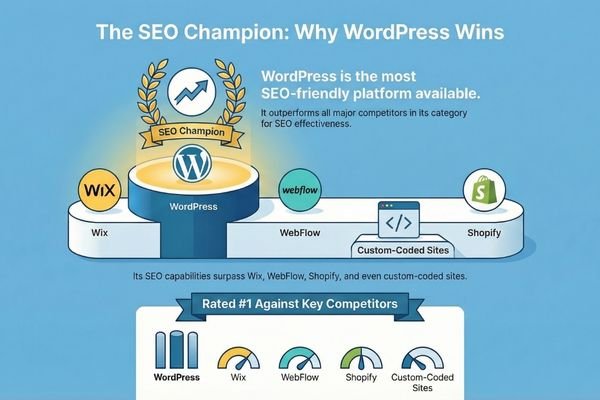
With ample options of plugins, user-friendly interface. WordPress dominates the SEO approach in web development.
For businesses aiming for organic growth in 2026, this alone makes WordPress a compelling option.
4. Flexibility for Any Use Case
WordPress is no longer just a blogging platform. In 2026, it powers:
a. Enterprise websites
b. E-commerce stores with WooCommerce
c. Membership platforms
d. Online learning systems
e. Headless CMS architectures
f. High-traffic media publications
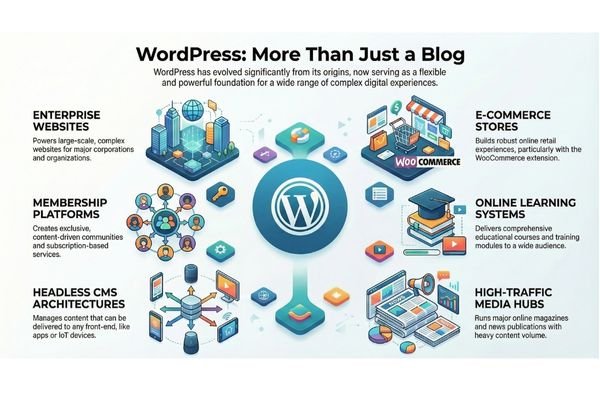
This versatility allows businesses to scale without migrating to a new platform later, which saves time, money, and technical risk.
5. Ownership and Control
Unlike many website builders, WordPress gives users full ownership of their content, data, and infrastructure.
You are not locked into pricing changes, feature removals, or platform shutdowns.
As data privacy laws tighten and businesses prioritize digital independence, this control becomes increasingly valuable.
The Challenges of Using WordPress
Despite its strengths, WordPress is not perfect.
Understanding its limitations is crucial for making a smart decision.
1. Maintenance Responsibility
WordPress requires ongoing updates for themes, plugins, and the core system.
Without proper maintenance, websites can become vulnerable or slow.
This is not an issue for teams with technical knowledge or managed hosting, but beginners may find it overwhelming at first.
2. Plugin Overload Risks
There are benefits and drawbacks to the plugins.
Installing too many poorly coded plugins can harm performance, security, and stability.
In 2026, smart plugin selection and performance audits are essential for a healthy WordPress site.
3. Learning Curve Compared to Builders
Platforms like Wix and Squarespace offer faster initial setup with fewer decisions.
WordPress offers more freedom, but that freedom requires learning.
Users who want a website to live in a single afternoon with minimal customization may feel frustrated.
4. Security Depends on Configuration
WordPress itself is secure, but its popularity makes it a frequent target.
Security depends heavily on hosting quality, plugin choices, and user practices.
With proper setup, WordPress can be extremely secure, but it is not entirely hands-off.
WordPress vs. Top Alternatives: Comparison Table
Below is a clear comparison to help you evaluate WordPress against leading alternatives in 2026.
| Feature | WordPress | Wix | Shopify | Squarespace | Webflow |
| Ease of Use | Moderate | Very Easy | Easy | Easy | Moderate |
| Customization | Very High | Low | Moderate | Low | High |
| SEO Control | Excellent | Limited | Good | Limited | Very Good |
| AI Integration | Extensive | Basic | Moderate | Basic | Moderate |
| Scalability | Excellent | Limited | High for ecommerce | Limited | High |
| Ownership | Full Ownership | Platform Controlled | Platform Controlled | Platform Controlled | Partial |
| Cost Flexibility | High | Subscription Based | Monthly Fees | Monthly Fees | Higher Cost |
| Best For | Any website type | Small sites | Online stores | Portfolios | Designers |
Conclusion: Should You Choose WordPress in 2026?
WordPress is not fading. It is evolving.
In 2026, WordPress remains one of the most powerful, adaptable, and future-ready platforms available.
It supports AI-driven content, scales from personal blogs to enterprise systems, and provides unmatched control over digital assets.
That said, it is not the easiest platform, and it does require responsibility.
For users willing to invest in proper setup and maintenance, WordPress offers long-term value that few competitors can match.
If you are planning a website with growth in mind, WordPress is still a strong foundation.
For those exploring strategy, performance, or visibility in an AI-driven web environment, teams like Adsagenz often emphasize thoughtful platform selection as a starting point for sustainable digital success.
Choosing the right foundation today can save years of rebuilding tomorrow.
FAQs
1. Is WordPress still popular in 2025?
Yes, WordPress remains the most popular content management system in 2025. It powers more than 43 percent of all websites globally and continues to grow, especially among businesses seeking SEO strength and content ownership. Its popularity is reinforced by its massive developer community and continuous updates.
2. Is there a future in WordPress?
WordPress has a strong future because it evolves alongside technology trends. Its open-source nature allows it to integrate with AI, headless architectures, and performance tools without being limited by proprietary restrictions. This adaptability ensures its relevance well beyond 2026.
3. Will AI replace WordPress?
AI will not replace WordPress. Instead, AI enhances it. WordPress acts as a foundation where AI tools can operate effectively, helping with content creation, optimization, personalization, and analytics. AI needs structured platforms like WordPress to function at scale.
4. Is there any better than WordPress?
No single platform is universally better. Some alternatives may be better for very specific needs, such as quick portfolios or simple online stores. However, when flexibility, scalability, SEO, and ownership are considered together, WordPress remains difficult to outperform.
5. Is Wix or WordPress better?
Wix is better for beginners who want speed and simplicity with minimal customization. WordPress is better for users who want long-term growth, advanced SEO, and full control over their website. The better choice depends on goals, not popularity.