










Category: Local SEO

  • 10 Key Local SEO Ranking Factors You Must Optimize in 2026

    10 Key Local SEO Ranking Factors You Must Optimize in 2026

    Local SEO is changing-but not in the way most people think.

    It’s not about chasing hacks or gaming Google Maps. It’s about sending the right signals consistently.

    In 2026, Google’s local algorithm is less forgiving.

    Local SEO helps businesses that look real, active, and genuinely useful to local customers.

    If you’re not showing up in the Map Pack, it’s usually not one big mistake.

    It’s a lot of small things you didn’t optimize.

    And those small things add up.

    This guide breaks down the local SEO ranking factors that actually matter in 2026.

    Not theory. Not outdated checklists. Just the local SEO signals Google is clearly rewarding right now.

    How Google Decides Local Rankings in 2026

    Here are 5 clear points explaining how Google decides local rankings in 2026, based on current trends and Google’s guidance:

    1. Relevance (Intent Matching

    Google prioritizes how well a business matches the user’s search intent.

    This includes optimized Google Business Profile (GBP) categories, services, descriptions, and on-site content aligned with local keywords and user needs.

    2. Proximity (User Location Awareness)

    Distance between the searcher and the business remains a major factor.

    In 2026, Google uses more precise real-time location signals (mobile GPS, movement patterns) to surface the most nearby and convenient options.

    3. Prominence (Brand Authority & Trust)

    Businesses with strong brand presence rank higher. This includes:

    a. High-quality reviews and ratings
    b. Review velocity and sentiment analysis
    c. Mentions across the web (citations, press, directories)
    d. Local backlinks and brand searches
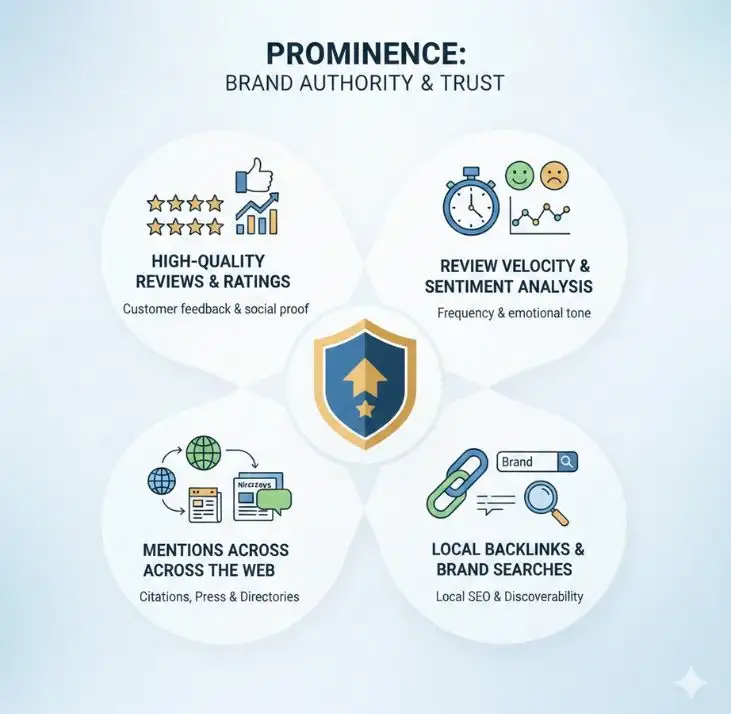
    A brand authority and trust infographic focusing on "Prominence," broken down into four quadrants: high-quality reviews, review velocity/sentiment, mentions across the web (citations), and local backlinks.

    4. User Engagement Signals

    Google evaluates how users interact with listings:

    a. Clicks, calls, direction requests
    b. Photo views and uploads
    c. Q&A activity and profile completeness

    Consistent engagement signals indicate real-world popularity.

    5. AI & Experience-Based Signals

    In 2026, Google heavily uses AI to assess real customer experiences:

    a. Review content quality (not just star ratings)
    b. Spam detection and fake review filtering
    c. Behavioral patterns showing repeat visits or long-term satisfaction

    In short: Google ranks local businesses based on who is most relevant, closest, trusted, engaged with, and proven to deliver good experiences.

    Core Local SEO Ranking Factors You Must Optimize

    Let’s break these down in a way that actually makes sense.

    1. Google Business Profile (GBP) Optimization

    Having a Google Business Profile is among the most important local SEO ranking factors.

    What to optimize:

    a. Accurate business name (no keyword stuffing)
    b. Correct primary & secondary categories
    c. Complete business description with local keywords
    d. Accurate hours, services, products
    e. Regular Google Posts
    f. Upload high-quality photos & videos
    g. Enable and optimize Q&A
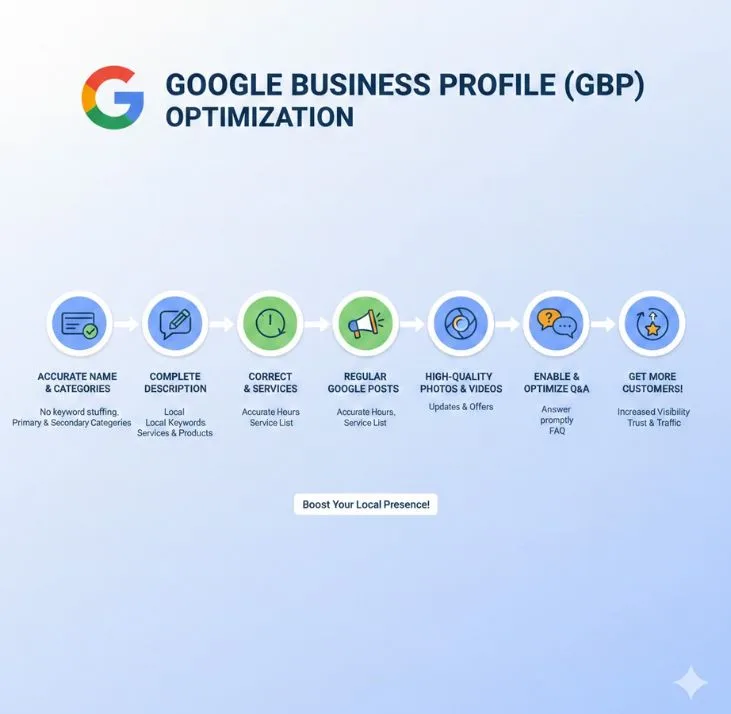
    An infographic outlining the 7 steps of Google Business Profile (GBP) optimization, including accurate categories, complete descriptions, correct services, regular posts, high-quality photos, Q&A engagement, and increasing visibility.

    Tip: Choose the most specific primary category, it carries the most weight.

    2. NAP Consistency (Name, Address, Phone)

    Google needs confidence that your business information is trustworthy and consistent.

    Where consistency matters:

    a. Google Business Profile
    b. Website (footer + contact page)
    c. Local citations (Yelp, Apple Maps, Bing, etc.)
    d. Data aggregators

    Even small differences (Suite vs. #, abbreviations) can hurt rankings.

    3. Reviews (Quantity, Quality, Velocity)

    Reviews are among the most prominent local seo ranking factors and conversion drivers.

    What Google looks at:

    a. Number of reviews
    b. Average star rating
    c. Frequency (new reviews over time)
    d. Review responses (especially from owner)
    e. Keywords mentioned naturally in reviews

    Always respond to reviews; positive and negative.
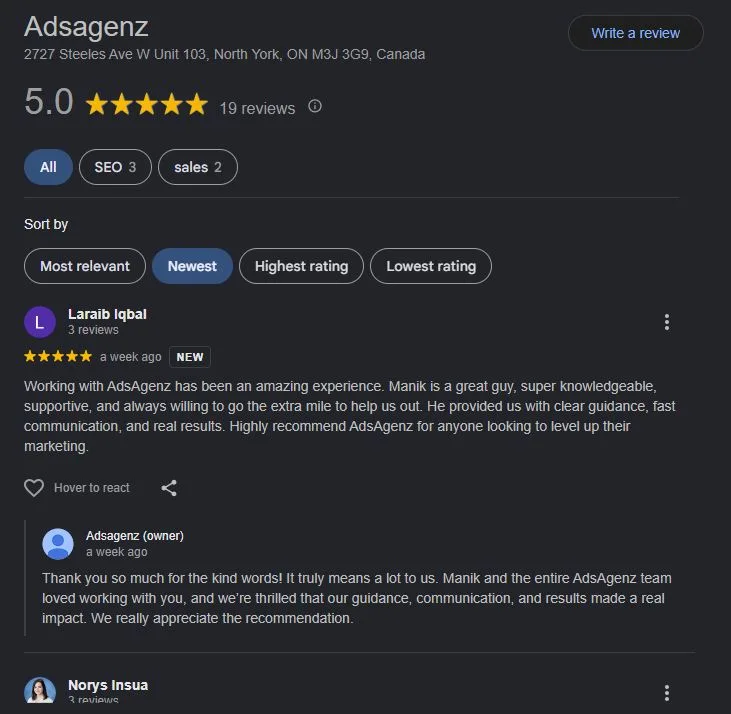
    A screenshot of the Google Business Profile for Adsagenz, showing a 5.0-star rating with 19 reviews. A 5-star review from Laraib Iqbal highlights "real results" and "fast communication," followed by a professional response from the owner.

    4. Local Proximity

    Google gives weightage to distance of business from the searcher.  Making it one of important local SEO ranking factors.

    What you can do:

    a. Optimize for service-area keywords
    b. Create location-specific pages
    c. Ensure correct pin placement on maps

    You can’t fake local proximity; don’t try.

    5. On-Page Local SEO Signals

    Your website still plays a huge role as on-page signals from your website is among the major local seo ranking factors.

    Must-have optimizations:

    a. City + service keywords in Title tags, H1/H2 headers, Meta descriptions
    b. Dedicated location pages
    c. Embedded Google Map
    d. Local schema markup
    e. Clear NAP on site

    Example:

    a. “Emergency Plumber in Austin, TX”

    NOT just “Emergency Plumbing Services”

    6. Local Citations & Directories

    Citations help validate business legitimacy.

    Priority platforms:

    a. Google, Apple Maps, Bing Places
    b. Yelp, Facebook
    c. Industry-specific directories
    d. Local chambers of commerce

    7. Local Backlinks

    Links from local and relevant sources are powerful.

    High-impact local link sources:

    a. Local news sites
    b. Sponsorships & events
    c. Local blogs
    d. Community organizations
    e. Business associations

    A few strong local links beat dozens of generic ones.

    8. Behavioral Signals (User Engagement)

    Google monitors how users interact with your listing.

    Signals that matter:

    a. Clicks from search results
    b. Direction requests
    c. Phone calls
    d. Website visits
    e. Dwell time

    Strong reviews + accurate info = better engagement.

    9. Spam-Free Environment

    Google rewards clean markets.

    Ways this impacts you:

    a. Competitors using fake listings may outrank you
    b. Reporting spam via Google Maps can improve your position
    c. Keyword-stuffed business names skew rankings

    Spam fighting is a legitimate local SEO strategy.

    10. Trust & Authority Signals

    Google favors established, credible businesses.

    Trust boosters:

    a. Business age
    b. BBB or professional certifications
    c. Consistent branding
    d. Press mentions
    e. Verified licenses (where applicable)
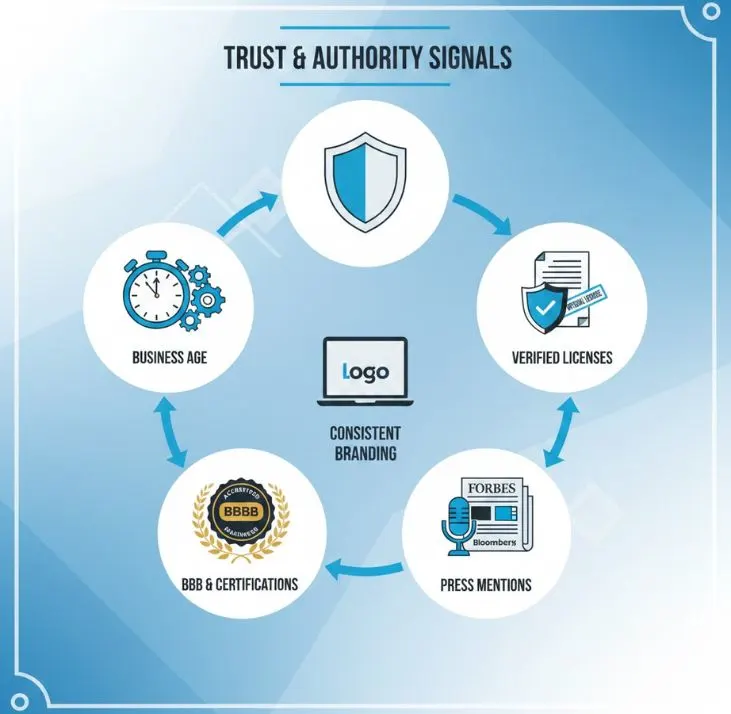
    A circular diagram showcasing five key trust and authority signals for businesses: business age, consistent branding, verified licenses, press mentions (like Forbes and Bloomberg), and BBB certifications.

    A Simple Local Search Ranking Checklist

    If you want a practical way to think about optimization, use this checklist:

    a. Google Business Profile fully completed
    b. Correct primary category selected
    c. Regular photo updates
    d. Consistent NAP across directories
    e. Ongoing review generation and responses
    f. Website optimized for local intent
    g. Mobile speed and usability checked

    You don’t need to do everything at once. You need to do the basics consistently.

    That’s what wins local SEO in 2026.

    Conclusion

    Local SEO in 2026 isn’t about chasing hacks, it’s about sending the right signals.

    a. Does your business look active?
    b. Does it feel credible and consistent?
    c. Are real customers choosing and engaging with it?

    When the answer is yes, rankings follow naturally.

    At Adsagenz, the focus is on fundamentals that last: accurate listings, ongoing engagement, and genuine customer feedback. Staying visible means staying reliable, responsive, and relevant.

    You don’t need to outsmart Google, You simply make it easy for Google and for people to trust your business.

    FAQs

    1. What are the most important local SEO ranking factors in 2026?

    Google Business Profile optimization, reviews, proximity, NAP consistency, and user engagement are the strongest local SEO ranking factors.

    2. Do reviews affect Google Maps rankings?

    Yes. Reviews impact both trust and visibility, making them a major map pack ranking factor.

    3. How important is a website for local SEO?

    Your website supports local rankings by reinforcing location, relevance, and trust signals.

    4. Can small businesses compete in local SEO?

    Absolutely. Consistency and engagement often beat large brands with neglected listings.

    5. How often should I update my Google Business Profile?

    At least monthly. Photos, posts, and review responses signal activity to Google.
  • How Local SEO Helps Small Businesses Dominate Google Maps?

    How Local SEO Helps Small Businesses Dominate Google Maps?

    Local SEO isn’t a nice-to-have for small businesses anymore, it’s essential. 

    Local SEO helps small businesses get discovered at the exact moment customers are searching nearby. 

    If your business doesn’t appear in Google Maps or local search results, you’re effectively invisible. 

    People won’t dig through pages of listings or spend time comparing options. 

    They’ll choose the business that shows up first, and they’ll decide quickly.

    Google reports that 76% of users who search for a local business visit one within 24 hours, and nearly 28% of those searches lead to a purchase. 

    Local SEO shortens the gap between intent and action, putting your business in front of customers who are ready to call, visit, or buy. 

    It also builds trust with Google, increasing your visibility where it matters most; local search results and Maps.

    This guide explains how local SEO helps small businesses.

    No buzzwords. No fluff. Just clear, practical strategies to help you win Google Maps and local search.

    Why Local SEO Matters for Small Businesses?

    Local SEO focuses on one thing: visibility at the moment of intent.

    When someone searches “near me” or includes a city name, Google prioritizes businesses that are relevant, trusted, and geographically close. 

    If your local search optimization is weak, you won’t appear, even if your service is better.

    Small businesses don’t have the luxury of wasting traffic.

    Every missed local search is a missed customer walking into a competitor’s store instead.

    This is where Local SEO helps small businesses level the playing field. 

    You don’t need massive budgets or national authority.

    You need strong local signals that tell Google your business deserves to rank.

    That’s why more SMBs are shifting marketing budgets toward local SEO services for small business growth, rather than broad, expensive campaigns.

    Local SEO also builds trust. 

    Customers rely heavily on Google Maps listings, photos, reviews, and proximity when choosing where to go.

    If you’re not present- or look unreliable- you’re out of the decision.

    How Local SEO Supports Google Maps Rankings

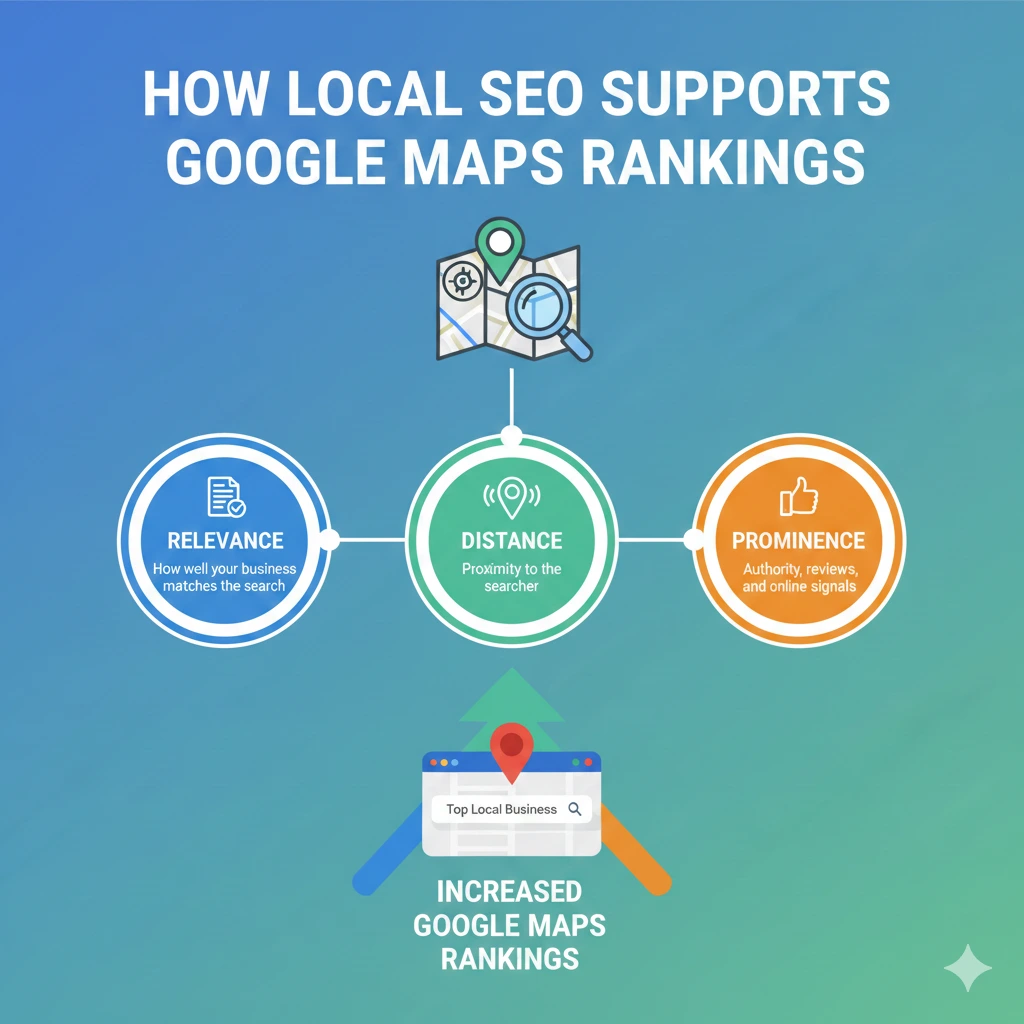
    Google Maps rankings are driven by three core factors:

    a. Relevance – how well your business matches the search
    b. Distance – proximity to the searcher
    c. Prominence – authority, reviews, and online signals

    A diagram explaining the three core pillars of Local SEO that lead to increased Google Maps rankings: Relevance (matching the search query), Distance (proximity to the searcher), and Prominence (business authority, reviews, and online signals). An arrow at the bottom points toward a search bar result for "Top Local Business."

    Local SEO strengthens all three.

    Optimizing your website, Google Business Profile, and local citations helps Google understand exactly what you do, where you operate, and why you’re trustworthy.

    When those signals align, your business appears in the Map Pack- the top three listings that capture the majority of clicks.

    Local SEO doesn’t just bring traffic. It brings high-intent traffic.

    Next, we’ll break down the local SEO strategies that actually move your business up the map.

    Local SEO Best Practices that helps Small Businesses

    The following local SEO tips for SMBs focus on consistency, clarity, and credibility- three things Google rewards heavily in local search.

    1. Optimize Your Google Business Profile

    Your Google Business Profile (GBP) is the most important asset for local search optimization.

    If it’s incomplete, outdated, or poorly optimized, your chances of ranking in Google Maps drop significantly.

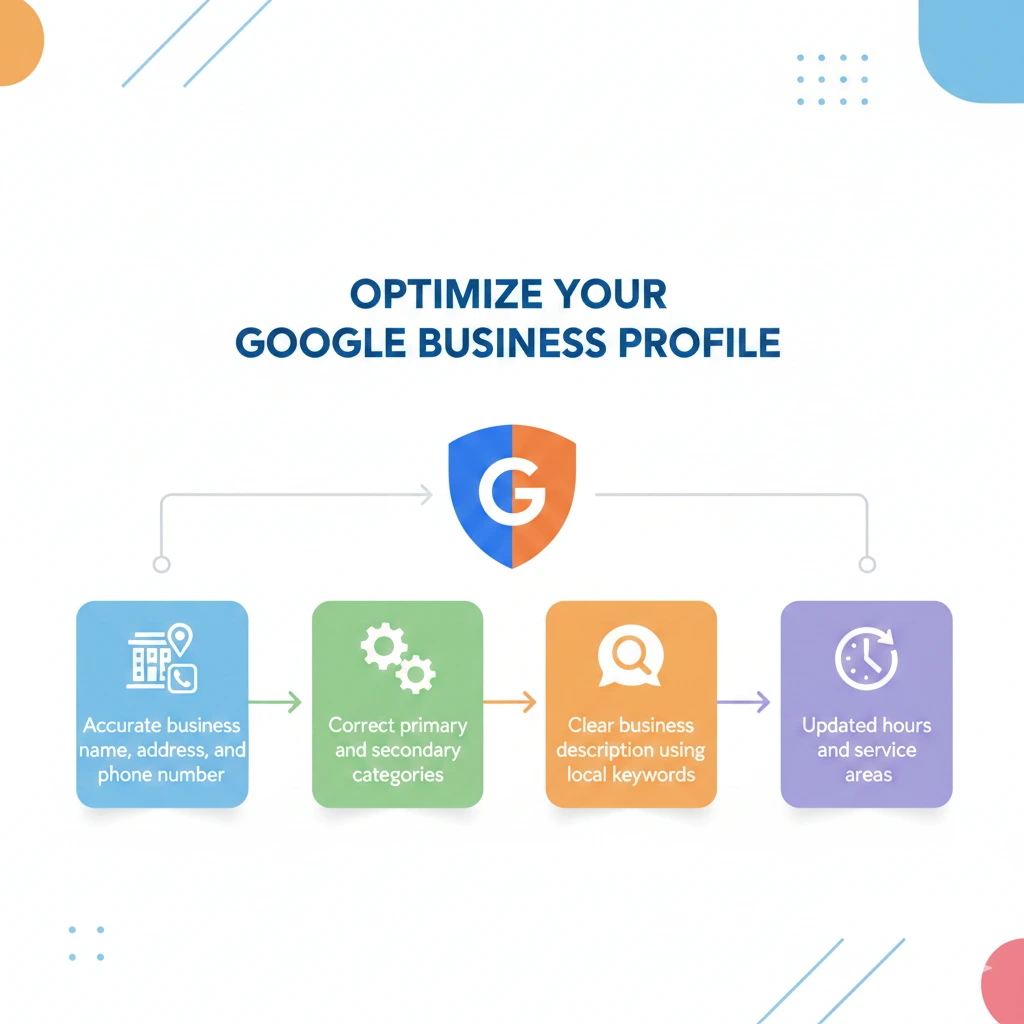
    Start with the basics:

    a. Accurate business name, address, and phone number

    b. Correct primary and secondary categories

    c. Clear business description using local keywords

    d. Updated hours and service areas

    A flow chart titled "Optimize Your Google Business Profile" with four colored icons. The steps include: using an accurate business name, address, and phone number; choosing the correct primary and secondary categories; writing a clear business description with local keywords; and keeping hours and service areas updated.

    Photos matter more than most businesses realize.

    Listings with high-quality images receive more clicks, more calls, and higher engagement.

    Regular updates also signal activity to Google.

    Think of your GBP as your digital storefront.

    If it looks neglected, customers assume the business is too.

    2. Focus on Local Keywords That Convert

    Small business local search optimization works best when it targets intent-driven keywords, not broad terms.

    Instead of chasing national phrases, focus on:

    a. “local seo for small businesses”

    b. “affordable local seo near me”

    c. “best [service] in [city]”

    Use these keywords naturally in:

    a. Page titles and meta descriptions

    b. Service pages

    c. Google Business Profile descriptions

    d. FAQs and location-based content

    This helps Google connect your business to local intent while keeping your content relevant and readable.

    The goal isn’t traffic volume. It’s local relevance.

    3. Build Consistent Local Citations

    Citations are online mentions of your business name, address, and phone number (NAP).

    Google uses them to verify legitimacy.

    Inconsistent listings confuse search engines and weaken trust signals.

    Make sure your business details match exactly across:

    a. Google

    b. Yelp

    c. Bing Places

    d. Apple Maps

    e. Industry-specific directories

    Strong citations reinforce location authority and help long-term local SEO growth, especially for small businesses competing in crowded markets, making a Local SEO Expert essential.

    4. Generate and Manage Reviews Strategically

    Reviews are one of the strongest ranking and conversion factors in local SEO.

    They influence:

    a. Google Maps visibility

    b. Click-through rates

    c. Customer trust

    Encourage satisfied customers to leave reviews consistently, not all at once.

    Respond to every review- positive or negative- professionally and promptly.

    This small practice in your local seo helps small businesses to a large extent

    Businesses with recent, authentic reviews tend to rank higher and convert faster.

    A graphic showing the impact of reviews on local pack rankings.

    Reviews don’t just help SEO.

    They close the sale before a customer ever calls you.

    5. Optimize Your Website for Local Search

    Your website still plays a critical role in local SEO strategy for small businesses.

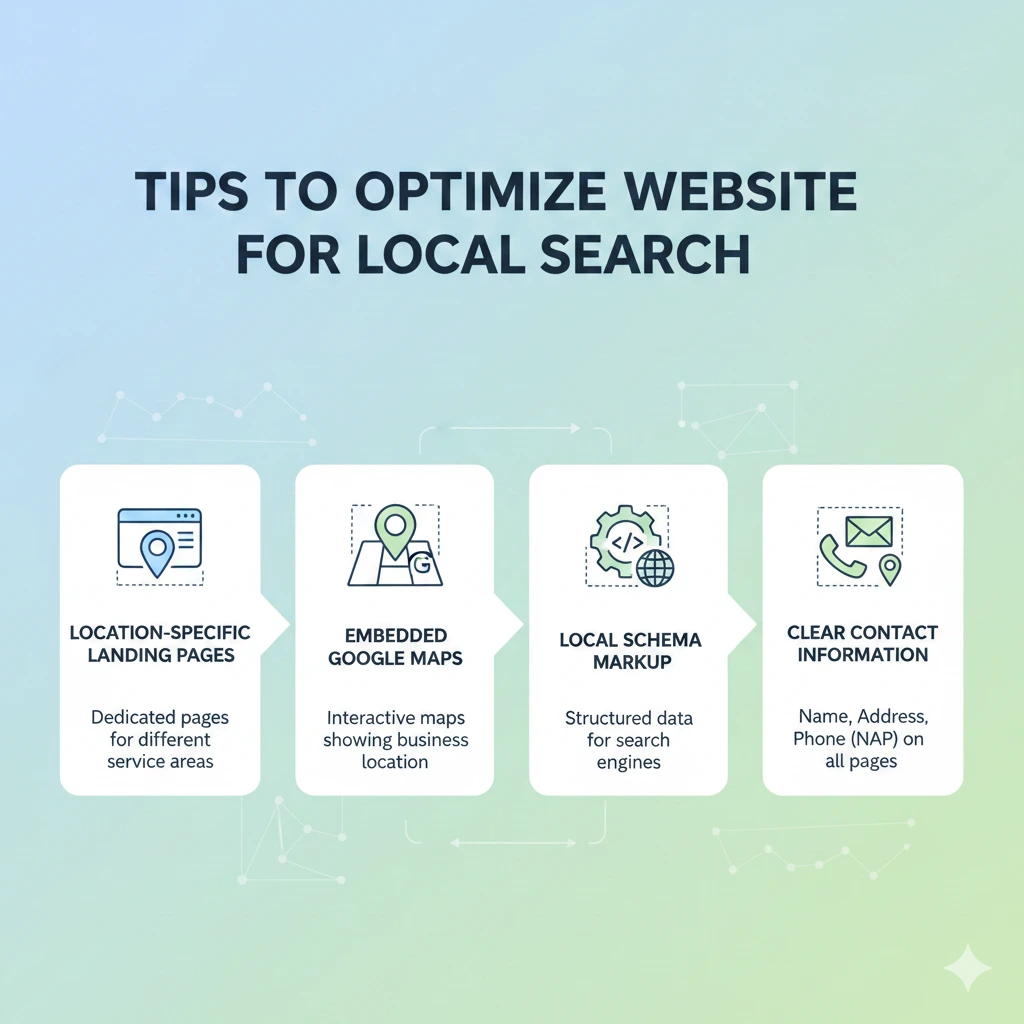
    Make sure it includes:

    a. Location-specific landing pages

    b. Embedded Google Maps

    c. Local schema markup

    d. Clear contact information on every page

    An infographic titled "Tips to Optimize Website for Local Search" featuring four key steps: 1. Location-Specific Landing Pages (dedicated pages for service areas), 2. Embedded Google Maps (interactive maps showing business locations), 3. Local Schema Markup (structured data for search engines), and 4. Clear Contact Information (NAP - Name, Address, Phone on all pages).

    Mobile optimization is essential.

    Most local searches happen on phones, and slow or confusing mobile sites lose customers instantly.

    A fast, locally optimized site strengthens your Google Maps presence and improves conversion rates at the same time.

    6. Use Affordable Local SEO Strategies That Scale

    Local SEO doesn’t require massive budgets to be effective.

    Affordable local SEO focuses on:

    a. High-impact optimizations

    b. Consistent updates

    c. Data-driven improvements

    Many small businesses outperform larger competitors simply by being more accurate, more active, and more locally relevant.

    This is how local SEO helps small businesses to deliver one of the highest ROIs in digital marketing.

    Track Performance and Improve Continuously

    Local SEO is not a one-time setup. It’s an ongoing process.

    Track key metrics like:

    a. Google Maps impressions

    b. Calls and direction requests

    c. Website visits from local searches

    d. Review growth and ratings

    Use Google Business Profile Insights and Google Search Console to identify what’s working and where improvements are needed.

    Small refinements, like updating photos, adding FAQs, or improving response times- can lead to noticeable ranking gains.

    Conclusion

    Local SEO helps small businesses win where it matters most: nearby customers ready to act.

    When your business appears in Google Maps, you’re no longer chasing leads.

    You’re capturing them at the exact moment of intent.

    1. Focus on accuracy.
    2. Build trust through reviews.
    3. Optimize for location, not volume.
    4. And never stop improving.

    Every update you make strengthens your local presence.

    Every signal you refine moves you closer to the top of the map- and closer to customers who are already looking for you.

    At Adsagenz, we focus on making sure your business appears in Google Maps so you’re no longer chasing leads, you’re capturing them at the exact moment of intent.

    FAQs

    1. What is local SEO for small businesses?

    Local SEO helps small businesses appear in local search results and Google Maps when nearby customers search for products or services. It focuses on location relevance, trust signals, and visibility.

    2. How does local SEO help Google Maps rankings?

    Local SEO improves relevance, distance signals, and prominence. Optimized Google Business Profiles, reviews, citations, and local content all contribute to higher map rankings.

    3. Is local SEO affordable for small businesses?

    Yes. Affordable local SEO strategies focus on high-impact actions like profile optimization, reviews, and citations, making it cost-effective for SMBs.

    4. How long does local SEO take to work?

    Most small businesses see noticeable improvements within 2–3 months, depending on competition and consistency.

    5. Do I need local SEO services for small business growth?

    While some tasks can be handled in-house, professional local SEO services help avoid errors, save time, and accelerate results- especially in competitive areas.