Category: Large Language Models

  • SEO for LLMs: 7 Powerful & Proven Strategies for Better AI Search Rankings

    SEO for LLMs: 7 Powerful & Proven Strategies for Better AI Search Rankings

    SEO for LLMs is not an experimental concept anymore. It is a necessary shift in how we approach visibility online. Traditional ranking tactics were designed for search engines that displayed ten blue links. AI search systems now interpret, summarise, and recommend information before users even click.

    That shift changes how content must be written, structured, and distributed.

    If your website is still optimised only for classic search engine optimisation, you may rank on Google — but remain invisible inside AI-generated responses. That’s the gap businesses are beginning to notice.

    This guide breaks down how AI search optimisation, Answer Engine Optimisation, and structured authority building work together, especially for companies targeting Canadian markets.

    Why SEO for LLMs Is Different From Traditional SEO
    Traditional SEO mostly focused on keywords, backlinks, and technical signals. While those still matter, large language models evaluate the content differently in it own way .

    They assess:

    • Contextual depth
    • Clarity of explanation
    • Authority signals
    • Structured formatting
    • Entity relationships

    An LLM does not “rank” content the same way Google does. Instead, it analyses patterns across its training data and retrieval sources to determine which content is reliable enough to summarise.

    This is where AI SEO strategy begins to differ from conventional optimisation.

    You are no longer trying only to rank a page. You are trying to become a reference.

    Understanding How AI Search Engines Select Content

    AI-driven platforms interpret the user queries in a very conversational way. Instead of matching the keywords exactly, they evaluate intent and the context.

    For example, when someone searches:

    “Who provides AI search optimisation services near me?”

    The system does not simply list websites with that phrase. It attempts to extract clear answers from structured content that demonstrate topical authority.

    If your content is vague or overly promotional, it will not be referenced.

    Businesses offering AI SEO services in Toronto often assume adding location keywords is enough. It isn’t. AI systems need contextual depth explaining:

    • What the service involves
    • How it works
    • Who it helps
    • Why it is credible

    Without those layers, you won’t appear in AI-generated summaries.

    The Real Meaning of Answer Engine Optimisation (AEO)
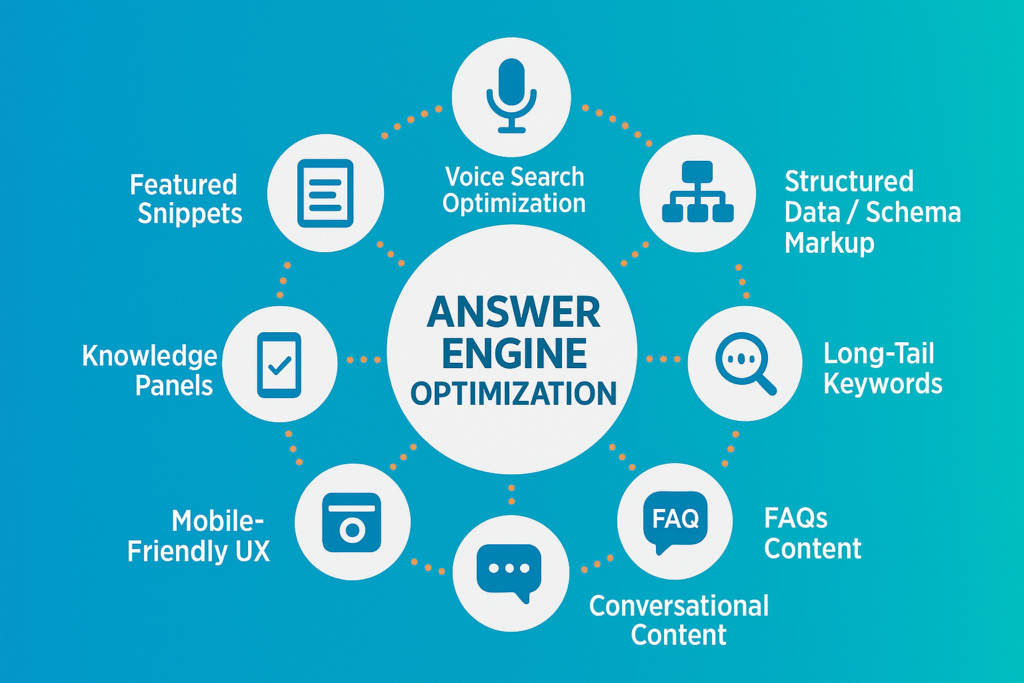
    Answer Engine Optimisation is about formatting your content so AI systems can directly extract answers from it.

    This requires more than adding FAQs at the bottom of a page. It involves writing clearly structured sections where each heading is followed by a concise explanation.

    For instance, instead of writing a very long paragraph and explaining the concept of thr shared information indirectly, you should define it in the first two sentences and then expand it eventually .

    AI tools scan for definitional clarity. They prefer content that:

    • States what something is immediately
    • Explains how it works
    • Provides context or examples
    • Avoids unnecessary filler

    When implemented correctly, AEO strategy increases your chances of appearing in AI summaries, featured snippets, and voice assistant responses.

    How AI Optimisation (AIO) Builds Long-Term Authority

    AI Optimisation is not about quick ranking wins. It is about building consistent authority signals across your domain and external ecosystem.

    From experience, AI systems favour brands that:

    • Publish multiple in-depth resources on related topics
    • Maintain consistent terminology
    • Build structured internal linking
    • Receive relevant mentions across authoritative platforms

    If you write one blog about LLM optimisation strategy and nothing else connected to it, AI will not treat you as an authority. But if you create a structured cluster around:

    • AI content indexing
    • voice search SEO
    • entity-based SEO
    • structured data SEO
    • AI-driven search optimisation

    You create contextual reinforcement.

    This layered approach signals expertise.

    Structuring Content So AI Can Interpret It Correctly

    One mistake I frequently see is long-form content without structural discipline. Walls of text may look detailed but are difficult for machines to interpret.

    Content designed for the AI search optimisation should follow a very logical flow as follows :

    • Firstly, defining the concept clearly.
    • Second, explain why it matters.
    • Third, describe implementation.
    • Fourth, provide examples or scenarios.
    • Finally, address common questions.

    This format mirrors how AI systems parse and summarise information.

    When working with companies targeting AI search optimisation services in Hamilton, restructuring content alone significantly improved their visibility in AI summaries — even before backlink growth.

    Structure matters more than people think.

    The Role of Semantic SEO and Entity Relationships

    Repeating a keyword ten times no longer strengthens content. In fact, it reduces credibility.

    AI systems understand the topic relationships through a semantic signals. That means instead of repeating one phrase, your content should naturally include related concepts.

    For example, a strong page on SEO for LLMs may include terms like:

    • AI content strategy
    • semantic SEO
    • schema markup for AI
    • voice search optimisation
    • machine-readable content

    These terms reinforce the context without forcing any sort of repetition.

    AI evaluates relationships between concepts, not just frequency.

    Voice Search and Conversational Queries

    Voice queries are longer and more conversational than typed searches. Optimising for voice search SEO means anticipating how people speak.

    Someone may ask:

    “Who offers reliable LLM optimisation for my business?”

    “What is the best way to optimise my website for the AI search?”

    Your content should mirror natural phrasing and provide direct answers.

    Avoid robotic transitions. Write as if you are explaining something clearly to a client sitting across the table.

    When done correctly, conversational formatting increases visibility in both AI assistants and traditional search.

    Technical Foundations That Support AI Visibility

    Even the best content usually fails without a proper technical infrastructure. For effective AI-driven search optimisation, your website must have following things :

    • Loading quickly across all the devices.
    • Maintain a clean URL structure.
    • Avoid duplicate content issues.
    • Use canonical tags correctly.
    • Implement structured schema markup.

    Structured data such as FAQ schema and the Article schema helps machines to interpret your content confidently , hence technical clarity builds machine trust.

    Building Authority Through Content Depth

    Surface-level articles rarely get referenced. AI systems prefer content that demonstrates layered understanding.

    Depth does not mean writing filler. It means covering :

    • Definitions
    • Use cases with practical examples
    • Implementation steps with easy explanations
    • Challenges faced
    • Real-world observations in detailed manner

    For example, businesses offering AI SEO services in Ontario should publish case studies that show:

    • Problem
    • Strategy
    • Implementation
    • Outcome

    Specificity builds credibility.

    Common Mistakes in SEO for LLMs

    One frequent mistake is to treat AI search like a new keyword opportunity rather than a structural shift. Another issue is the publishing of thin blogs and then targeting high-volume terms without any topical depth in the content.

    Some companies add FAQs randomly without aligning them to the actual user intent. And many ignore schema completely. Ractifying these issues often produces a very measurable improvements within months but not overnight, but steadily.

    Measuring Success in AI Search

    Traditional metrics still matter: rankings, traffic, and conversions.

    But for AI SEO strategy, additional signals are important:

    • AI-generated brand mentions
    • Inclusion in featured snippets
    • Increased branded search queries
    • Knowledge panel improvements

    AI visibility for a website is subtle at the begnning but compounds along with time.

    Closing Perspective

    The shift toward AI search is not about abandoning traditional SEO. It is about refining it.

    The brands that win in this space are not chasing keywords blindly. They are building structured authority, publishing clear explanations, and reinforcing expertise across interconnected topics.

    SEO for LLMs rewards clarity, depth, and discipline.

    And unlike short-term ranking tactics, this approach compounds over time.

    Frequently Asked Questions

    What is SEO for LLMs?

    SEO for LLMs is the process of structuring and optimising content so large language models can interpret, summarise, and recommend your information in AI-generated responses.

    How does AI search optimisation work?

    AI search optimisation focuses on semantic clarity, structured answers, authority signals, and machine-readable formatting rather than just keyword rankings.

    What is the key difference between AEO and traditional SEO?

    Answer Engine Optimisation prioritises providing direct, extractable answers for AI systems, while traditional SEO focuses more on ranking webpages in search results.

    Does schema markup improve AI visibility?

    Yes. Implementing schema markup for AI improves content interpretation and it also increases the chnaces of being referenced in an AI summaries.

    How important is voice search SEO?

    Voice search SEO is now increasingly important because the conversational queries are now growing across smart assistants and AI platforms.

    Can local businesses rank in AI-generated answers?

    Yes. With structured content and a strong local AI SEO strategy, regional businesses can appear in AI-driven responses.
  • LLMs vs Traditional AI Models: What Businesses Must Know Before Choosing in 2026

    LLMs vs Traditional AI Models: What Businesses Must Know Before Choosing in 2026

    When we are evaluating LLMs vs Traditional AI Models, most of the business leaders assume they are just two versions of the same technology , but in reality they are not. The architectural differences, training methods, scalability limits and cost implications are fundamentally different.

    I’ve seen companies invest in the wrong AI stack simply because “AI” sounded like one bucket. It isn’t. If you’re running operations, marketing, SaaS, analytics, or automation projects, understanding the difference can save months of misaligned implementation.

    This guide breaks down the technical distinctions, practical implications, and business use cases — without hype.

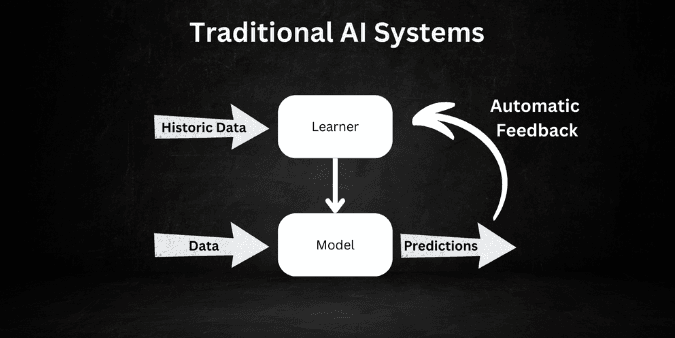
    What Are Traditional AI Models?

    Traditional AI Models VS Generative AI

    Before Large Language Models (LLMs) became mainstream, most AI systems were rule-driven or trained on narrow datasets.

    Traditional AI models typically include:

    • Machine Learning models
    • Decision Trees
    • Support Vector Machines
    • Random Forest algorithms
    • Linear Regression models
    • Rule-based automation systems

    These models are designed for specific tasks. Fraud detection. Demand forecasting. Email classification. Inventory optimization.

    They perform extremely well — but within clearly defined boundaries.

    For example:

    • A retail forecasting model predicts next month’s demand.
    • A credit scoring model evaluates loan eligibility.
    • A recommendation engine suggests products.

    Each system is trained for one objective.

    That focus is both their strength and their limitation.

    What Are LLMs?

    Large Language Models (LLMs) are the deep neural networks trained on massive text datasets. Unlike traditional systems, they are pre-trained on broad knowledge and then adapted for multiple tasks.

    Popular examples include:

    These models are built using transformer architecture, enabling them to:

    • Generate human-like text
    • Understand the context across long detailed documents
    • Performing reasoning tasks
    • Write code
    • Summarize reports
    • Answer open-ended queries

    Unlike traditional AI models, LLMs are general-purpose systems.

    Core Differences: LLMs vs Traditional AI Models

    Let’s break this down practically.

    1. Architecture

    Traditional AI:

    • Built using statistical or shallow machine learning models
    • Designed for structured datasets
    • Limited contextual understanding

    LLMs:

    • Based on deep neural networks
    • Trained on billions of parameters
    • Understand semantic relationships and context

    A traditional fraud detection system analyzes predefined risk variables. An LLM can analyze the complaint email, the transaction history summary, and customer tone — simultaneously.

    That’s a major difference.

    2. Training Approach

    Traditional AI training approach is as follows :

    • Trained on specific labeled datasets
    • Requires clean, structured data
    • Retraining needed for new tasks

    LLMs:

    • Pre-trained on massive unstructured datasets
    • Fine-tuned using smaller datasets
    • Can perform zero-shot or few-shot learning

    This flexibility reduces development time significantly.

    3. Use Case Breadth

    Traditional AI excels on the following points :

    • Demand forecasting
    • Supply chain optimization
    • Risk modeling
    • Predictive analytics
    • Classification problems

    LLMs excel at:

    • Conversational AI
    • Knowledge retrieval
    • Content automation
    • Code assistance
    • Long-form document analysis

    The real shift is in cognitive flexibility.

    4. Data Requirements

    Traditional AI requires:

    • Clean tabular data
    • Feature engineering
    • Domain specific pre-processing

    LLMs:

    • Handle unstructured data
    • Work with documents, PDFs, chats, transcripts
    • Require prompt engineering instead of heavy feature engineering

    Businesses dealing with large knowledge bases often prefer LLM-based systems.

    For example, enterprises building AI knowledge assistants in Toronto have increasingly lean itself toward the LLM-powered retrieval systems instead of traditional keyword search models.

    5. Explainability

    Traditional models are easier to interpret:

    • Feature importance analysis
    • Clear mathematical relationships
    • More transparent decision paths

    LLMs explainability power :

    • Operate as black-box systems
    • Harder to fully explain the outputs
    • Basically rely on the probabilistic token predictions.

    If regulatory compliance is critical (like finance or healthcare), this matters.

    6. Cost Structure

    Traditional AI:

    • Lower infrastructure cost
    • More predictable computation requirements
    • One-time development focus

    LLMs:

    • Higher token-based inference cost
    • API usage fees
    • Infrastructure for the vector databases and its embeddings
    • Continuous optimizations are required.

    In mid-sized enterprise deployments in Hamilton, teams often underestimate long-term LLM API consumption costs.

    Budget modeling is essential.

    7. Scalability and Integration

    Traditional AI:

    • Harder to repurpose
    • Separate model per use case

    LLMs:

    • Single model can power multiple workflows
    • its has a easier API based integration system
    • Faster deployment cycles

    This makes LLMs attractive for SaaS companies building multi-functional AI features.

    When Should You Choose Traditional AI Models?

    Traditional AI Models

    Choose traditional AI if:

    • Your dataset is structured and historical
    • You need explainability
    • The task is repetitive and narrow
    • You want lower ongoing cost
    • Accuracy on a defined metric is critical

    Example such as :

    A manufacturing company optimizing predictive maintenance across facilities in Ontario may rely on traditional time-series forecasting models rather than LLMs.

    Because structured sensor data doesn’t require generative reasoning.

    When Should You Choose LLMs?

    Choose LLMs if:

    • You deal with documents, chats, or emails
    • You need conversational interfaces
    • You want knowledge automation
    • You are in the need of cross-domain flexibility
    • You want a very rapid deployment

    Customer support automation, AI copilots, and enterprise search systems benefit heavily from LLM infrastructure.

    Hybrid Approach: The Real-World Strategy

    In practice, most serious deployments combine both.

    Example architecture:

    • Traditional AI model predicts churn risk.
    • LLM generates personalized retention email.
    • Vector database can stores knowledge embeddings in it.
    • Rule-based system act as an enforcer in compliance guardrails.

    That hybrid stack delivers better ROI than choosing one side blindly.

    Performance Considerations

    Accuracy metrics differ:

    Traditional AI:

    • Precision
    • Recall
    • F1 Score
    • RMSE
    • ROC-AUC

    LLMs:

    • Hallucination rate
    • Context retention
    • Token latency
    • Response consistency
    • Retrieval accuracy (RAG systems)

    Performance benchmarking should align with the business goals.

    Security and Data Privacy

    Traditional AI:

    • usually hosted internally
    • Have a full data control.

    LLMs:

    • Often API-based
    • Requires vendor evaluation
    • Data retention policies matter

    Enterprises implementing AI must review:

    • Data encryption
    • Model hosting environment
    • Fine-tuning control
    • Compliance alignment

    Long-Term Business Impact

    Traditional AI is mainly used to improve the processes and to make operations more efficient. LLMs, on the other hand, support work that involves thinking, writing, and decision-making.

    Because of this difference the companies often needs to adjust how teams are structured and how responsibilities are divided.

    Operations teams have usually been benefited more from predictive AI systems that help with forecasting and performance tracking.

    Marketing, HR, support, and product teams benefit from LLM capabilities.

    This shift is why enterprises are restructuring AI budgets toward generative systems while still maintaining classical ML for analytics.

    SEO-Relevant Key Terms Covered

    Throughout this article, we’ve addressed:

    • LLMs vs Traditional AI Models
    • Large Language Models
    • Machine Learning models
    • Transformer architecture
    • Generative AI
    • Predictive analytics
    • AI cost comparison
    • Enterprise AI implementation
    • AI model scalability
    • AI infrastructure decisions

    Final Thoughts

    The debate around LLMs vs Traditional AI Models should not be framed as replacement.

    Traditional AI solves the structured prediction problems with a outstanding precision. LLMs handle language, context, and reasoning at scale.

    Businesses that understand where each belongs build smarter systems — and avoid expensive missteps.

    If your main pillar article covers broad Large Language Models, this supporting piece clarifies decision-making criteria and captures comparison-based search intent — which is strong for SEO in 2026.

    What is the main difference between LLMs and traditional AI models?

    The main difference is that LLMs vs Traditional AI Models differ in scope and flexibility. Traditional models are task-specific and structured-data driven, while LLMs are general-purpose models trained on large unstructured datasets and capable of handling multiple language-based tasks.

    Are LLMs more accurate than traditional AI models?

    Not necessarily. Traditional AI models can often outperform LLMs in narrow, well-defined predictive tasks. LLMs perform better in contextual understanding and language generation.

    Which is more cost-effective: LLMs or traditional AI?

    Traditional AI models typically have lower ongoing inference costs. LLMs can become expensive due to token-based pricing and infrastructure requirements.

    Can businesses combine LLMs and traditional AI?

    Yes it can . A hybrid approach using a predictive AI models alongside Generative AI systems often delivers better results.

    Do LLMs replace machine learning models?

    No. Machine Learning models remain essential for forecasting, anomaly detection, and numerical prediction tasks. LLMs extend capabilities into language-based applications.

  • Popular LLMs Compared in 2026: Features, Performance, Pricing & Business Use Cases

    Popular LLMs Compared in 2026: Features, Performance, Pricing & Business Use Cases

    If you are evaluating Popular LLMs Compared for real business use, this detailed breakdown will help you understand which Large Language Models actually deliver measurable value — and which ones are simply popular due to hype.

    Businesses investing in AI adoption today are no longer impressed by demo outputs. They care about the cost per token, latency, hallucination rates, data privacy, fine-tuning flexibility and integration readiness.

    Whether you are building SaaS products, automating support along with improving internal workflows or launching AI-driven platforms then choosing the right LLM model directly impacts ROI.

    This blog compares the most widely used Large Language Models in 2026, explains where each one excels, and outlines real-world business implications — especially for companies exploring AI solutions in Toronto.

    What Makes an LLM “Popular” in 2026?

    LLM “Popular” in 2026
    LLM “Popular” in 2026

    Popularity in 2026 isn’t about social buzz. It comes down to five measurable factors:

    • Model accuracy & reasoning depth
    • Context window size
    • Inference speed
    • Fine-tuning capabilities
    • Enterprise data security compliance

    The strongest Generative AI models today balance performance with operational efficiency. Enterprises care about output consistency and governance more than creativity.

    1. OpenAI GPT-4o and GPT-4 Series

    OpenAI GPT-4o
    OpenAI GPT-4o

    Strengths

    • It has a very strong reasoning capability
    • Multimodal support (text, vision, structured input)
    • it has a mature API ecosystem
    • Stable enterprise deployment options

    Weaknesses

    • Its premium pricing tiers
    • Occasional hallucinations under a complex reasoning chains

    OpenAI models remain dominant for businesses building AI SaaS, legal drafting tools, and automation systems. Their AI API integration ecosystem is robust, documentation is reliable, and enterprise security standards meet strict compliance needs.

    For the companies that are building AI products in regulated industries, GPT-4 variants are still a safe bet.

    2. Google DeepMind Gemini 1.5 & Gemini Ultra

    Strengths

    • Extremely large context window
    • Strong multimodal reasoning
    • Deep integration with Google Cloud

    Weaknesses

    • Performance varies across tasks
    • Pricing tiers can be complex

    Gemini models shine in large document processing. If your work revolves around reviewing thousands of pages on daily basis or large internal company documents, Gemini can handle it smoothly because it can process a lot of information at once.

    Organizations running on Google Cloud infrastructure may prefer this stack for seamless deployment.

    3. Anthropic Claude 3 Series

    Strengths

    • Strong long-form reasoning
    • Reduced hallucination rates
    • Ethical guardrails

    Weaknesses

    • It has a slower output power compared to other lighter models
    • Slightly conservative behaviour while generating responses

    Claude is often preffered for a legal rreview work along with with compliance documentation and enterprise content generation. Its outputs feel measured rather than flashy.

    Businesses prioritizing accuracy over creativity tend to favor Claude.

    4. Meta LLaMA 3

    Strengths

    • Open-source flexibility
    • On-premise deployment options
    • Custom fine-tuning friendly

    Weaknesses

    • It requires ML level expertise
    • another weakness is infrastructure management overhead

    LLaMA models are preferred for private deployments where data sovereignty is critical. For organizations concerned about data exposure, open-source LLMs allow full control.

    However, they demand technical depth.

    5. Mistral AI Mixtral & Mistral Large

    Strengths

    • Efficient Mixture-of-Experts architecture
    • Competitive pricing
    • Fast inference

    Weaknesses

    • Slightly weaker reasoning in edge cases

    Mistral’s models are attractive for startups managing tight budgets while still needing scalable AI automation tools.

    Real-World Business Impact

    Choosing the right Enterprise AI solutions model influences:

    • Customer support automation quality
    • Sales chatbot accuracy
    • Content production scale
    • Internal workflow efficiency
    • Software development assistance

    In Hamilton AI consulting services, companies are increasingly requesting hybrid setups — combining closed API models for reasoning and open-source models for internal operations.

    Similarly, organizations that are adopting AI development in Ontario are focusing on governance frameworks alongside performance benchmarks.

    Cost Considerations

    LLM pricing is no longer simple “per request.” It involves:

    • Token usage
    • Context window size
    • Model tier
    • Fine-tuning cost
    • Hosting infrastructure

    Smaller businesses often underestimate inference costs. A chatbot that is serving 50,000 monthly users can scale up the costs quickly if prompt engineering isn’t optimized well enough.

    Which LLM Should You Choose?

    Here’s a practical decision framework:

    Choose GPT-4 Series if :

    You need strong reasoning, structured output, and reliable APIs.

    Choose Gemini if :

    You process large knowledge bases or internal documentation.

    Choose Claude if :

    Your domain demands a higher factual reliability.

    Choose LLaMA if :

    Data privacy and control outweigh convenience.

    Choose Mistral if :

    Cost efficiency is critical during early growth.

    Future of Large Language Models in 2026

    Trends shaping the future of AI models as follows :

    • Smaller specialized models outperforming general models
    • Retrieval-augmented generation (RAG) becoming standard
    • Increased regulatory compliance requirements
    • AI governance frameworks maturing

    We’re moving from experimentation to accountability.

    FAQs

    Which is the best Large Language Model in 2026 for businesses?

    The best Large Language Model depends on the use case. GPT-4 performs well for the reasoning while Gemini handles large document analysis and Claude is preferred for compliance heavy industries.

    What is the difference between open-source and closed LLM models?

    Open-source models are like LLaMA that allows private deployment along with customization, while closed models are known to provide managed infrastructure and faster integration.

    Are Large Language Models safe for enterprise data?

    They can be, if deployed with secure APIs, encryption standards, and compliance policies. Many providers are now offering enterprise grade security.

    How much does it cost to implement an LLM in a business?

    Costs may vary based on the token usage, context size, infrastructure, and fine-tuning requirements. Small implementations may cost a few hundred dollars monthly, while enterprise setups scale significantly.

    Which LLM is best for chatbot development?

    GPT-4 and Claude are considered perfect for conversational agents, while the Mistral offers a very budget friendly alternative.

    Can LLMs be customized for specific industries?

    Yes. Through fine-tuning or retrieval-based systems, models can adapt to legal, healthcare, finance, or e-commerce needs.

    How do I choose the right LLM for my company?

    Start by defining your use case, compliance needs, expected user volume, and budget. Then test two models under real workload conditions before final selection.

  • How LLMs Work Internally: Architecture, Training Process, and Business Applications in 2026

    How LLMs Work Internally: Architecture, Training Process, and Business Applications in 2026

    Artificial intelligence has been shifted from acting like an experimental to becoming essential digital infrastructure. To truly understand their impact, businesses must first understand how LLMs work internally.

    Large Language Models are not any magic systems that are generating instant answers, they are complex neural architectures trained on enormous datasets to predict, interpret, and generate language with high contextual accuracy.

    In 2026, organizations across Toronto and broader Canada are now integrating LLMs into marketing automation , in search optimization even in healthcare documentation and financial analysis. But before implementing them, leaders need clarity on what happens behind the interface.

    This pillar guide explains the internal mechanics of Large Language Models, their architecture, training lifecycle, reasoning processes, deployment models, and why understanding their structure is critical for responsible AI adoption.

    Understanding the Core of Large Language Models

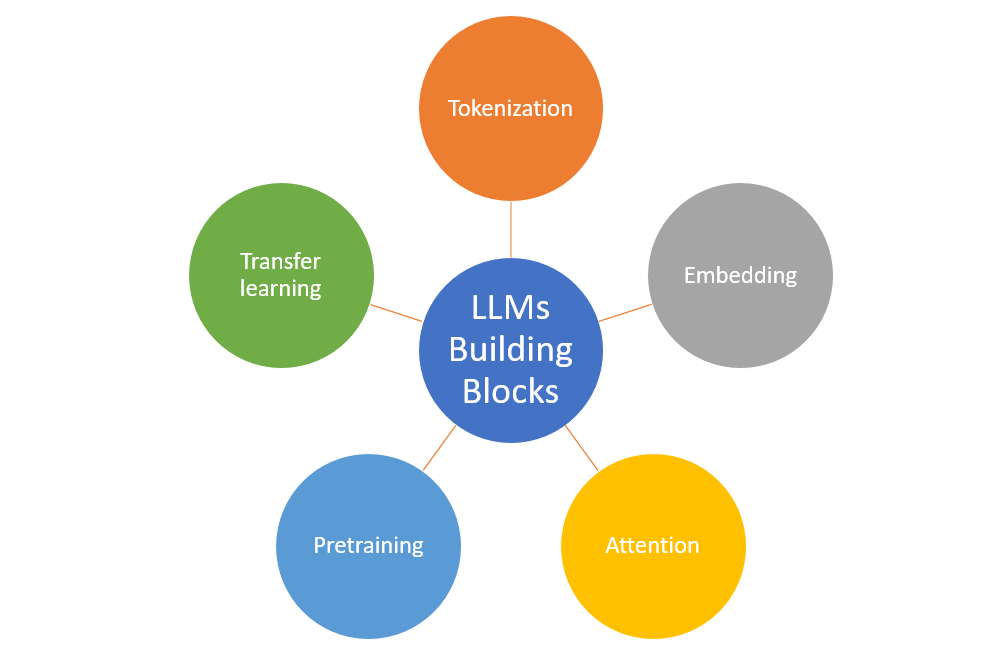
     Core of Large Language Models
    Core of Large Language Models

    At their foundation, Large Language Models are deep learning systems built using neural networks. These networks attempt to simulate how patterns in human language relate to one another.

    An LLM does not “know” facts the way humans do. Instead, it calculates probabilities. When you type a sentence, the model predicts the most statistically relevant next word based on patterns learned during training.

    That prediction process happens at scale — across billions (sometimes trillions) of parameters.

    The Transformer Architecture: The Engine Behind Modern LLMs

    Nearly all advanced language models in 2026 rely on transformer architecture. This innovation fundamentally changed AI performance.

    Why Transformers Matter

    Traditional models processed text sequentially. Transformers analyze the relationships between all the words simultaneously using the attention mechanisms.

    This allows:

    • Deep contextual understanding
    • Long-form coherence
    • Semantic precision
    • Improved reasoning over extended text

    Self-Attention Mechanism Explained

    Self-attention helps the model determine which words in a sentence are most important relative to others.

    For example:

    In the sentence:

    “The startup in Toronto secured funding because it showed rapid growth.”

    The word “it” refers to “startup.” Self-attention identifies that relationship instantly.

    Without attention mechanisms, maintaining long-range context would be nearly impossible.

    Tokenization: How LLMs Read Language

    Before text is processed, it must be broken down into smaller pieces called tokens.

    Tokens can be:

    • Whole words
    • Sub-words
    • Characters

    For example:

    “Artificial Intelligence” might become:

    • Artificial
    • Intelligence

    Or even smaller segments depending on the tokenizer.

    Tokenization allows the model to:

    • Handle multiple languages
    • Manage unknown words
    • Improve computational efficiency

    This process is foundational to how LLMs work internally because prediction happens token by token.

    Pretraining Phase: Learning From Massive Data

    Pretraining is the most computationally intensive stage.

    Data Sources Used

    LLMs are trained on diverse data such as:

    • Books
    • Academic research
    • Websites
    • Code repositories
    • Publicly available articles

    The goal during pretraining is simple:

    Predict the next token in a sequence.

    By repeating this process billions of times, the model learns and understand the grammar, structure, tone, reasoning patterns, and contextual relationships.

    Why Scale Matters

    The larger the dataset and parameter count, the more nuanced the model becomes. However, scale also increases:

    • Infrastructure costs
    • Energy consumption
    • Hardware requirements

    This is why many companies in Ontario and Toronto rely on cloud providers rather than building foundational models from scratch.

    Fine-Tuning and Alignment

    After pretraining, models are not yet ready for enterprise use.

    Fine-tuning adapts them to specific tasks.

    Types of Fine-Tuning

    1. Domain-specific training (healthcare, finance, legal)
    2. Instruction tuning
    3. Reinforcement Learning with a Human Feedback (RLHF)

    RLHF actually improves the response quality by incorporating human preferences.

    This step reduces hallucinations and aligns outputs with business requirements.

    Organizations across Canada adopting AI solutions increasingly invest in custom fine-tuning to ensure compliance with Canadian data protection standards.

    Model Parameters: What Do Billions of Parameters Mean?

    Parameters are the internal weights that influences how input transforms into an output.

    Think of parameters as an adjustable dials inside a neural network. During training, these dials are optimized to minimize prediction errors.

    More parameters generally mean:

    • Better contextual understanding
    • More nuanced generation
    • Higher computational demand

    However, 2026 trends show that efficiency is now more important than size. Smaller, optimized models are becoming competitive alternatives.

    Inference: What Happens When You Ask a Question?

    Once trained, the model enters inference mode.

    When a user inputs text:

    1. The text is tokenized
    2. Tokens are converted into numerical embeddings
    3. The transformer layers process relationships
    4. The model predicts the most likely next token
    5. The process repeats until completion

    This happens within a fraction of seconds. Behind the scenes, probability distributions determine each word.

    Embeddings: Representing Meaning Numerically

    Embeddings convert language into high-dimensional vectors.

    Words with a similar meanings appear closer together in vector space.

    For example:

    “Doctor” and “Physician” will have closely aligned embeddings.

    Embeddings power:

    • Semantic search
    • Recommendation engines
    • AI-driven marketing targeting
    • Conversational search systems

    Businesses in Hamilton’s growing tech ecosystem increasingly use embeddings for intelligent data retrieval.

    Memory and Context Windows

    Modern LLMs can process the extended context windows, which means they can remember earlier parts of a conversation.

    Context windows determine how much text the model can consider at once.

    Longer context windows improve:

    • Legal document summarization
    • Research analysis
    • Multi-step reasoning

    For enterprise users in Toronto and Ontario, this capability is critical for document-heavy workflows.

    Multimodal Expansion

    Large Language Models (LLMs) are evolving beyond just processing text. Multimodal systems can handle different types of data , such as :

    • Images
    • Audio
    • Video
    • Text simultaneously

    This expansion also allows to :

    • Medical imaging interpretation
    • Visual search
    • AI-powered tutoring platforms
    • Voice-enabled enterprise systems

    Across Canada’s AI innovation hubs, multimodal AI is one of the fastest-growing sectors.

    Deployment Models: Cloud vs On-Premise

    Understanding how LLMs work internally also requires understanding deployment.

    Cloud-Based APIs

    Pros:

    • Lower infrastructure cost
    • Faster implementation
    • Scalability

    Cons:

    • Data control limitations

    On-Premise LLMs

    Pros:

    • Higher security
    • Regulatory compliance
    • Full customization

    Cons:

    • Requires very higher infrastructure investment

    Canadian enterprises operating under strict privacy regulations often like to prefer hybrid models.

    Security and Data Governance

    Internal architecture influences security decisions.

    Key considerations:

    • Data encryption
    • Model isolation
    • Access control
    • Monitoring outputs

    Businesses that are implementing AI adoption strategies in Canada must ensure compliance with evolving AI governance frameworks.

    Why Understanding Internal Mechanics Matters for SEO

    Search engines are increasingly influenced by language models.

    LLMs impact:

    • Conversational search
    • Featured snippet generation
    • Semantic ranking
    • Answer engine optimization

    Brands in Toronto investing in digital marketing AI services are restructuring content to answer intent-based queries rather than targeting isolated keywords.

    Real-World Applications Across Canadian Markets

    Healthcare (Ontario)

    Hospitals use LLM-powered documentation systems to summarize patient records.

    Finance (Toronto)

    Banks are deploying language models for the analysis of compliance documents and automate client communication.

    Education (Hamilton)

    Adaptive tutoring platforms now integrating personalize learning pathways using AI-driven content generation.

    Marketing (Across Canada)

    Agencies are using LLMs to generate:

    • Content briefs
    • Email sequences
    • SEO outlines
    • Market research summaries

    Few Limitations of LLMs are as follows :

    Limitations of LLMs
    Limitations of LLMs

    Despite their capabilities, LLMs are not flawless.

    1. Hallucinations
    2. Bias in training data
    3. High computational requirements
    4. Data privacy risks

    Understanding how LLMs work internally helps organizations design mitigation strategies.

    Efficiency Trends in 2026

    Emerging improvements include:

    • Parameter-efficient fine-tuning
    • Retrieval-augmented generation (RAG)
    • Smaller specialized models
    • Energy-efficient training

    Canada’s AI ecosystem is actively investing in responsible scaling practices.

    The Strategic Advantage of Internal Knowledge

    Businesses that understand internal architecture can:

    • Choose the right model size
    • Reduce deployment risk
    • Optimize integration costs
    • Improve compliance readiness

    Instead of blindly adopting AI technology, well informed organizations create scalable frameworks.

    The Future of Internal LLM Development

    Looking ahead:

    • Models will become more explainable
    • Factual grounding will improve
    • Industry-specific micro-models will dominate
    • Real-time personalization will become standard

    Ontario’s innovation clusters are driving enterprise AI transformation through research partnerships and startup incubators.

    Conclusion

    How LLMs work internally is no longer an option for forward-thinking organizations . From transformer architecture and tokenization to embeddings and fine-tuning, each layer plays a role in shaping output quality, reliability, and scalability.

    Those who understand the technicality of Large Language Models will deploy them more strategically, securely and profitably.

    As AI becomes foundational digital infrastructure, the competitive edge will belong to companies that combine technological literacy with practical application.

    How do LLMs actually work behind the scenes?

    Large Language Models work by breaking your text into a smaller units known as tokens and then predicting the most likely next word based on patterns they learned during training. Internally, they use transformer architecture and attention mechanisms to understand context and generate accurate responses.

    What happens inside an LLM when I ask it a question?

    When you ask a question, the model converts your words into numerical representations, analyzes relationships between them, and predicts a response token by token. This process happens in milliseconds using billions of trained parameters.

    Are LLMs thinking like humans when they generate answers?

    No, LLMs do not think or understand the way humans do. They can calculate the probabilities based upon the patterns present in data. While their responses may sound intelligent, they are generated through statistical prediction rather than true comprehension.

    Why are transformer models important for LLMs?

    Transformers allow LLMs to analyze entire sentences at once instead of processing word by word. This actually help them to understand long-form context, relationships between words and help in maintaining coherence in detailed responses.

    How do businesses in Canada use LLMs internally?

    Companies across Toronto, Hamilton, and Ontario use LLMs to automate customer service, summarize documents, generate marketing content, and enhance search visibility . Many organizations are now customizing the models for industry-specific tasks while ensuring data security compliance.

    What is fine-tuning in Large Language Models?

    Fine-tuning is the process of training a prebuilt language model on specialized data so it performs better in specific industries like healthcare, finance, or legal services . It improves the accuracy, safety, and also aligns with business goals.

    Are LLMs secure enough for handling sensitive business data?

    Security depends on the deployment. Cloud-based APIs are offering scalability, while on-premise or hybrid models are providing stronger data control . Businesses that are handling sensitive data often implement strict governance and compliance frameworks.

    How will LLMs evolve in the next few years?

    Future of LLMs is expected to become more even more efficient, accurate and better at reasoning. We’ll also see growth in multimodal capabilities, real-time personalization, and smaller industry-specific models across Canada’s expanding AI ecosystem.

  • What Are LLMs in 2026? A Complete Guide to Large Language Models, Real-World Use Cases & Business Impact

    What Are LLMs in 2026? A Complete Guide to Large Language Models, Real-World Use Cases & Business Impact

    Artificial Intelligence has evolved rapidly over the past few years, but nothing has transformed the digital ecosystem quite like Large Language Models. In 2026 businesses, marketers  developers and even enterprises across industries are leveraging LLMs in 2026 to automate communication, generate insights, improve customer experiences, and optimize search visibility.

    If you’ve been hearing terms like AI language models, Generative AI systems, and enterprise LLM solutions but still feel unclear about what they truly are, this in-depth guide will break everything down in simple, practical terms.

    This blog covers how LLMs work, why they matter, their architecture, use cases, limitations, future trends, and how businesses across Canada AI adoption trends are integrating them into daily operations.

    What Are Large Language Models?

    Large Language Models are advanced artificial intelligence systems trained on massive volumes of text data to understand, generate, and predict human-like language. These models use deep learning techniques and are built on neural network architectures capable of recognizing patterns in language at scale.

    Unlike traditional rule-based systems, modern language processing AI learns context, grammar, tone, and even intent.

    In simple terms:

    An LLM reads billions of words, learns how language works, and then predicts the next most relevant word in a sentence with remarkable accuracy.

    That prediction ability allows it to write articles, answer questions, summarize documents, translate languages, and even assist with coding.

    How Do LLMs Work?

    To understand how Large Language Models work, we need to explore three core components:

    1. Transformer Architecture

    Most advanced LLMs are built using the Transformer architecture in the AI, which depends on the attention mechanisms. Instead of processing text word-by-word in sequence, transformers analyze relationships between words simultaneously.

    This allows:

    • Better contextual understanding
    • Long-form reasoning
    • Improved semantic accuracy

    2. Pretraining on Massive Data

    LLMs undergo unsupervised language model training using :

    • Books
    • Websites
    • Research papers
    • Articles
    • Code repositories

    During training, the system predicts missing words in sentences. Over time, it learns patterns, tone, and structure.

    3. Fine-Tuning & Alignment

    After pretraining, models go through AI fine tuning processes where they are optimized for specific tasks such as

    • Customer support
    • Medical documentation
    • Legal summarization
    • Marketing copy generation

    This improves safety, accuracy, and usability.

    Types of Large Language Models in 2026

    LLMs today vary based on size, specialization, and access model.

    TypeDescriptionUse Case
    General Purpose LLMsTrained on broad datasetsChatbots, writing tools
    Domain-Specific ModelsFine-tuned for industriesHealthcare, finance
    Multimodal AI ModelsUnderstand text + images + audioAdvanced assistants
    On-Premise LLM DeploymentsHosted internallyEnterprise security

    Businesses in regions like Toronto AI technology companies are increasingly investing in customized models for secure deployment.

    Key Capabilities of LLMs

    1. Natural Language Understanding

    LLMs greately excels at Natural Language Processing advancements, allowing them to :

    • Interpret user intent
    • Answer contextual questions
    • Generate meaningful responses

    2. Content Generation

    They power:

    • Blog writing
    • Ad copy
    • Email marketing
    • Technical documentation

    This is why marketing teams widely adopt AI content generation tools.

    3. Semantic Search & AEO

    With the rise of AI-driven search engines, LLMs help optimize for:

    • Answer Engine Optimization strategies
    • Featured snippets
    • Conversational search

    Companies that are adopting GEO targeted AI marketing approaches are leveraging this capability to improve visibility in specific regions without relying solely on traditional SEO.

    4. Code Assistance

    LLMs assist developers in debugging, suggesting improvements, and generating documentation through AI coding assistants.

    Real-World Applications of LLMs

    Healthcare

    Hospitals that uses an AI powered medical documentation systems to summarize patient records and reduce administrative load.

    Finance

    Banks leverage financial AI language processing to analyze risk documents and customer communications.

    E-commerce

    Retail brands use AI product description generation to scale catalog content efficiently.

    Education

    Schools and universities can integrate adaptive AI tutoring systems for their personalized learning experiences .


    Across Ontario artificial intelligence ecosystem, startups are building niche LLM-powered applications for industry-specific needs.

    Why LLMs Matter for Businesses in 2026

    Businesses are no longer asking whether to use AI — they are asking how fast can we implement it?

    Here’s  are the reason why:

    1. The Cost Efficiency

    Automation of repetitive communication reduces the overall operational costs.

    2. Personalization at Scale

    LLMs enable hyper personalized customer engagement AI, making each user interaction feel unique.

    3. Data Insights

    Through AI driven data interpretation tools, companies extract actionable insights from large datasets.

    4. Competitive Advantage

    An early adoption of the enterprise generative AI platforms provides measurable performance gains.

    Organizations exploring innovation hubs like Hamilton tech startup growth are particularly focused on scalable LLM integration.

    The Technical Backbone: LLM Architecture Explained

    This layered structure allows deep learning language networks to model complex patterns across millions of parameters.

    Challenges & Limitations of LLMs

    While Large Language Models are very powerful but they’re not flawless. Like any technology, they come with a few important limitations businesses should keep in mind:

    1. Hallucinations

    Sometimes, LLMs can produce answers that sound very confident—but are actually incorrect or partially inaccurate. This usually happens because they have predicted the language patterns rather than truly “understanding” facts.

    2. Bias

    Since these models are trained on vast amounts of internet data, they can unintentionally reflect existing biases present in that data. Without proper monitoring and fine-tuning, this can impact fairness and neutrality.

    3. Data Privacy Concerns

    For many businesses, privacy will always be the most important consideration. Before integrating LLMs into the workflows, it is important to evaluate safe deployment methods along with data handling policies and compliance requirements to protect the sensitive information .

    4. High Computational Costs

    Developing and running an advanced LLMs usually requires a very significant computing power. This can lead to higher infrastructure costs, especially for organizations deploying models at scale.
    In short, LLMs offer huge opportunities but thoughtful implementation and oversight are key to using them responsibly and effectively.

    This is why many organizations in Canada digital transformation strategy initiatives are opting for hybrid AI solutions.

    LLMs and the Future of Search (SEO, AEO & GEO)

    Search has evolved from keyword matching to intent understanding.

    LLMs are central to:

    • Conversational AI search engines
    • Voice-based search queries
    • Predictive information retrieval

    To stay competitive, brands must integrate:

    • AI powered search visibility optimization
    • Conversational query optimization methods
    • Semantic content structuring frameworks

    Businesses targeting markets like Toronto digital marketing AI services are restructuring content to answer real questions rather than just rank for phrases.

    This shift from task-based systems to multi task generative AI systems marks a fundamental evolution in computing.

    How Companies Are Implementing LLMs in 2026

    Implementation typically follows this roadmap:

    1. Define business objective
    2. Choose model type
    3. Customize with domain data
    4. Test for bias and safety
    5. Deploy via API or private server

    Organizations focusing on AI adoption in Canada and other location businesses are increasingly combining LLMs with automation platforms.

    Ethical Considerations

    Responsible AI use includes:

    • Transparent disclosures
    • Bias mitigation protocols
    • Data protection compliance
    • Human oversight

    Regulators across Canadian AI governance policies are shaping standards for responsible development.

    The Future of Large Language Models

    By the year 2026 and beyond, we will be seeing:

    • Smaller but more effective models
    • Improved reasoning abilities of the models
    • Better factual grounding
    • Multimodal expansion
    • Real-time personalization

    Emerging innovation clusters in Ontario AI innovation hubs are accelerating this growth.

    Final Thoughts

    In the year 2026 , Large Language Models are not just only  any technological innovations but they are the foundational digital infrastructure. From the marketing automation to a customer experience and even from semantic search to enterprise analytics, LLMs are now reshaping how businesses operate.

    As adoption accelerates across regions like Toronto, Ontario, Hamilton, and across Canada more broadly, companies that strategically integrate language-based AI systems will gain long-term competitive advantage.

    Understanding the mechanics, capabilities, and limitations of LLMs ensures smarter, safer, and more profitable implementation.

    The future belongs to organizations that learn how to collaborate with intelligent systems — not compete against them.

    What is a Large Language Model in simple terms?

    A Large Language Model is an artificial intelligence system trained on vast text data that can understand, generate, and respond in human-like language.

    How are LLMs different from traditional AI models?

    Traditional models perform narrow tasks, while LLMs can handle multiple language-based tasks such as writing, summarizing, translating, and answering questions.

    Are businesses in Canada using LLMs actively?

    Yes, many companies across various industries are adopting language-based AI systems to automate workflows, improve customer service, and optimize digital visibility.

    Can LLMs replace human writers?

    LLMs are helping the writers by improving the speed and structure but human creativity, strategy, and judgment remain essential for high-quality content.

    Is it expensive to implement enterprise LLM solutions?

    Costs can vary depending on the infrastructure, customization level and even the deployment method. Cloud-based APIs are generally more accessible than building models from scratch.

     What industries benefit most from LLM integration?

    Healthcare, Finance, education, marketing and e-commerce are currently seeing the highest impact from AI-driven language systems.

     How do LLMs impact SEO and search visibility?

    They shift focus toward intent-based content, structured answers, and conversational query optimization.

    Are LLMs secure for handling sensitive data?

    Security depends on deployment model. Private hosting and strict data governance frameworks are recommended for sensitive industries.